
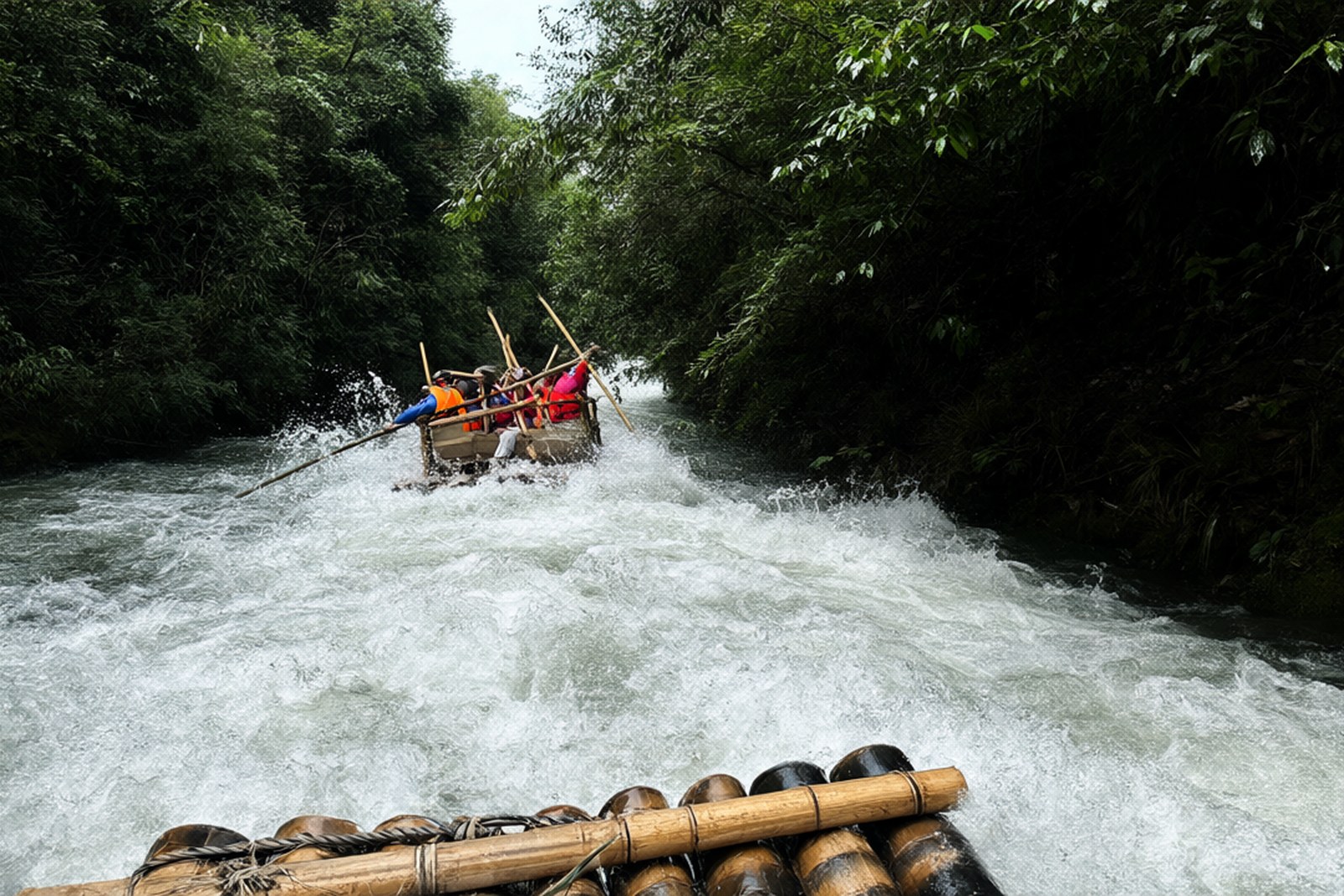
The 万泉河 Wàn quán hé is the third longest river on Hainan, running about a hundred and sixty kilometres from the 五指山 Wǔ zhǐ shān country down the east side of the island to the sea at 博鳌 Bó’áo, and the drift on its upper reaches is the way to see the part of 琼海市 Qiónghǎi shì that has no buildings in it. Up here the river is still a river: narrower than it is at 嘉积, quick where it runs over rock, slow where it has widened behind a bar, banked on both sides with forest and plantation rather than with anything built, and loud enough at night to be the only thing you can hear. The rafting runs are on this upper stretch, above and below the dam that holds the reservoir the county calls 万泉湖 Wàn quán hú, and they take a half day rather than a day.
The river is the county’s own water in a way that is worth spelling out. 琼海 is where the 红色娘子军 Hóng sè niáng zǐ jūn, the Red Detachment of Women, was formed in 1931, and the unit fought in these valleys and on the roads between the villages, which is why the river and the story are inseparable in the local telling and why the memorial park for it is in the city. The water itself has been managed for centuries and is managed harder now: upstream there is a dam and the reservoir behind it, downstream the canals that the county’s plantations and rice fields run on, and along the banks are the crops the river makes possible – 橡胶 xiàng jiāo, rubber, and 槟榔 bīng láng, betel palm, with 胡椒 hú jiāo, pepper, and coconut behind them, the same planting that covers the country around 中原镇 Zhōng yuán zhèn.
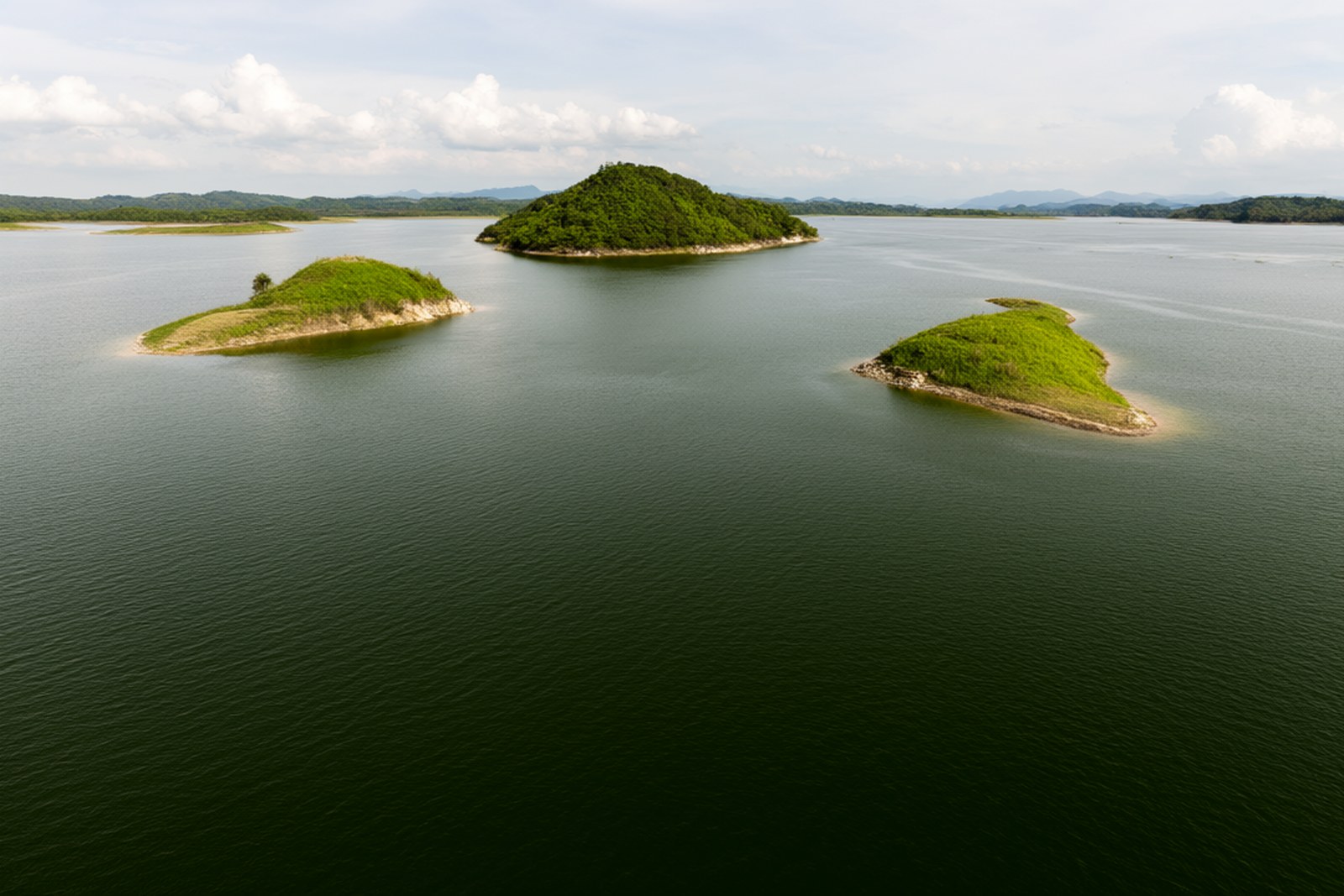
The stretch that is worth the trip is the one through 会山镇 Huì shān zhèn, the only Miao township in the county, where the road comes down off the hills and the river runs between slopes that are still wooded rather than planted. The villages here are Miao and the houses are on the higher ground above the flood line, and the rafting operators work out of the same valley, using the road that serves the township. The 万泉湖 behind the dam is a quiet stretch of open water with drowned hills standing in it, and it is a better place for a slow boat and an afternoon than for anything with a gradient; the drift proper is where the water moves.
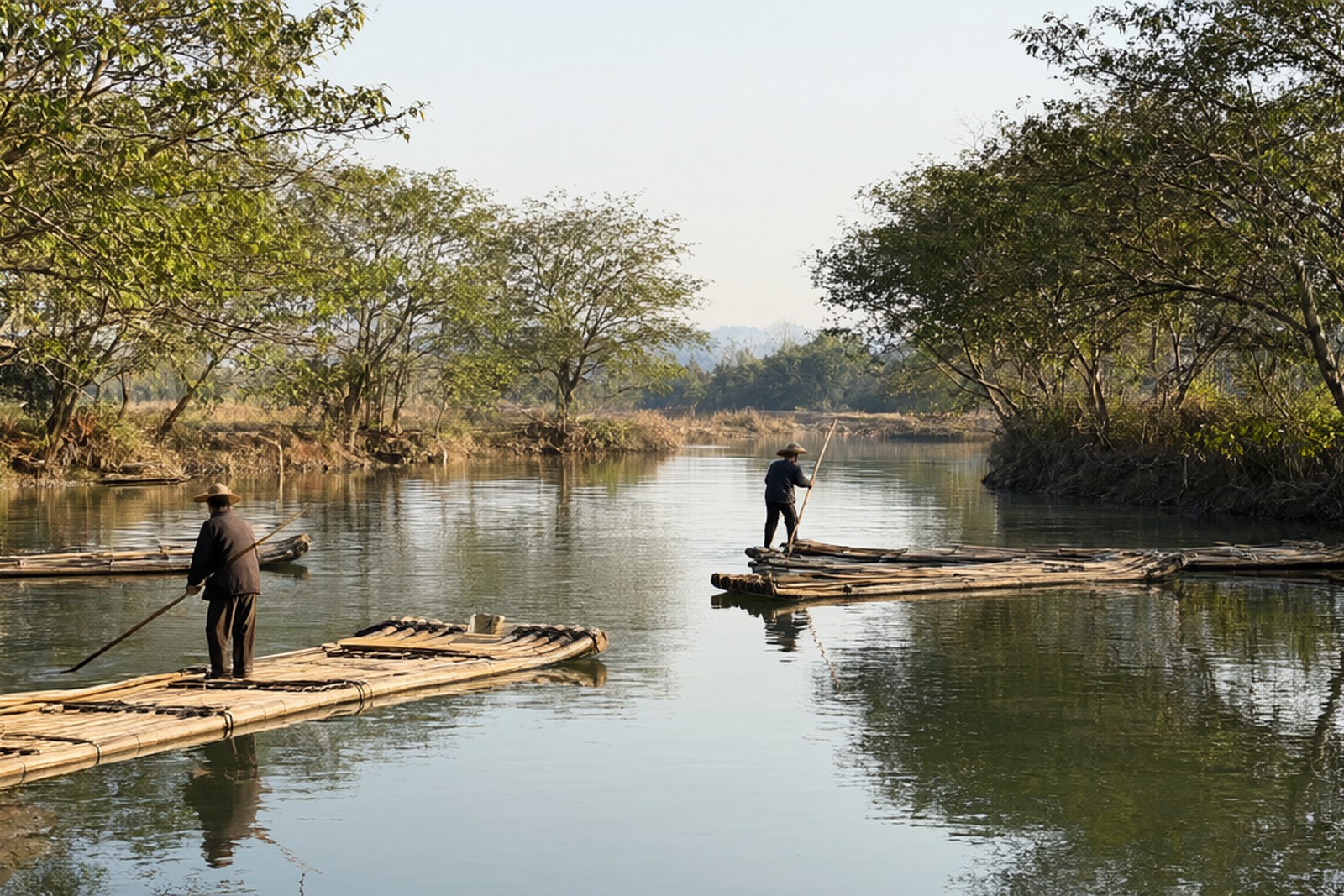
The practical version is uncomplicated. A raft or a rubber boat takes two to four hours depending on the water and the section, and the operators supply the boat, the life jackets and a boatman, with a driver to bring you back to the start; some sections are run with several boats together and a guide, which is the better option for a first time. The river is at its best from November to April, when the water is lower, clearer and more predictable, and at its most energetic in the wet months when the rain fills it. Bring a change of clothes, sandals that will stay on your feet, and nothing that cannot get wet, and ask about the water level before booking, because a drift that is fast in February is a different trip in September and the operators will say so.
Practicalities
Tickets. The drift is a commercial arrangement rather than a ticket gate, and prices vary with the section and the boat: roughly ¥150 to ¥250 a head for a half day including the boat and the return transfer, with a minimum number of people on some sections. A slow boat on the reservoir is cheaper, at around ¥60 to ¥120.
Opening hours. Runs go out in the morning from about 09:00 and again in the early afternoon, less often in the wet season and not at all on days when the river is in spate. A drift takes two to four hours including the transfer, so a half day is the allowance; the reservoir can be done in two hours. The operators need booking a day ahead in the high season.
Getting there. There is no station at the river. 琼海站 Qiónghǎi zhàn on the 东环 high-speed line is about an hour away by road from the upper valley and 嘉积镇 Jiā jī zhèn about an hour downstream; the road in runs through 会山镇 Huì shān zhèn. 琼海博鳌机场 Qiónghǎi Bó’áo jī chǎng is about ninety minutes by road. A car or a hired driver is essential and the operators organise the transfer from the meeting point.
Closing day. There is no closing day, but the river has them: the drift does not run when the water is too high or too low, and the wet season from May to October can close it for days at a time after heavy rain. The best window is November to April, and the busiest days are over the Spring Festival and the October week, when the boats book out several days ahead.
flowcloud would say that a river which was the setting for a company of women soldiers in 1931, and which now runs rafts past plantations of rubber and betel in the same valley, has quietly kept the argument that land is worth holding by making sure it is worth farming.
Getting there: the drift runs on the upper 万泉河 in 琼海市, reached by the road through 会山镇 Huì shān zhèn, about an hour by road from 嘉积镇 Jiā jī zhèn and about an hour from 琼海站 Qiónghǎi zhàn on the 东环 high-speed line; operators meet clients at the township and provide the transfer.