
文笔峰 Wén bǐ fēng is a hill of about 180 metres in 龙湖镇 Lóng hú zhèn, some 20 km southeast of the Ding’an county seat and 46 km from Haikou, and it stands alone on flat ground, which is why its old name was 尖岭 Jiān lǐng, the pointed ridge; the Ming renamed it the writing brush to promote the district’s scholars. The complex on its flanks, 玉蟾宫 Yù chán gōng, the Palace of the Jade Toad, is the seat of the Southern School, and the area around it was rated national 4A in October 2012, the first in the county. Ding’an has no railway station, so the last leg is by road from Haikou East or Meilan.
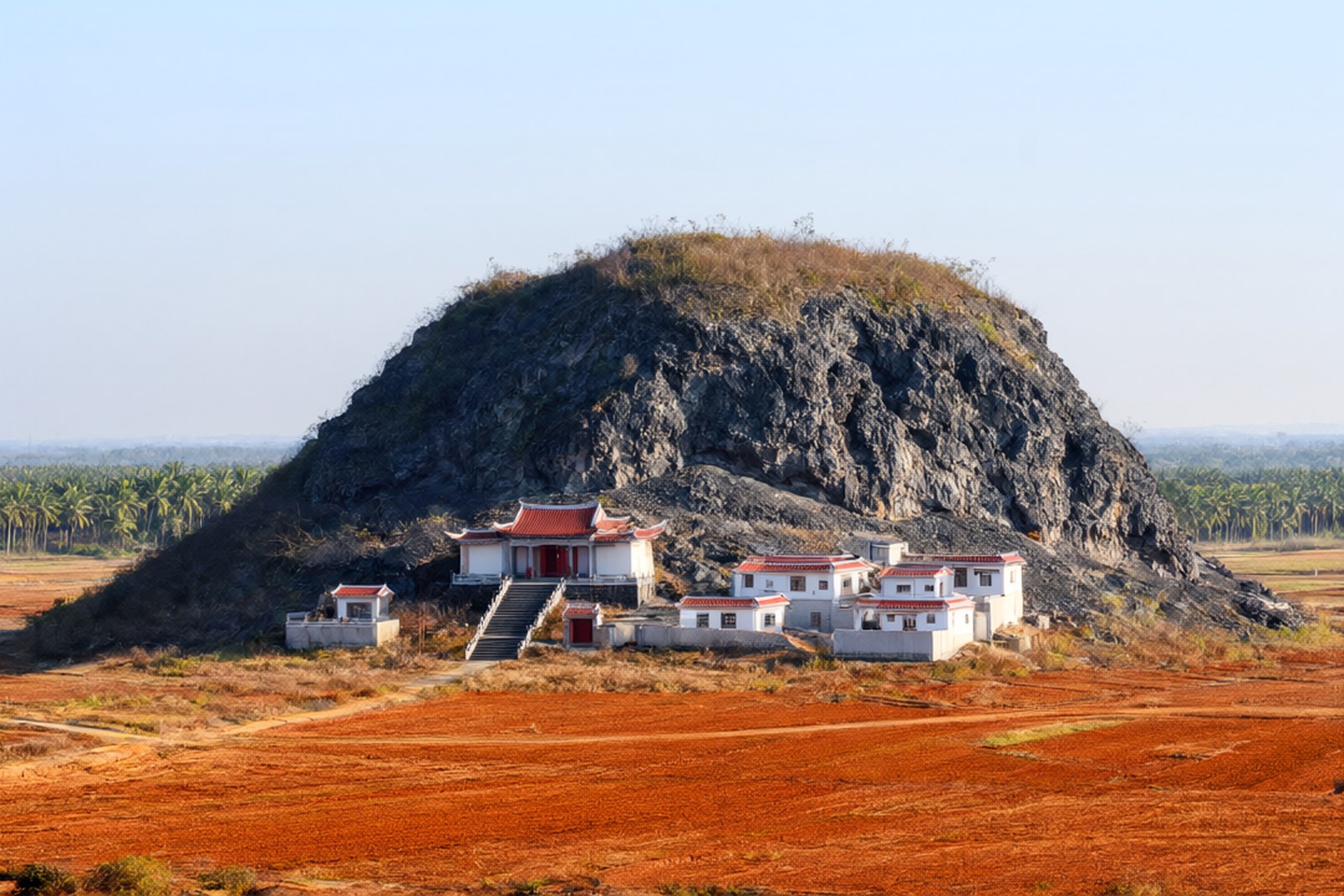
In 864 the Tang emperor Yizong Lǐ Cuǐ sent four officers to pacify the country behind 黎母山 Lí mǔ shān, and on the way back they climbed this peak, petitioned for a thirty-li tract to be set aside and were granted the name 李家岭 Lǐ jiā lǐng. What a visitor walks today is much younger: from 2003 a Hainan developer spent close to a billion yuan, and the complex opened in April 2006, on the fifteenth of the third lunar month and the reported birthday of 白玉蟾 Bái Yùchán, with a consecration ceremony. The 4A rating followed in 2012, and a heritage village planned nearby sits unbuilt in the county’s 2023 work list.
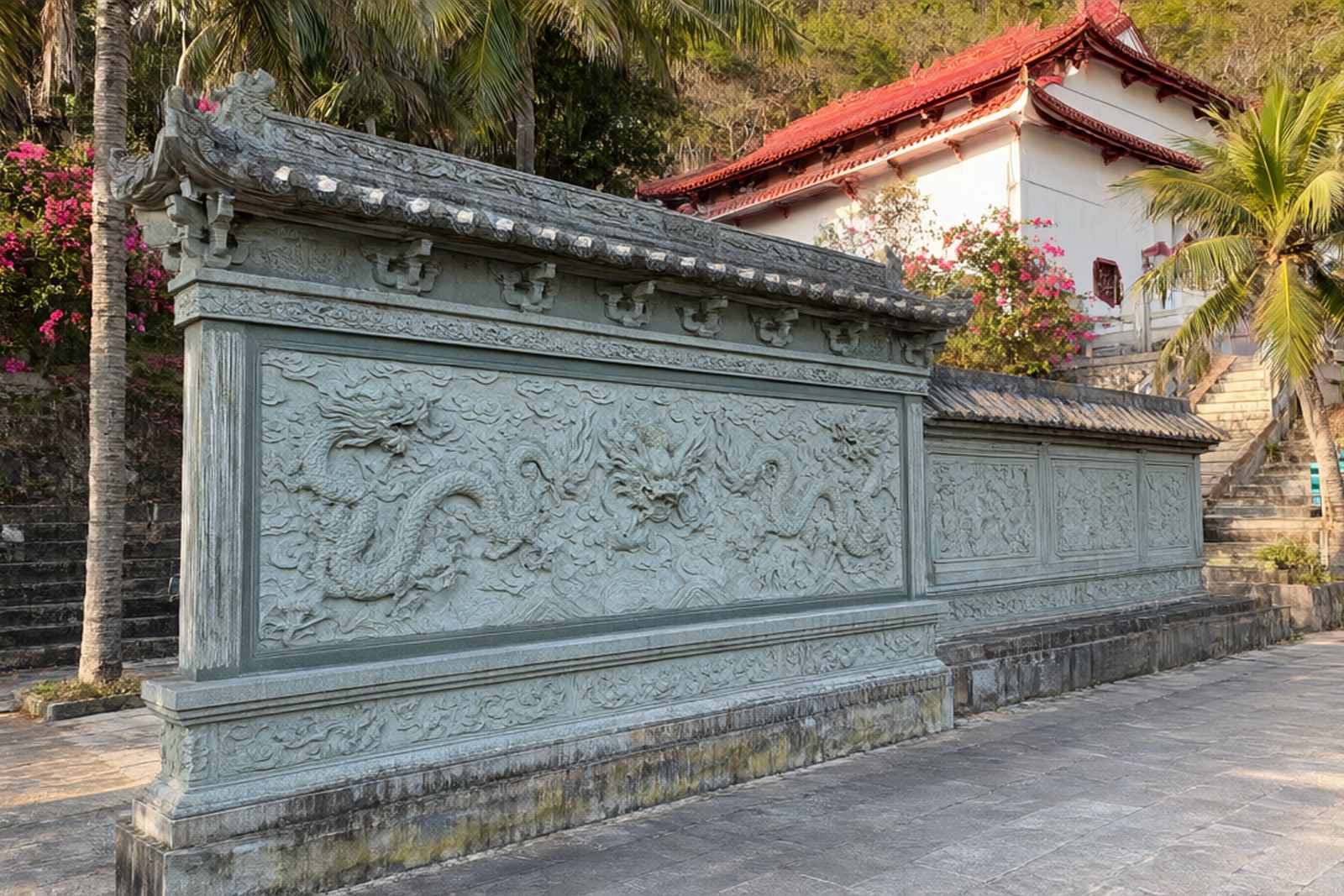
The buildings are meant to be read as one statement: more than twenty halls in a Southern Song manner, white walls and heavy eaves stacked up the slope. The main hall is the octagonal 玉蟾阁 Yù chán gé, whose shape and name refer to the eight-pointed radiance of the Taoist heaven; around it stand halls for the Medicine King, for Wealth, for Wenchang and for the Li mother, with the Three Pure Ones on the summit, reached from the south gate past the lotus ponds and the bell and drum towers. The five-gate archway and the dragon screen are the most photographed pieces, and the back of the screen carries 白玉蟾’s 道德宝章 Dàodé bǎozhāng, his commentary on the Laozi, in calligraphy attributed to Zhao Mengfu.
白玉蟾 was born 葛长庚 Gě Chánggēng, not in Ding’an but in a village that is today part of Haikou, with the family home in 闽清, Fujian. He lost his father at six, wrote verse at seven, failed the boys’ examination at twelve because the examiner thought his lines on a loom impudent, and left home at sixteen, first for 黎母山 and then to 松林岭 Sōng lín lǐng in Danzhou, a 193-metre hill with a stone chamber on top. At twenty-three he crossed the strait with three hundred coins and an umbrella; in 1175 he met 陈楠 Chén Nán, the fourth patriarch; in 1197 the elixir was declared complete; and by 1225 he had lectured to the emperor at the Taiyi palace and been titled the Perfected Man of Clear Purity.
What gives this hill its soundtrack is that the county’s Taoist music is officially Hainan’s: the 斋醮科仪音乐 zhāi jiào kēyí yīnyuè entered the second national list of intangible cultural heritage on 7 June 2008, item Ⅱ-139, number 638, filed by Ding’an county, its 醮 offered to the deified figures of this coast, among them the Lady 冼夫人 Xiǎn fūren, and its 斋 for the dead. Three things are unsettled. 白玉蟾’s birth year is 1134 in the encyclopaedias and 1194 according to 詹石窗 Zhān Shíchuāng, who rejects the 1229 death; that death is placed on the Gan river in Jiangxi, while the temple has him ascend from the rock on this summit, a legend. And the claim that the palace is the only legal Taoist temple in Hainan is the scenic area’s wording, with no religious affairs document behind it.
Practicalities
Tickets. No official price list has been found from the county or the operator, so the figures in circulation are second-hand. The encyclopaedia entry gives a base ticket of 51 yuan, a shuttle at 15 yuan, a combined adult ticket with the shuttle at 68 and a version with a vegetarian meal at 93; third-party guides quote 40 to 60 yuan for the ticket alone. This is the one number here that nobody has seen on an official notice.
Opening hours. The published time is 09:00 to 18:00, from the same second-hand source as the ticket, so treat it as an indication rather than a timetable. In practice the hill is a daylight visit, and two to three hours covers the main halls and the Three Pure Ones altar on the summit; allow half a day if a ceremony is on, because the temple is in religious use and the hours can lengthen around the festival dates.
Closing day. No closing day is reported, and for a temple in daily use none should be expected. The rhythm that matters is the festival calendar the site has kept since 2019: a temple fair on the ninth day of the first lunar month, the patriarch’s birthday on the fifteenth of the third, the seventh of the seventh, the Zhongyuan rites on the fifteenth of the seventh and the Wenbi summit meeting on the fifteenth of the eighth.
Getting there. By road from Haikou take the eastern expressway and leave at the Longhu junction, with the hill west of the exit. Of the buses, the Haikou to Zhongrui service stops at Wenbi Peak, while the Haikou to Huangzhu and Haikou to Ding’an services stop at the Longhu junction. From 10 January 2026 the intercity line between Mingzhu Square in Haikou and Zhongrui farm calls here and at Nanli Lake’s Huanle Bay, Longmen, Lingkou, Hanlin and Zhongrui; the scenic area’s telephone is 0898-63733252.
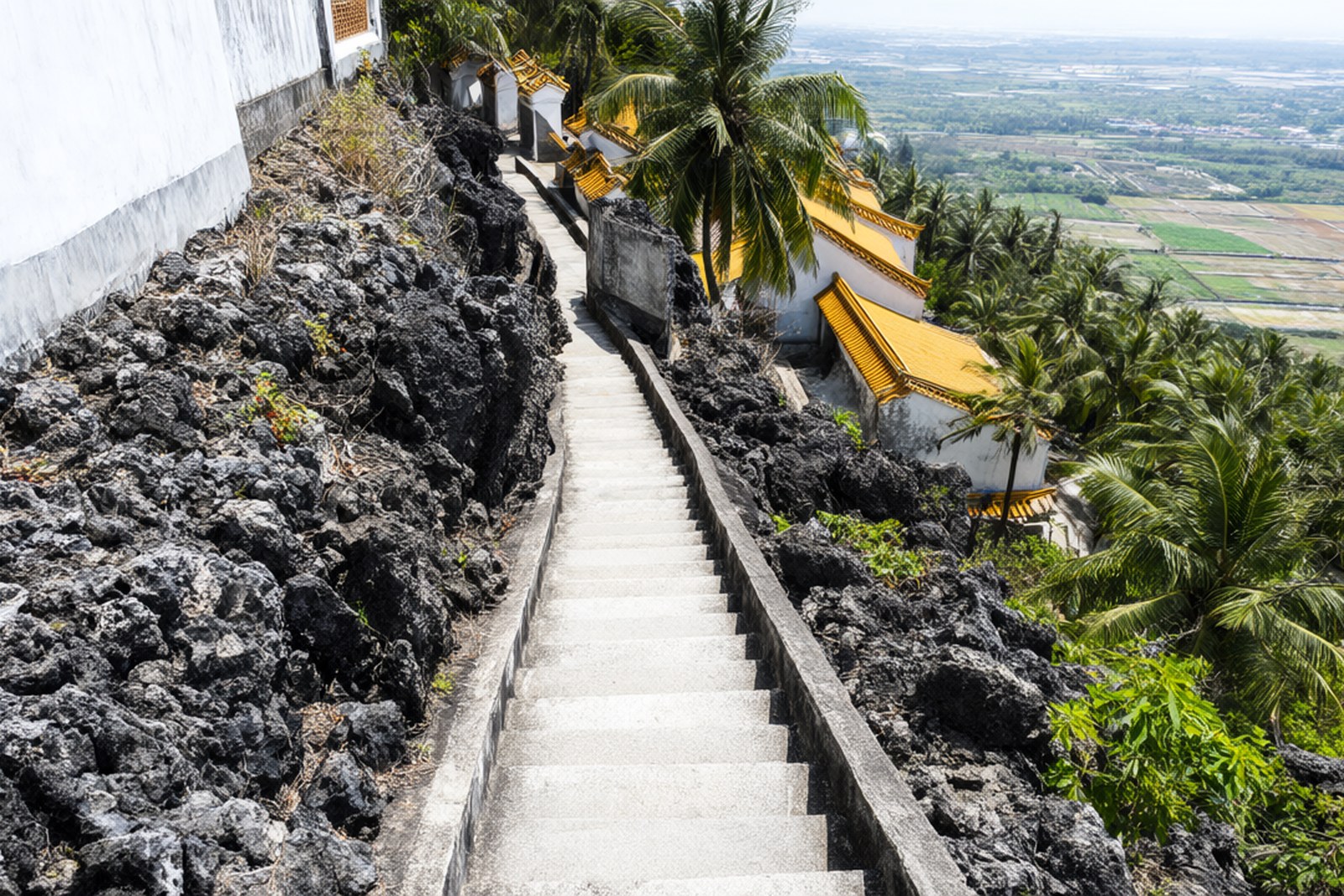
Allow half a day and walk it in the order the operators set out, because the sequence is the argument: an archway, a lake of lotus, the drum and bell towers, the octagonal pavilion, and then rock and wild hill behind it. The halls themselves were finished in the 2000s, so this is a modern reconstruction of an old idea. What is old is the idea: a hill renamed after a writing brush so that the county would produce scholars, a patriarch born somewhere between 1134 and 1194 said to have flown off its summit, and a soundtrack that is Hainan’s official ceremonial music.
Getting there: 文笔峰盘古文化旅游区 stands in 龙湖镇 in 定安县, about 20 km southeast of the county seat and 46 km from Haikou, reached by car from the eastern expressway’s Longhu junction or by the Haikou to Zhongrui bus at the Wenbi Peak stop; the published figures of 51 yuan and 09:00 to 18:00 are second-hand rather than official, no closing day is reported, the festival calendar runs from the ninth of the first lunar month to the fifteenth of the eighth, and Ding’an has no railway station, the nearest being Haikou East and Meilan.