
The two launch towers stand about a kilometre apart on a shelf of cleared coastal scrub, one taller and one shorter, painted in the pale grey-green that everything at a launch site seems to be painted, and from the road they look less like the machinery of the space age than like two very large industrial sheds that have been left in a field. Then you notice the lightning masts, and the bunkers, and the flame trench, and the fact that the whole thing is pointing out over open water, and the scale of the decision starts to land. They put a spaceport here, at the north-east corner of 海南 Hǎinán, because of two things that have nothing to do with sheds: the latitude, and the sea.
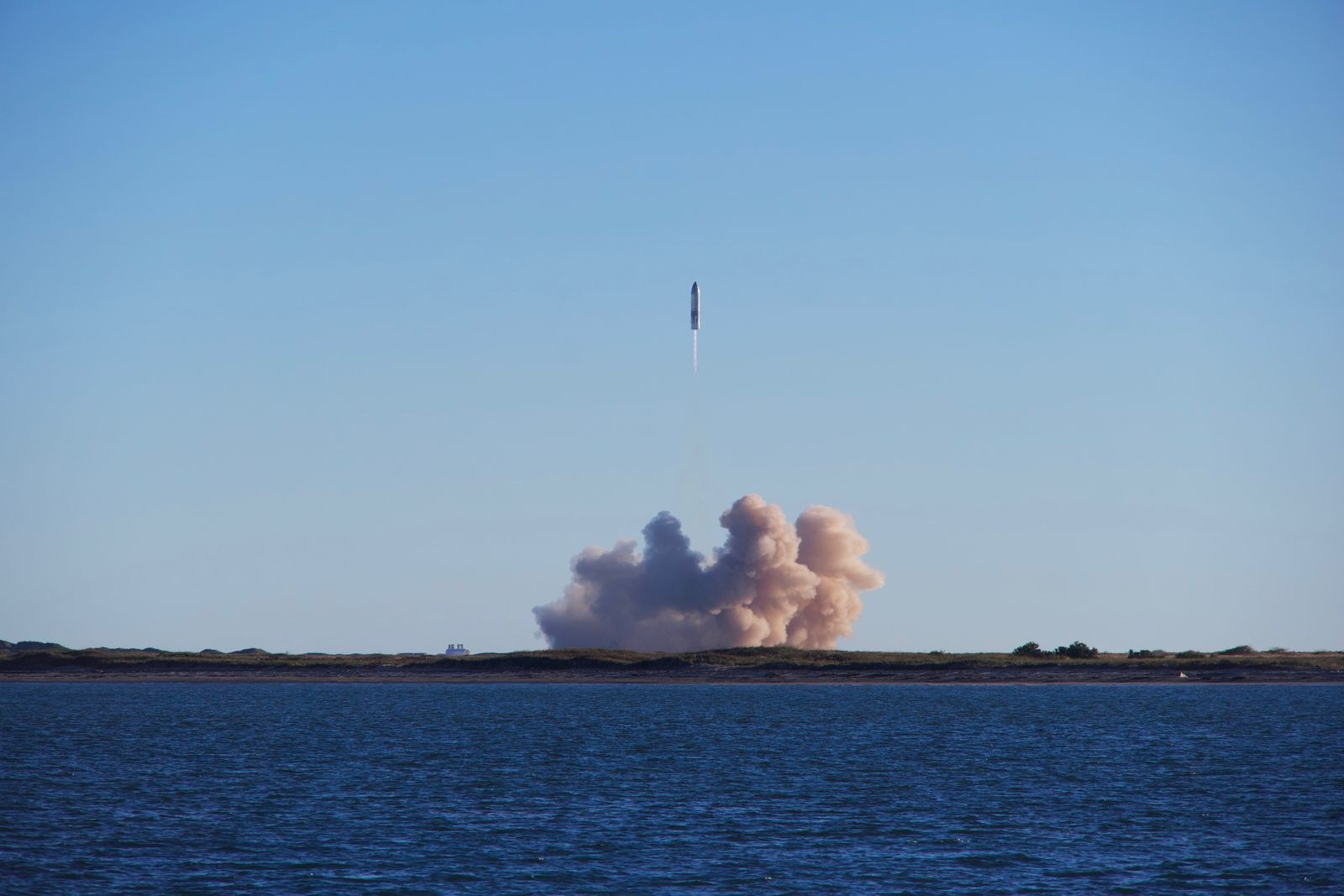
The 文昌航天发射场 Wénchāng Hángtiān Fāshèchǎng, the Wenchang Spacecraft Launch Site, sits in 龙楼镇 Lónglóuzhèn in the north-east of 文昌 Wénchāng. It is the fourth of China’s launch sites and the newest, opened in 2016 with the first flight of a 长征七号 Chángzhēng Qīhào rocket, and it is the first one China has built on a coast. Before this, the country’s launches went up from 酒泉 Jiǔquán in the Gobi, 太原 Tàiyuán in the hills of Shanxi, and 西昌 Xīchāng in the mountains of Sichuan. Wenchang changed the arithmetic.
Why Here
Two advantages, both physics, both large.
The latitude. Wenchang is at about nineteen and a half degrees north. The closer a launch site is to the equator, the faster the Earth’s surface is already moving eastward underneath a rocket when it lifts off — at nineteen degrees that is roughly 440 metres a second of free velocity you did not have to burn fuel to get. For a mission to a geostationary transfer orbit or a lunar trajectory, that is worth a substantial fraction of the payload. Every kilogram saved in the launch vehicle is a kilogram available for the spacecraft.
The sea. This is the one you can see. Launch sites in the interior have to drop their spent first stages onto land, which means tracking a corridor, evacuating villages, and accepting a debris footprint you have to negotiate with several levels of local government. Wenchang’s rockets fly out over open water, and the boosters land in the sea. It also means the very large rockets can be delivered to the site by ship — the 长征五号 Chángzhēng Wǔhào is over fifty metres tall and five metres in diameter, and it arrives at 清澜 Qīnglán port by sea from 天津 Tiānjīn, which is not something you could do with a mountain site and a railway tunnel.
The 长征五号 is the reason most people have heard of this place. It is the heavy-lift vehicle that put the 天和 Tiānhé core module of the 中国空间站 Zhōngguó Kōngjiānzhàn into orbit in 2021, carried 嫦娥五号 Cháng’é Wǔhào to the Moon in 2020 and brought the lunar samples back, launched 天问一号 Tiānwèn Yīhào to Mars, and returned far-side lunar material with 嫦娥六号 Cháng’é Liùhào. When something in the Chinese space programme is big, it almost always leaves from this coast.
What You Can Actually See
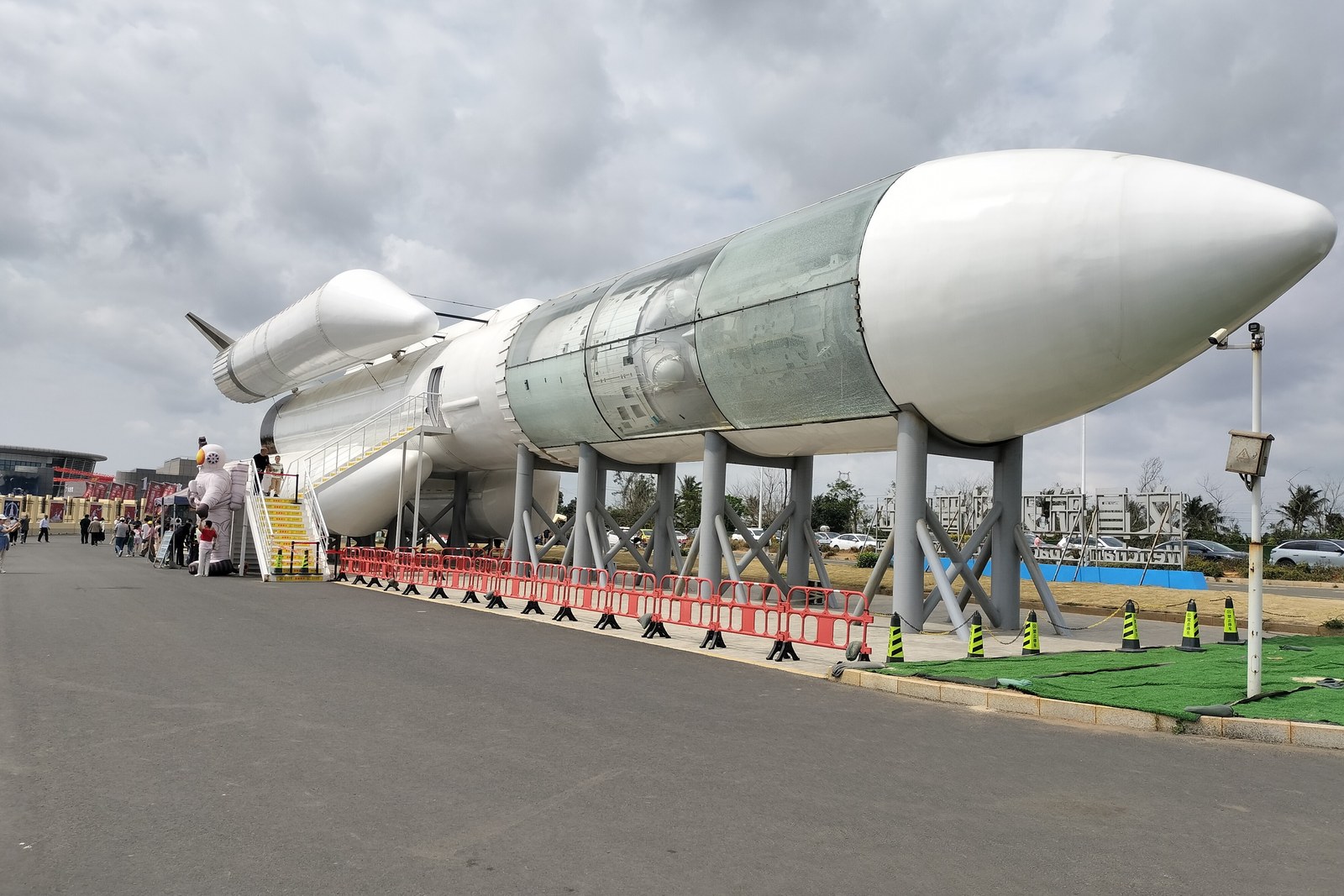
The launch site itself is a working facility and access is controlled. There is a visitor and science-education centre associated with the site which can be visited with a booking, and it runs to a walk-through exhibition, a model hall, and — on the good days — a view of the assembly buildings and the pads from a distance. Tours are not continuously open to independent travellers and the arrangements change; check the official channel and book before you travel, not on the day. Anyone who tells you they can drive you onto the pads is either confused or lying.
What is unfailingly available is the surrounding coast, and it is genuinely good. The launch viewing spots are a short drive apart:
铜鼓岭 Tónggǔlǐng, the hill north-east of the site, is the classic elevated view — you look down and along the coast and the two towers are a pair of grey marks against the sea. It has a shuttle and a walkway and it gets busy on launch days.
石头公园 Shítou Gōngyuán, on the coast below the hill, is a shore of huge rounded granite boulders where people climb out onto the rocks and watch from the water’s edge.
淇水湾 Qíshuǐwān, the beach south-east of the site, is where the crowd goes: sand, palms, a few stalls, thousands of people with phones held up.
龙楼镇 Lónglóuzhèn itself, the town next to the site, has become the unofficial viewing venue of the whole enterprise. Guesthouses have chairs on their roofs; restaurants open at midnight after a night launch and stay open until two.
The Sound
Whatever view you choose, the sequence is the same and worth waiting for. The light appears first, rising, silent, faster than you expect. Then nothing, for about twenty seconds — the gap is the time it takes sound to cover four kilometres. Then the sound arrives, and it is not a sharp crack but a long rolling physical thing that you feel through your feet and chest before your ears file it, and it keeps going, and going, and you find yourself grinning at complete strangers, which is what a launch does to a crowd.
If you are lucky enough to be there for a night launch, the flame is visible for far longer and the light on the underside of the clouds is something people spend the rest of their lives describing badly.
Practicalities
Tickets: There is no ticket and no barrier for the coast, the hill or the beach — 铜鼓岭 (Tónggǔlǐng) charges a modest admission for the shuttle and walkway, and parking at the beach costs a few yuan. The launch site’s science-education and visitor centre requires an advance booking through the official channel; prices and opening arrangements change from season to season, so confirm before you travel.
Opening hours: The coast is public land and open at all hours — which is the point, because launches happen at night as often as not. The visitor centre, where open, generally runs daytime hours; 铜鼓岭 (Tónggǔlǐng) is best reached in the morning before the heat and the coaches. Do not expect anything to be open in the small hours except the restaurants, which will be.
Closing day: None for the coast. The visitor centre closes on a published schedule and around launch operations, when the whole area goes into a security footing and the roads to the site are controlled.
Getting there: 文昌 (Wénchāng) has its own station on the 海南 Hǎinán east-coast high-speed rail loop — about twenty minutes from 海口美兰 (Hǎikǒu Měilán) airport and ninety minutes from 三亚 (Sānyà) — and from the station it is roughly forty minutes by taxi to 龙楼镇 (Lónglóuzhèn). By car, come out from 文城 (Wénchéng) along the coastal road towards 龙楼, which is signed throughout. Check the launch calendar before you plan anything. Launches are scheduled weeks ahead and then move; on the day itself the roads around 龙楼 close some hours beforehand and the town fills to the point where a room booked a month early is the only sensible plan. Come for a scheduled launch, or come anyway and enjoy one of the best stretches of coast in Hainan for what it is. flowcloud would say that a country which puts its heaviest rockets next to a fishing village, and lets the village sell watermelon on its roofs while they go up, has a healthier relationship between the enormous and the ordinary than most space programmes manage. Pick your spot, get there early, and wait — the twenty seconds of silence is part of the show.