
Wolong Mountain Wò lóng shān stands a little under eight kilometres north of the Tunchang county town, on the western side of the old central highway, and it is 499 metres high. That is not a great height in the abstract, but it is the whole of the local topography: 屯昌县 Tún chāng xiàn has no coastline, only low hills around a basin of reservoirs, and a hill of this size therefore commands everything in sight. The name means Crouching Dragon, and it is not a marketing invention. Four summits are strung together by a ridge that runs like an animal lying down with its head raised, and the fourth and highest is 龙头峰, Dragon Head Peak, its face a cliff of several tens of metres.
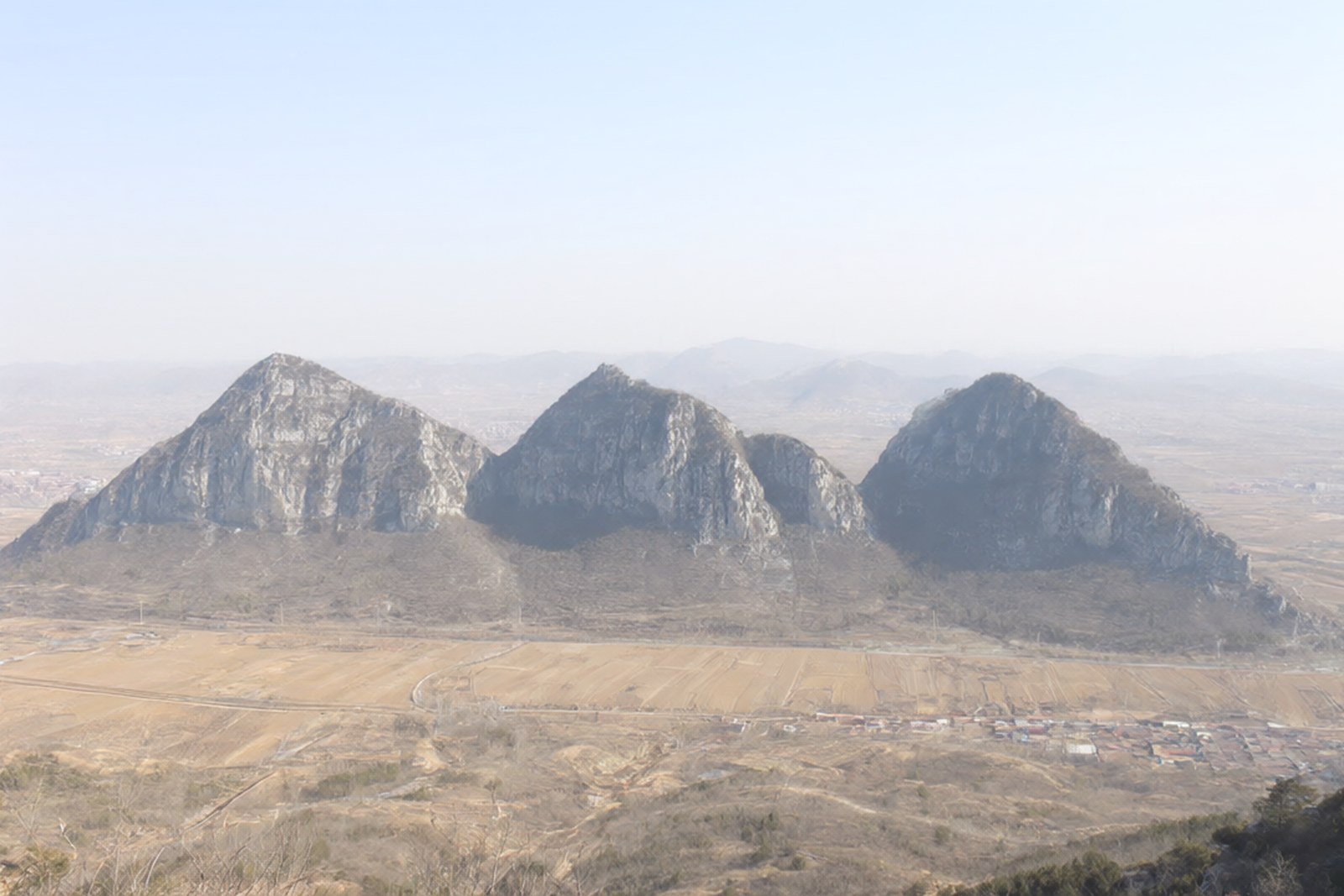
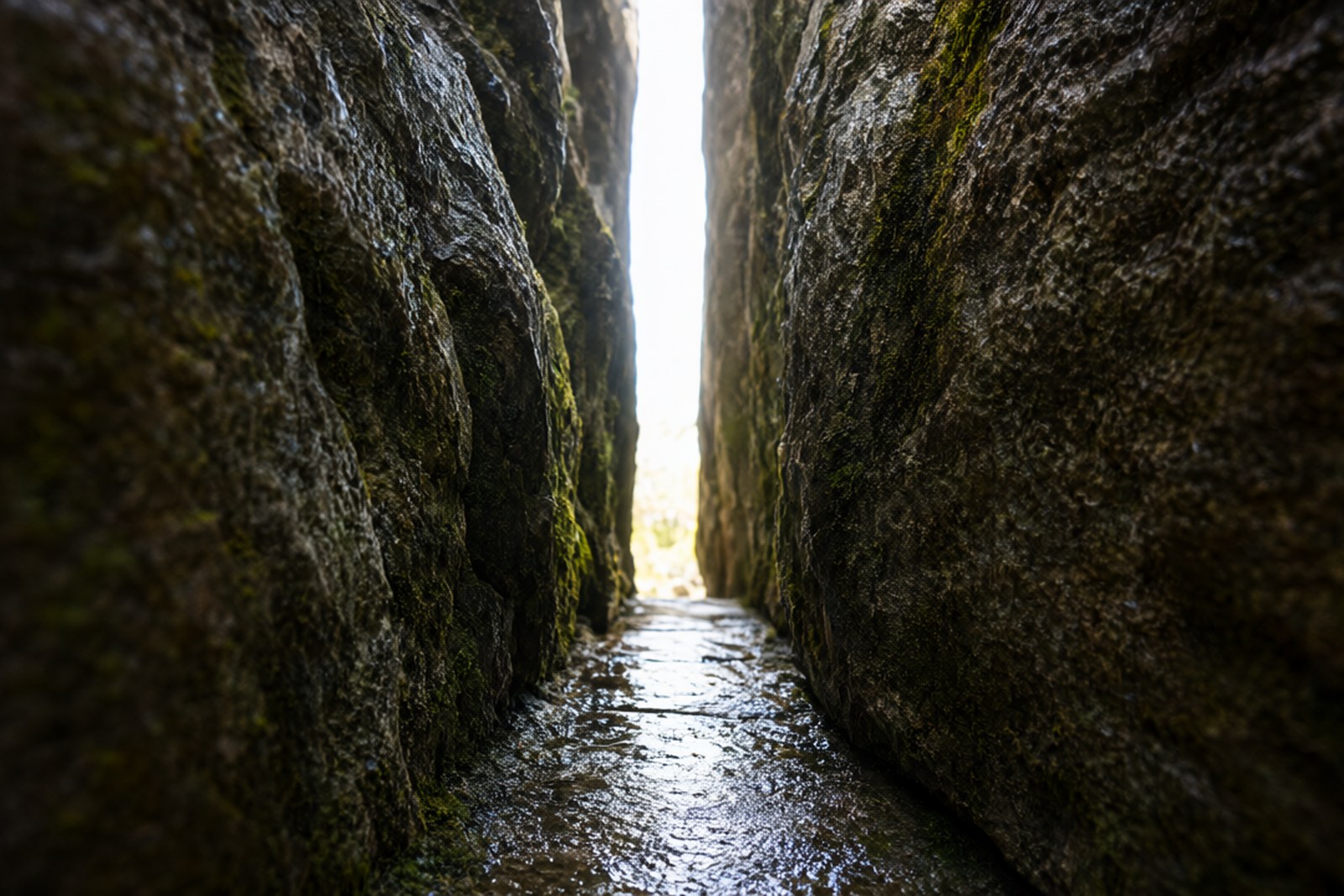
The stones have names, and the names are the reason to come. Local tradition counts 十二绝 shí èr jué, the Twelve Wonders, and the list runs from Dragon Mouth Rock and Dragon Brain Cap through Bird Rock, the Immortal Lighting the Lamp, the Immortal’s Vegetarian Rock, the Ox Pen, the Sky-Patching Stone, the Fairy Lane, the Fairy Cave, the Stone House Spring and the Stone Bed. Three of them carry their own measurements. The Gold Brick Stone is about four metres long, two wide and one and a half thick, and it stands on a single corner with the other three in the air. The Immortal Lighting the Lamp is a group of boulders about ten metres tall with one black stone balanced on top. The Fairy Lane is a corridor between two slabs leading to the Fairy Cave, five metres across at the mouth and reported to run some two kilometres into the hill.
Every stone here has a story, and they are good stories. In the founding one, the Jade Emperor sent a dragon to keep the floods down in this basin, and the dragon lay down and turned to rock, which explains the shape of the ridge and the absence of a river through the town. The Gold Brick Stone is about a beggar and a bully: an immortal saw how poor the villagers were and left a brick of gold, a local strongman came with his men to take it, and the immortal threw it into the ground in anger, where nobody could move it and where it became a boulder. The lamps on the Immortal Lighting the Lamp are said to glow red at night when a stone gong on the hill is struck. None of this is documented history and none of it claims to be.
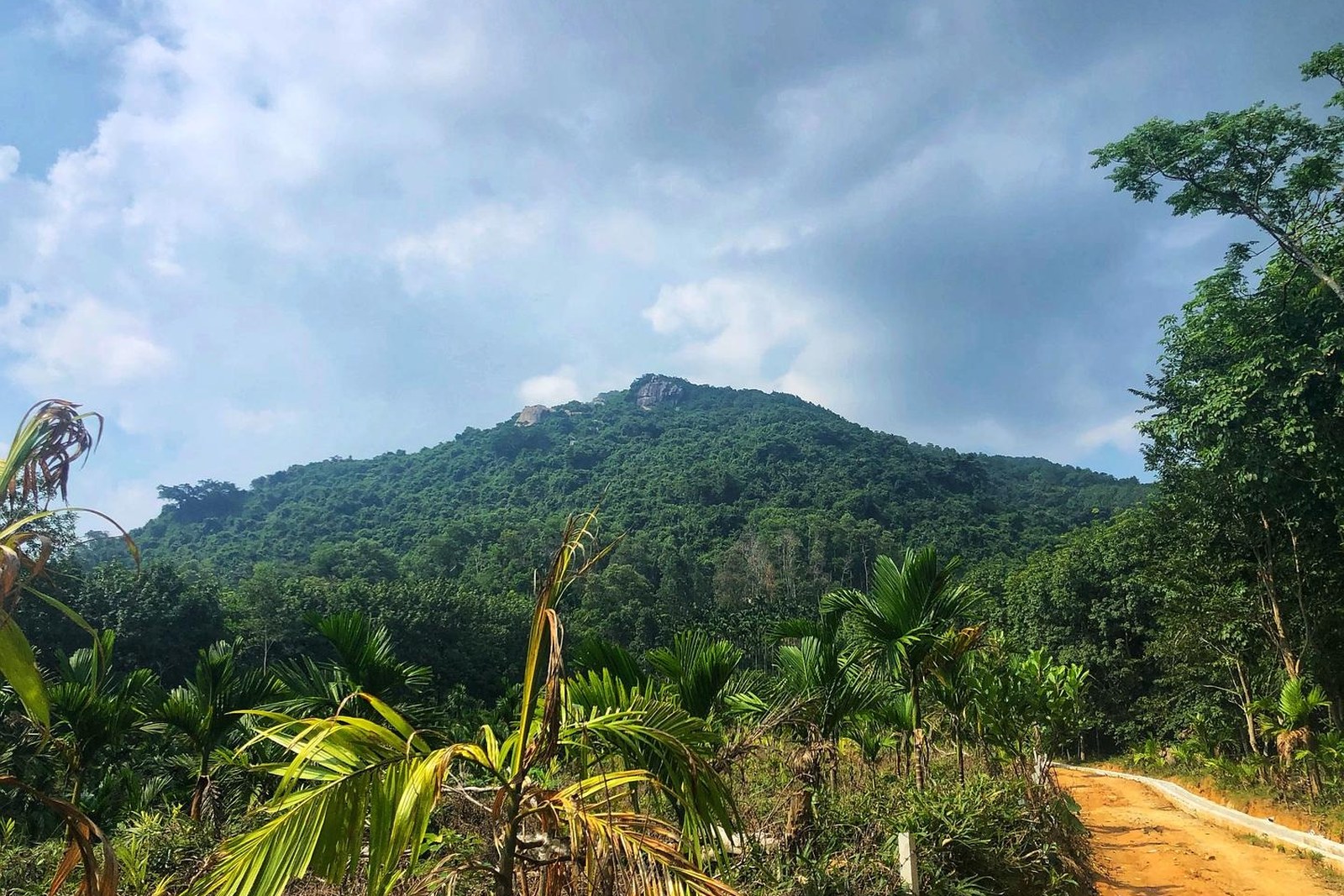
What is new here is a path. In March 2024 the county approved a feasibility study for a climbing trail with a total investment of 12.8275 million yuan: 10.5 kilometres of path, 1.5 metres wide, with viewing and rest platforms and a car park. In 2025 and 2026 a first phase of a forest resort project began acquiring land, roughly a hundred mu within the hazard assessment boundary. Read those dates carefully, because they mean the mountain is not a finished attraction: the trail was approved, not necessarily completed, and no reliable source confirms that it is open and in use. There is no cable car, no ticket office and no commercial development on the summit. The one substantial building nearby is 福庆寺, Fuqing Temple, at Datang village, which began in 1738 as a Buddhist nunnery and is claimed locally as Hainan’s only Tibetan Buddhist site, though its hours and any charge are published nowhere.
Two practical warnings, and then the view. Hainan has several mountains called Wolong, and the 499 metres here belong to Tunchang alone. The old township name has also moved: most sources still put the mountain in Datong township, but that is now a village area inside the county town, and recent official notices describe the land as falling within three village groups of the Haijun committee, so describe the position by direction and distance rather than by an administrative name that no longer exists. Go up in the late afternoon if you can, when the sun is low over the fields and the rock is at its clearest, and give the Fairy Lane the middle of the day, because the light only drops into the gap between the slabs when the sun is high.
Practicalities
Tickets. There is no charge to walk the mountain. Travel listings that carry a price all carry zero, and there is no gate, no ticket window and no booking system. The temple is a separate matter: no reliable source gives either a ticket price or an opening time for 福庆寺, so treat it as a working religious site, go respectfully, and ask locally before planning a visit around it.
Opening hours. No official hours are published, and in the ordinary sense there is nothing to open or close, since the hill, the paths and the viewpoints are simply there. Walking is best in the first two or three hours of daylight, before the heat builds on a ridge with very little shade, and the light for photography is best in the late afternoon, when the flat lake at the foot of the hill catches the sun.
Closing day. No closing day is reported for the mountain, and none exists, because there is no venue, no staff and no schedule to rest from. The caveats are weather and construction: the rock is slippery after rain, and the trail works approved in 2024 and the land acquisition of 2025 and 2026 mean that parts of the hillside may be a building site at any given time.
Getting there. The mountain is about eight kilometres north of Tunchang town and about four kilometres west of the old central highway; the approach road is reported to run some way up the slope, so the walking is optional and the view is not. No bus route is documented. Coaches from Haikou reach Tunchang easily, and local motorcycle taxis in town have long been the documented way out to the hill, which is fine for the trip up. There is no published parking information, no cable car, no guide service and no official telephone number.
Give Wolong Mountain half a day and spend at least an hour of it sitting on the summit doing nothing. The pleasure is not the height, which is modest, and not the forest, which is ordinary; it is that a hill this small has been given a full cast of characters by the people who live under it, and that the characters are still standing where the stories left them. Bring shoes with grip, because the blocks are loose and there is no railing anywhere. In a county with no coast, this is what passes for a sea view: four peaks lying down in a line and a boulder balanced on one corner that a god is supposed to have thrown there.
Getting there: About 8 km north of Tunchang town and roughly 4 km west of the old central highway near the 499 m summit; coaches from Haikou reach the county town and local motorcycle taxis or a hired car cover the last stretch, no bus route or parking notice is published, the hill is free and always open, and nothing official is published for the temple at Datang village.