
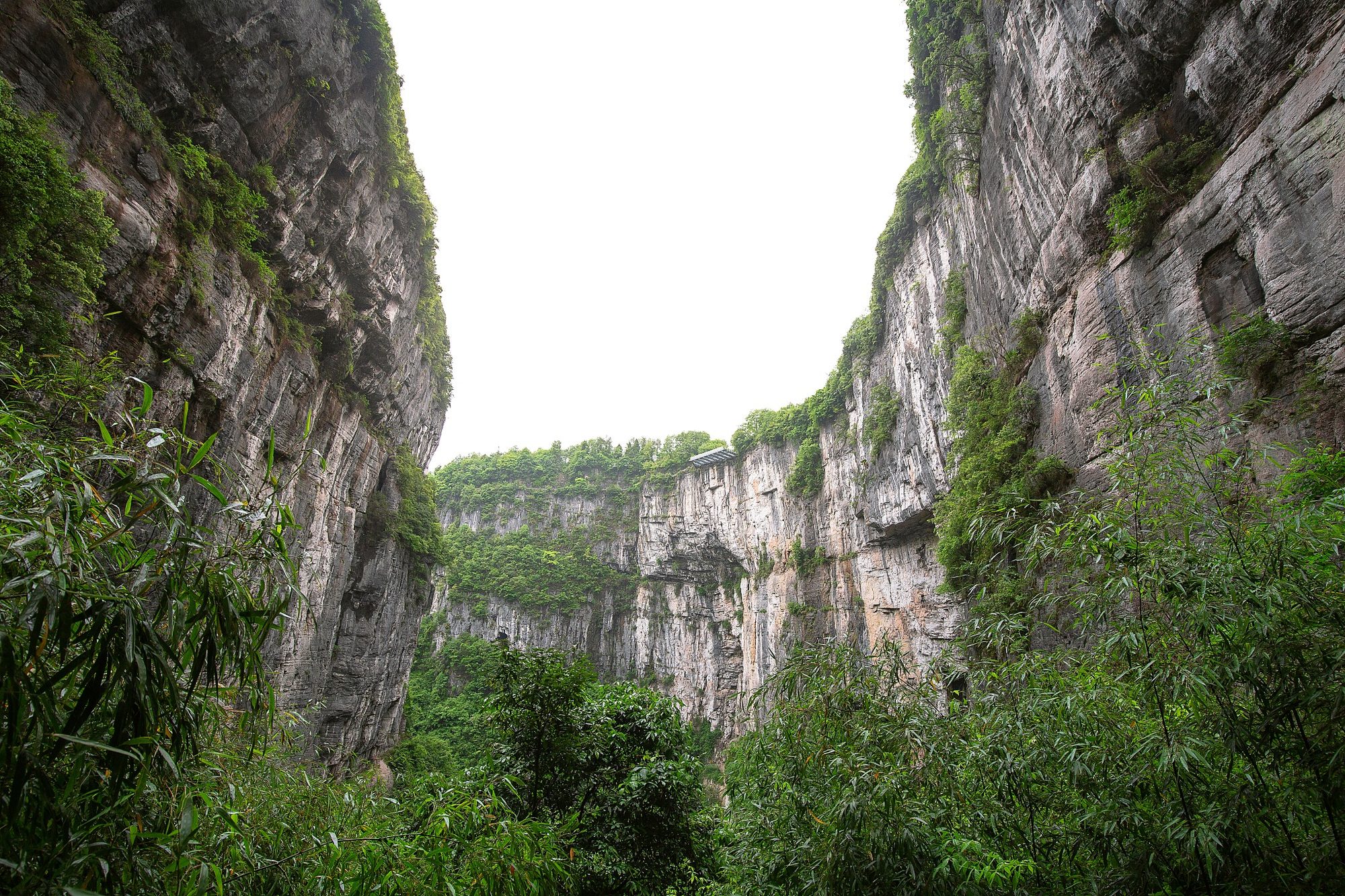
Tiansheng Three Bridges (天生三桥, Tiānshēng Sānqiáo) is the headline act of the Wulong Karst, inscribed on the UNESCO World Natural Heritage list, and the reason most travellers ever hear the name Wulong at all. Three colossal stone arches — Sky Dragon, Green Dragon and Black Dragon (天龙桥, 青龙桥, 黑龙桥) — stand in a line inside a single karst sinkhole system on the Furjiang River, a tributary working south towards the Wujiang. The sinkhole drops more than 300 metres from rim to floor; the bridges themselves span between 100 and 200 metres of open air.
The Three Gorges country upstream gets the fame, but this is where the limestone shows what deep time does to it. Three hundred million years of shallow seas laid the rock; later uplift cracked it; slightly acidic rain and the river below dissolved the cracks into caverns; the cavern roofs collapsed, and what survives are the arches, standing in the open air like the ribs of something enormous and patient. Walk the floor of the gorge and you are walking inside the negative space of a mountain range that used to be there.
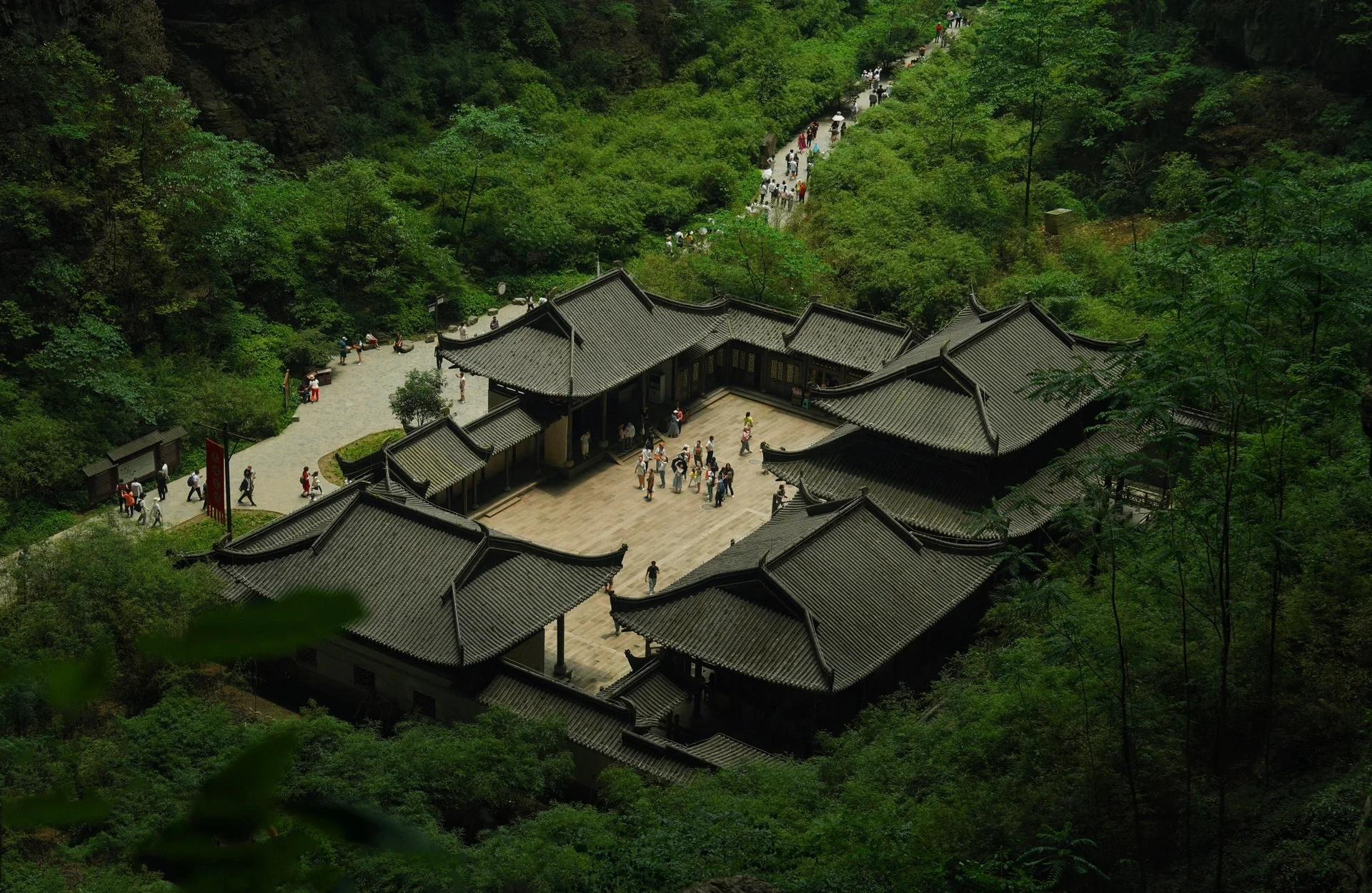
Halfway along the route stands a small courtyard complex, Tianfu Post Station (天福官驿), a recreation of a Song-dynasty relay post — the kind of building that once carried official riders and mail along the old route. It is best known outside heritage circles as a location for Zhang Yimou’s Curse of the Golden Flower (2006). The quadrangle is worth ten minutes for the roof lines alone.
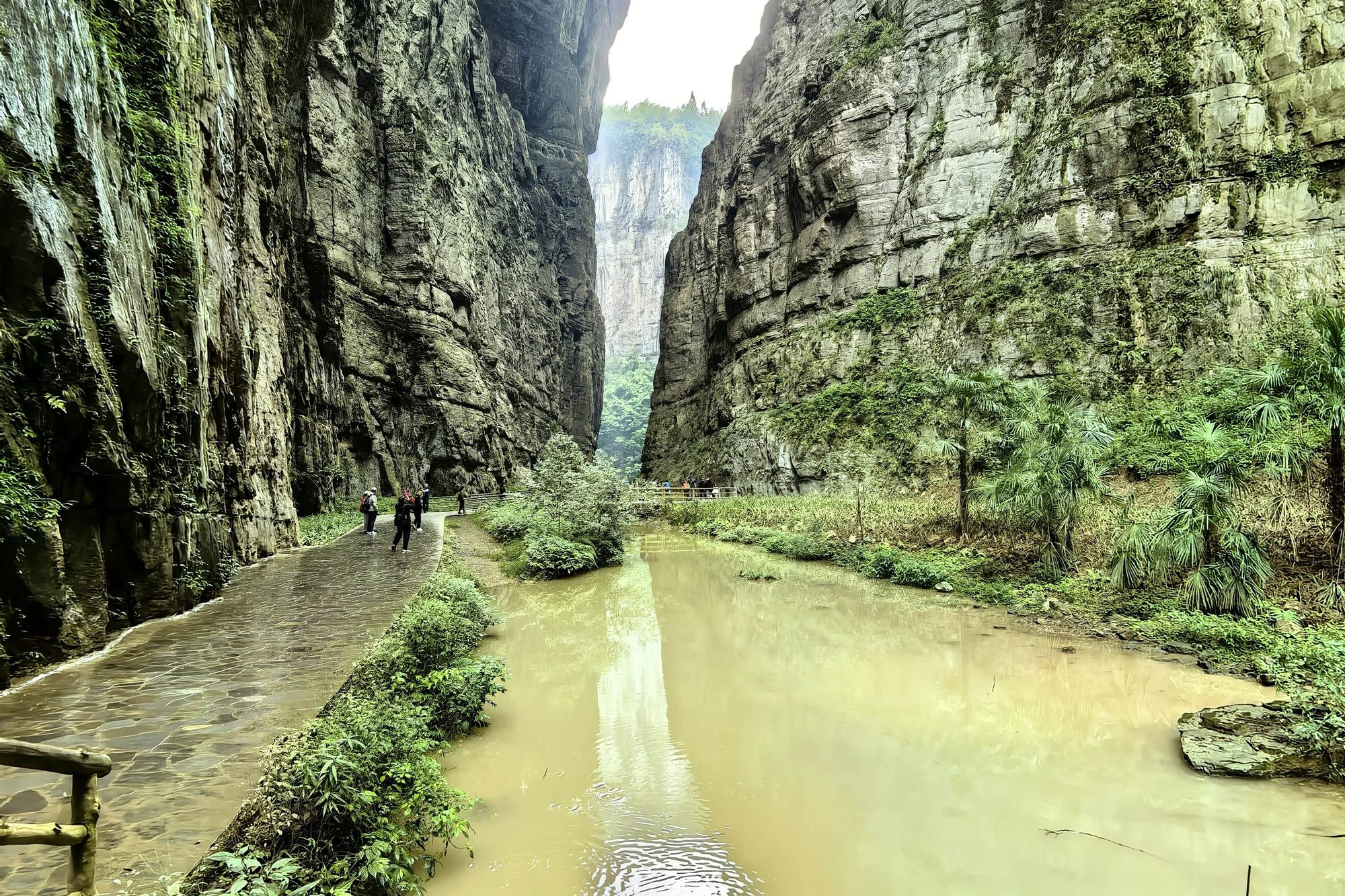
Local guides measure the visit in bridges, not hours. The standard walk enters at the south gate and exits north, roughly three kilometres of level boardwalk and stone path; nobody who is halfway fit needs the shuttle. In summer the gorge floor is genuinely cool — a cave’s temperature without the cave’s dark — and in the high-sun hours the light on the arch undersides is the reason photographers come. If rain is forecast for your Wulong day, reschedule: the paths turn to polished slate.
flowcloud would say that the Wulong Karst is the one place in Chongqing where the mountain stops being scenery and starts being architecture — and you should pay the off-season 40 yuan for the privilege of walking under it alone.
Practicalities
- Rating: 5A, part of the Wulong Karst World Natural Heritage (inscribed with the property; the Chinese 5A grading dates to June 2011)
- Tickets (旺/淡, peak/off-season): 70 / 40 yuan
- Season note: peak-season rate applies roughly July–August and public holidays; the off-season 40-yuan rate is the quiet-season bargain
- Getting there: shuttle buses from Wulong’s Fenghua Street bus station and from the Xiannvshan tourist hub; the Three Bridges and Longshui Gorge are usually ticketed and visited as a pair (checked October 2026, subject to change)
- Time needed: 2.5–3 hours at an unhurried pace
Words and Names
天生三桥 Tiānshēng Sānqiáo — the Three Natural Bridges, the karst arch group that anchors the Wulong World Heritage property · 天龙桥 Tiānlóng Qiáo — Sky Dragon Bridge, the tallest and most photographed of the three · 天福官驿 Tiānfú Guānyì — Tianfu Post Station, the recreated Song-dynasty relay courtyard · 武隆喀斯特 Wǔlóng Kāshítí — the Wulong Karst, the World Natural Heritage property of which the bridges form one component · 芙蓉江 Fúróng Jiāng — the Furjiang, the underground river that cut the gorge