
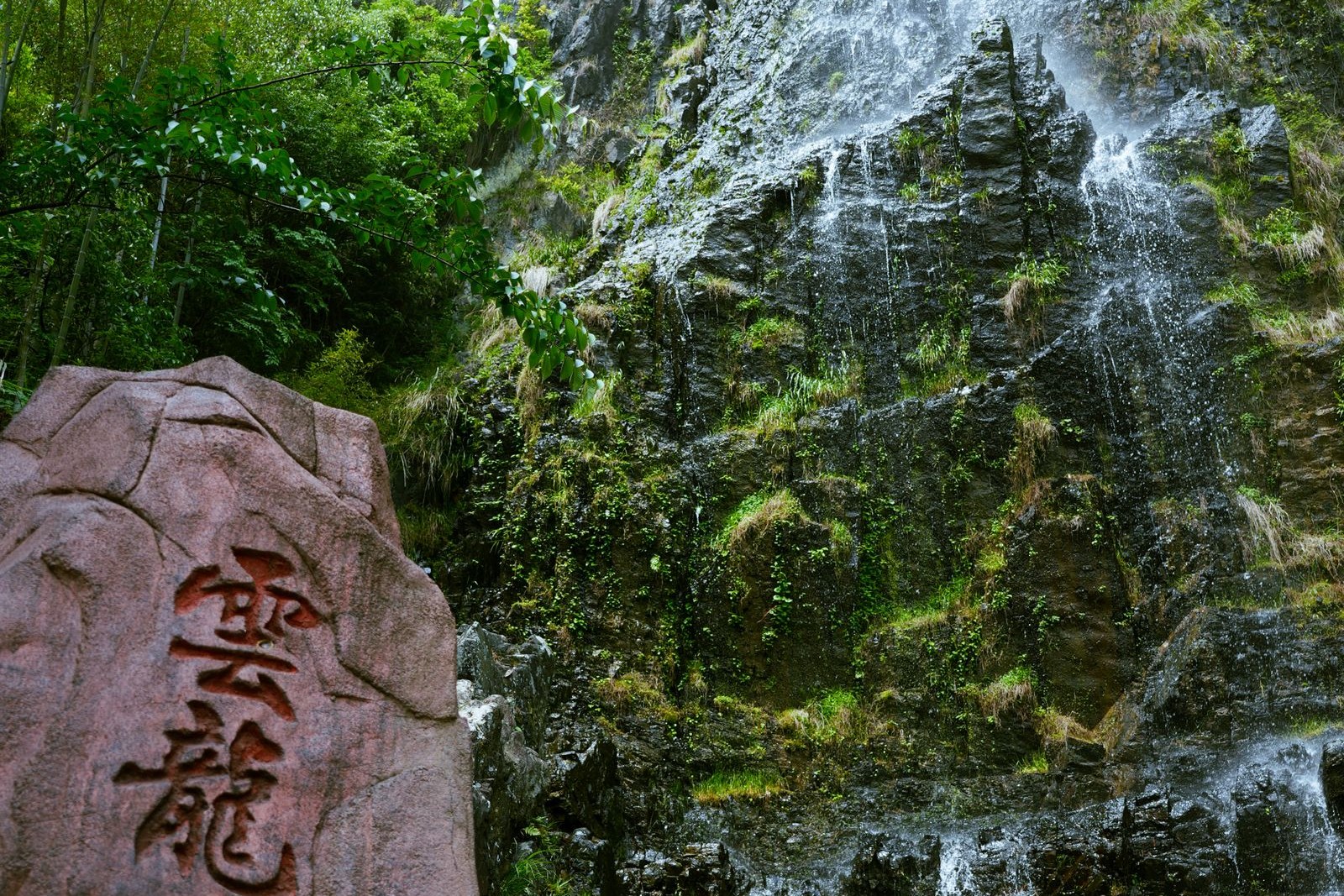
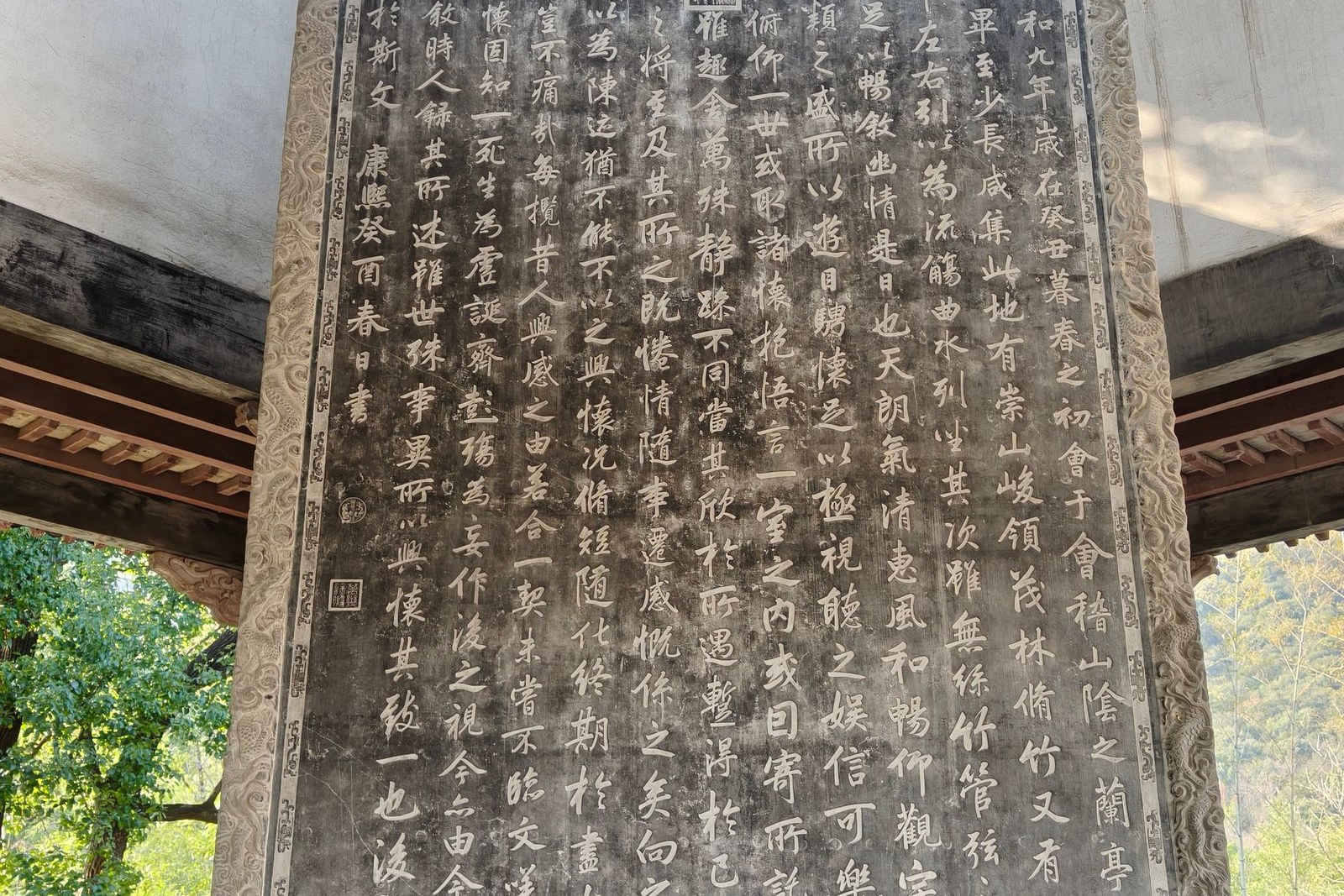
A limestone cliff above a river, and every square metre of it covered in writing for the length of a long walk. 浯溪碑林 Wúxī Bēilín, the Wuxi Stele Forest at 祁阳 Qíyáng, holds several hundred inscriptions cut into the rock over a span of more than a thousand years, in every size and hand, from imperial edicts to the graffiti of eighteenth-century officials. Some of it is enormous, characters two feet high and cut deep enough to hold a shadow at noon. Some of it is tiny and almost worn away. And among all of it, at the centre, is the thing everyone comes for: a single text cut into the cliff face in 771 that is usually described as the greatest piece of calligraphy in Chinese history that was ever carved outdoors.
The text is 大唐中兴颂 Dà Táng Zhōngxīng Sòng, the Ode on the Restoration of the Great Tang, written by 元结 Yuán Jié, a poet and official who had been posted to this stretch of the Xiang River, and written out in the hand of 颜真卿 Yán Zhēnqīng, the greatest of the Tang calligraphers after Wang Xizhi and the one whose style every educated Chinese person has copied at school. 元结 had the piece carved on the cliff at 浯溪 Wúxī, a stream he had named himself — 浯 wú being, by his own account, a character he more or less invented for the purpose — and the result is the piece that gives the site its three-character reputation: 文奇、字奇、石奇 wén qí, zì qí, shí qí, marvellous writing, marvellous calligraphy, marvellous stone.
The rest of the cliff grew around it over the following millennium. Officials posted to Hunan came to see the Yan Zhenqing and, having come, added their own inscriptions; there are pieces by Song, Ming and Qing hands, poems, colophons, records of repairs and, in one case, an emperor’s response. The density is what makes the place startling — this is not a museum with a few objects, it is a riverbank that has been used as a guestbook by the literate elite of China for a thousand years, and the guestbook is the exhibit. There is also a set of 石镜 shíjìng, stone mirrors, and a small hall with rubbings and explanations. Bring a guide or a translation app; without the text the cliff is beautiful but mute.
Practicalities
Tickets. Around ¥40–60 for the 浯溪碑林 Wúxī Bēilín scenic area, which includes the cliff, the river frontage and the small exhibition halls.
Opening hours. Roughly 08:00–17:30. The light on the cliff is best in the morning, when the sun is low enough to throw shadows into the cut characters instead of flattening them out.
Closing day. No closing day. It is open every day; January and February are cold and wet but the site is almost empty.
Getting there. 祁阳 Qíyáng is on the high-speed line between 长沙 Chángshā and 永州 Yǒngzhōu; the 祁阳站 Qíyáng Zhàn is about 15 minutes and ¥30–50 by taxi from the site. From 永州 Yǒngzhōu city it is about 50 kilometres and an hour by road.
What People Get Wrong
They photograph the big Yan Zhenqing panel from the front in the middle of the day and leave in twenty minutes. The site is a riverbank walk of more than a kilometre; the later inscriptions in the smaller hands, including some startling Ming and Qing pieces, are further along and almost nobody sees them. Give it two hours and go slowly.
Getting there
It is an easy half-day from 永州 Yǒngzhōu or a stop on the rail line between Yongzhou and Changsha. Combine it with 祁阳曲米鱼 Qíyáng qūmǐ yú, the fermented rice fish of the same town, which you can buy in the market five minutes away, and with 零陵 Línglíng and its 柳子庙 Liǔzi Miào, half an hour downstream.
flowcloud would say that a cliff which has been signed by a thousand years of officials is a very Chinese kind of monument — nobody came to build anything, everybody came to write something, and the accumulation turned a stream bank into the densest piece of calligraphy in the country.
Getting there: 浯溪碑林 (Wúxī Bēilín), 祁阳市 (Qíyáng shì), 永州市 (Yǒngzhōushì), 湖南 (Húnán). Open daily 08:00–17:30, no closing day, entry ¥40–60. About 15 minutes and ¥30–50 by taxi from 祁阳站 (Qíyáng Zhàn). Go in the morning for the light in the carved characters, and allow two hours.