
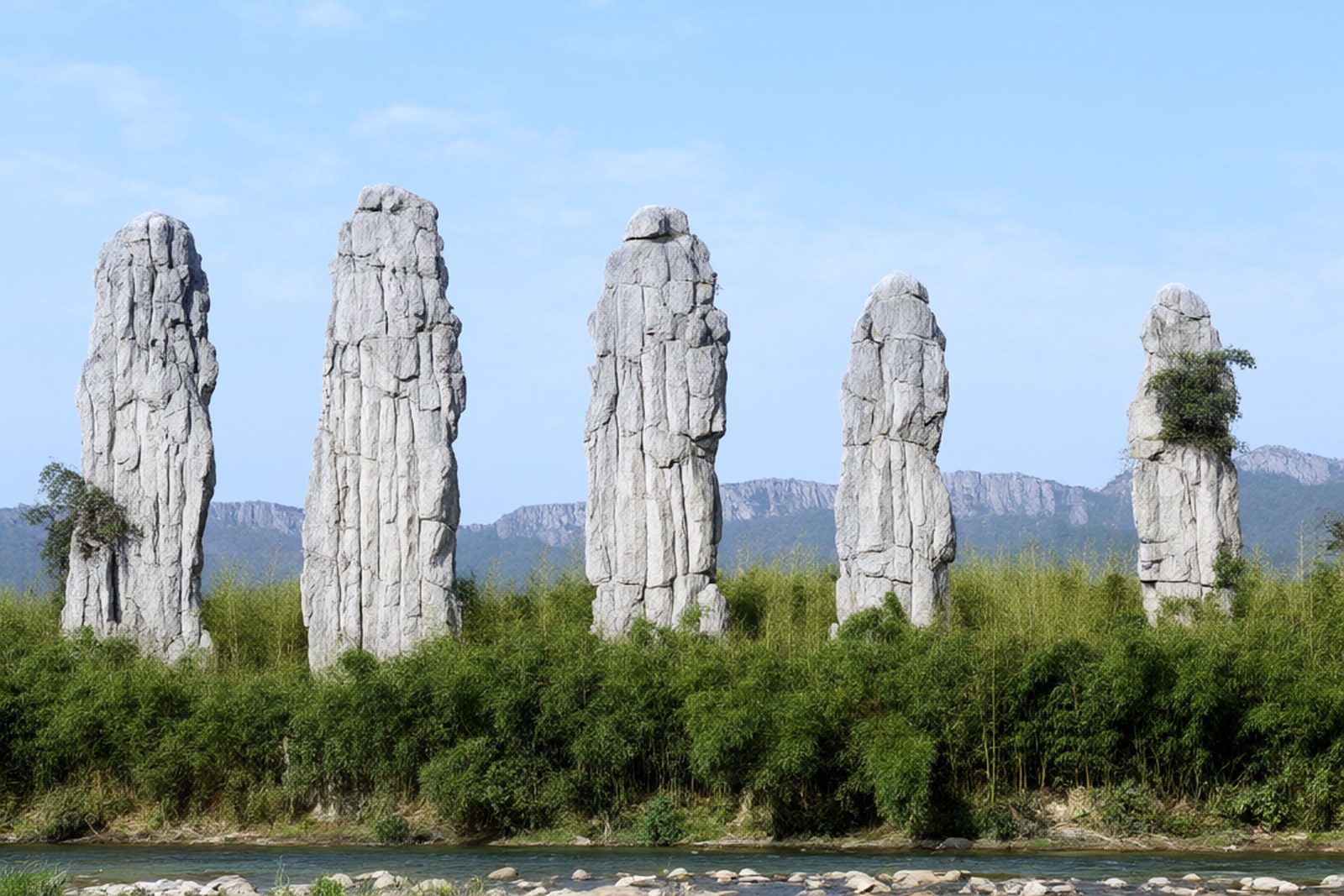
Five fingers, and the name is not a marketing decision. 五指石 Wǔzhǐshí is a group of upright rock pillars in 差干镇 Chāgān Zhèn at the northern edge of 平远县 Píngyuǎn Xiàn, in the far north of 梅州 Méizhōu, and the massif is split by vertical joints into five tall columns that stand side by side above the river, close enough to the shape of a hand that nobody has ever needed a second name for them. The rock is grey, coarse and jointed rather than smooth, and the formations continue along the ridge in smaller groups, so the five fingers are the headline rather than the whole site. What makes the place unusual in Guangdong is not the rock but the position: this is the southern tail of the 武夷 Wǔyí range, the hills that separate the province from 江西 Jiāngxī, and the weather, the vegetation and the sense of being at the edge of the province all belong to that geography rather than to the delta.
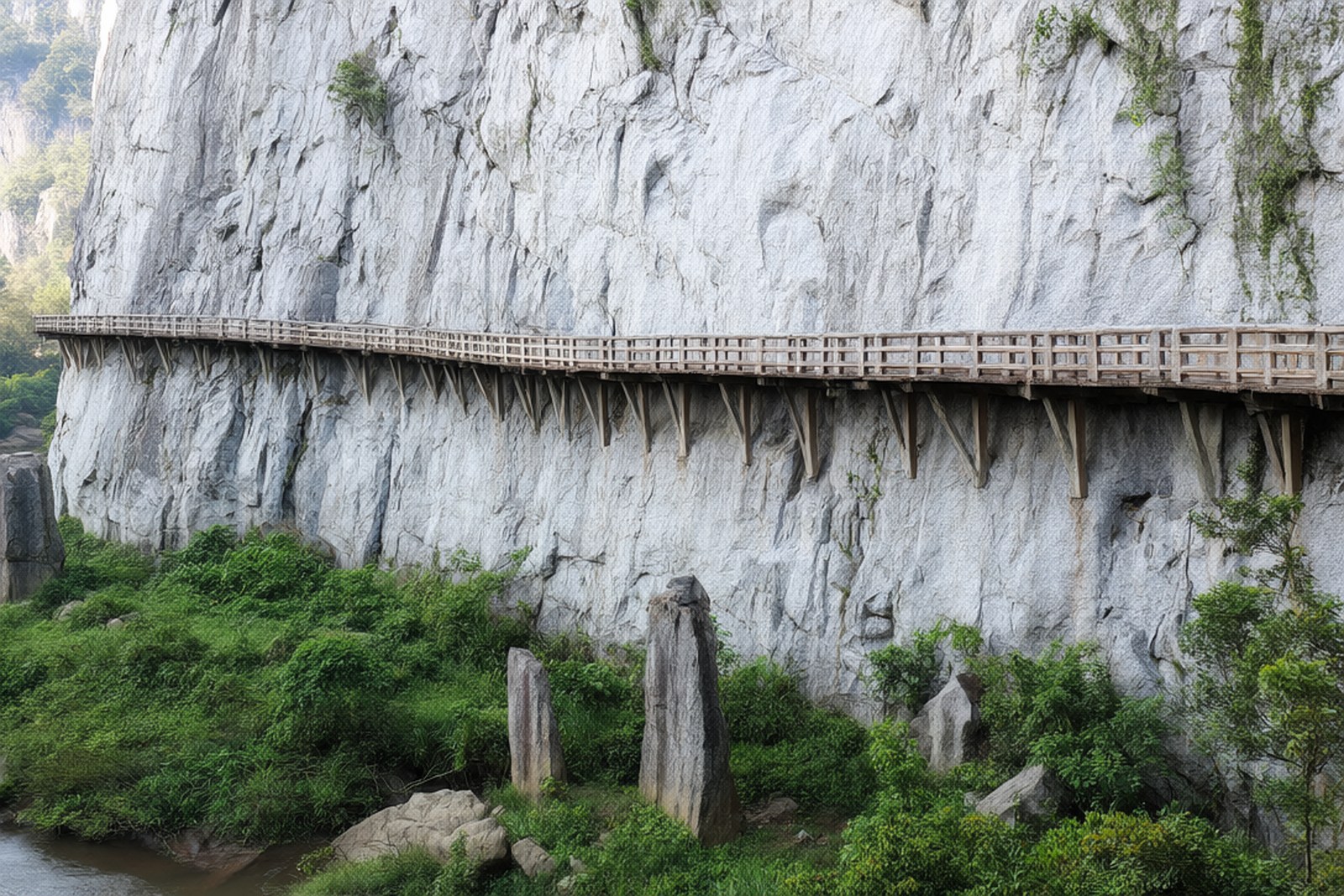
The site is a provincial scenic area and it is organised like one: a ticket gate, a shuttle, a network of stone steps and a system of cliff walkways. The walkways are the reason people talk about it. A long 栈道 zhàndào is bolted to the vertical face of the rock at height, part timber and part glass, and walking it takes you around the shoulder of the pillars with the valley floor a long way below and nothing between you and it but the structure you are standing on. The glass sections are optional detours, well signposted, and the timber ones are perfectly solid. If heights are not your subject, the lower paths reach the same viewpoints by a longer route through the forest.
The rest of the massif rewards an hour of walking rather than a photograph. 石林寺 Shílín Sì, the Stone Forest Temple, sits under the rocks and is a working temple rather than a monument, with the usual arrangement of halls and a spring behind it that the site claims is good for the eyes. Narrow slots run between the pillars, one of them famous enough to be called 一线天 yīxiàntiān, a line of sky, and the forest between the rock groups is dense enough that the temperature drops several degrees as soon as you leave the exposed ridge. In spring the hillsides carry camellias and the local 青梅 qīngméi plums are in flower, which is when the county looks its best.
Practicalities
Tickets. About ¥80 for the scenic area including the shuttle, with the cliff walkways included. Glass-walkway sections are free but require shoe covers, which are handed out at the entrance to each. Prices are raised occasionally around national holidays.
Opening hours. Roughly 08:00 to 17:30 daily, with the last shuttle up leaving well before closing. The walkways close in high wind or heavy rain, which happens most often in the summer typhoon season; ask at the gate before buying a ticket if the forecast is poor.
Getting there. 差干镇 Chāgān Zhèn is in the north of 平远县 Píngyuǎn Xiàn, roughly two hours by road from 梅州市 Méizhōu Shì and about forty minutes from 平远 Píngyuǎn town. There is no railway station in the county; buses run from the 梅州 terminal to 平远 and then on toward 差干, but the connections are slow, so a car or a hired driver is the practical way. The site is close to the 江西 Jiāngxī boundary, which is why the road in climbs for the last half hour.
Closing day. No closing day: the scenic area is open every day of the year, though individual walkway sections can be shut for maintenance without notice.
Reading the Rock
The pillars are the product of two things happening to the same block of rock over a very long time. The massif was intruded as a body of coarse granite and then cooled slowly enough to develop a set of vertical cooling joints, which is why the rock splits into columns rather than crumbling. Weathering since then has worked along those joints, widening them and deepening the gaps, and running water has done the rest at the base. The result is a group of towers that are still, structurally speaking, one body of rock with slots cut through it, which is why they stand so close together and why the gaps between them are straight and parallel instead of random. The red colour that visitors sometimes expect from Chinese rock scenery is absent: this is grey stone, with black water stains down the faces and green plants in every crack that will hold soil.
Words and Names
五指石 Wǔzhǐshí is the name: 五 wǔ five, 指 zhǐ fingers, 石 shí stone. 栈道 zhàndào is the cliff walkway, originally a plank road and now also used for these bolted steel-and-timber structures. 一线天 yīxiàntiān is the narrow slot between rocks, literally a line of sky; 石林寺 Shílín Sì is the Stone Forest Temple; 青梅 qīngméi is the green plum grown in these hills. 平远 Píngyuǎn is the county, 差干 Chāgān the township, and 梅州 Méizhōu the municipality.
flowcloud would say that 五指石 is the reverse of most Chinese scenic areas, since the crowds come for the walkway bolted to the cliff and the cliff is the older and better piece of engineering.
Getting there: by road to 差干镇 Chāgān Zhèn, 平远县 Píngyuǎn Xiàn, about two hours north of 梅州市 Méizhōu Shì and forty minutes from 平远 town; there is no station, so a car or a hired driver is the practical option. Arrive at opening to walk the cliff path before the shuttle crowds build, take the lower forest route if the walkways are closed, and give the temple and the 一线天 yīxiàntiān slot time on the way down.