
Xian’an Stone Forest, the Karst Garden of Maogan
Xian’an Stone Forest lies in Maogan Township in the far west of the county, about 37 kilometres from the county seat, in a fold of hills where the rainforest gives way to limestone. The site runs to some 600 mu of pinnacles and slots, and its entrance now sits directly on the Baoting section of the Rainforest National Park scenic loop road, which is the single biggest change for visitors in years: what used to be a rough hill track is now a signed drive. The stone forest is a rare thing in Hainan, a tropical karst landscape wearing a full canopy. As the geographer Zhao Zhizhong of Hainan Normal University puts it, wherever there is limestone in Hainan there is karst – and here the limestone stands exposed in blades rather than buried.
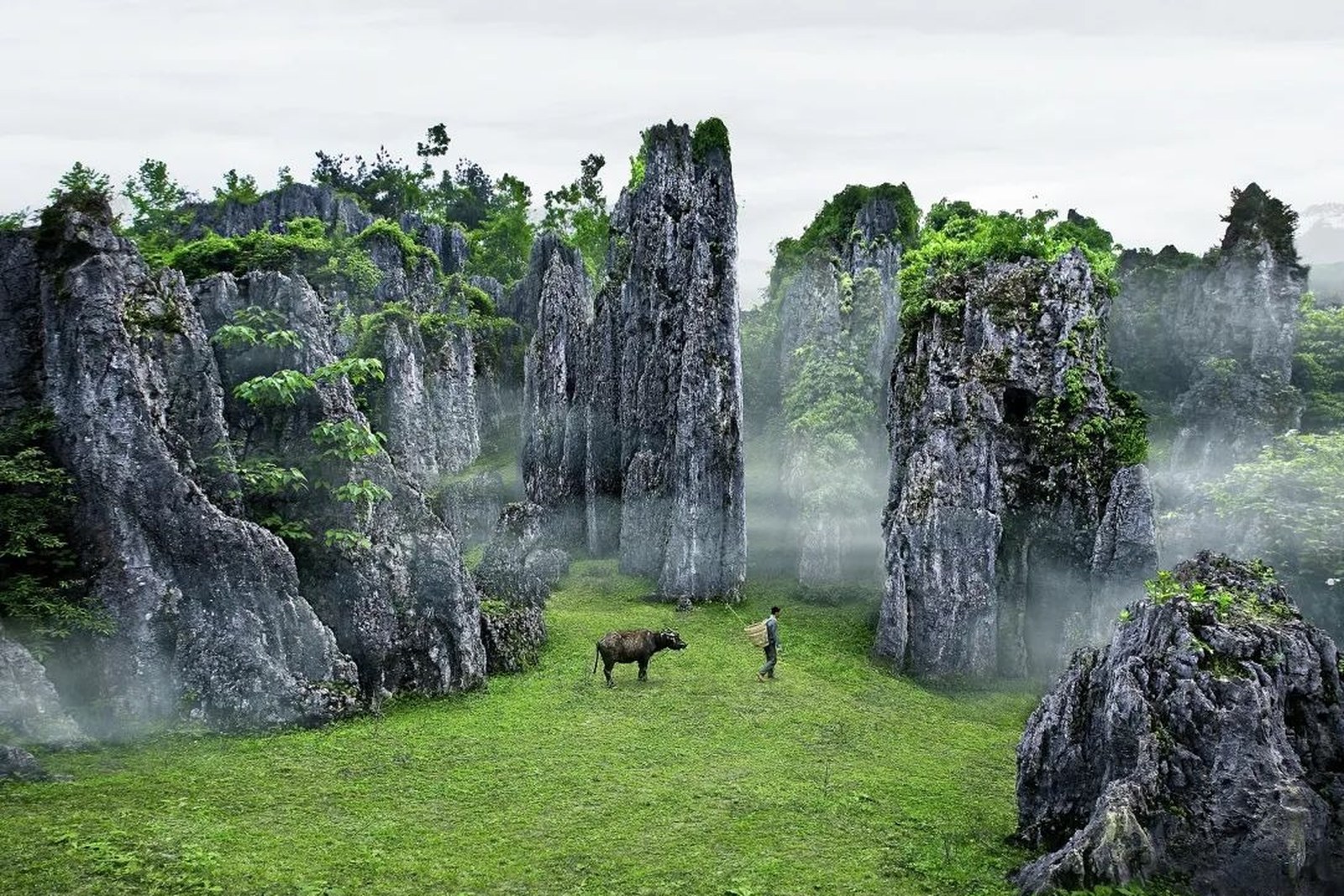
The geology is a story of a sea that became a mountain and then a garden. The limestone began as marine sediment, was lifted and folded, and then spent millions of years being cut by running water, which carves the surface into ridges, needles and blades and the subsurface into caves. At Xian’an the solution slots between the blades reach as deep as 25 metres and the residual rock teeth stand as high as 35 metres, with vegetation over about 70 per cent of the ground, giving the low-mountain rainforest look that the county says filled a gap in China’s karst inventory: a stone forest under tropical rainforest. The difference from the famous stone forests of Yunnan is contained in the word tropical. Heat and heavy rain speed the chemistry, and the shapes come out sharper, greener and more heavily overgrown than their temperate relatives.
A few kilometres away, and geologically part of the same story, is the cave system the county knows as Qianlong Cave, also called Xianlong Cave. The county government puts its length at 23 kilometres, a single-source figure that no second authority repeats, so it is best quoted as the official measurement rather than a surveyed fact. Inside, the report from a 2025 visit describes stalactites, stalagmites and stone columns, with bats hanging from a rock dome tens of metres overhead, and an underground river crossing the floor on its way to feed the Ningyuan River – the water that surfaces in the gorge outside the cave mouth, a hundred metres down a path from the entrance. Around the main cave cluster are smaller chambers – Xiaoqianlong, the Fairy Cave and Panlong Cave among them – some big enough for several hundred people, and in the 2016 accounts boats could be rowed on the river below.
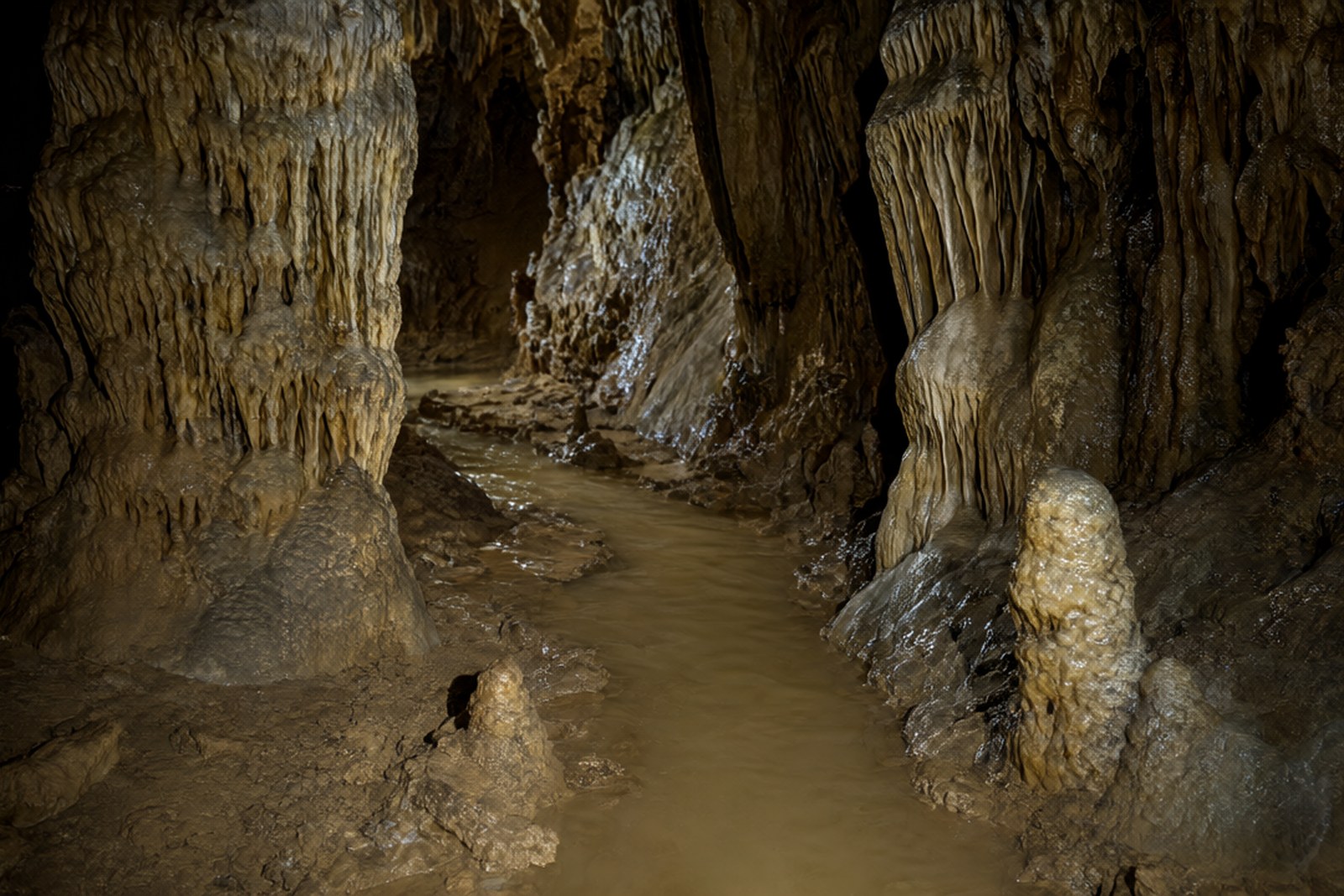
What visitors will not find is a developed attraction. Xian’an has no walls, no ticket office and no management buildings; it is an open natural site, and the commercial listings that carry it price entry at zero. A reporter who walked the cave in 2025 described the experience plainly: damp cool air at the mouth, every step taken carefully, and a torch the only thing that showed the way. The village memory belongs to Huang Yufang, deputy head of the Qianlong village group in Nanhao village, who told the paper that local children played in the caves and that nobody knows where they lead. The formal product around the site dates to 2016, when an official self-drive itinerary offered a 300-metre zipline, a Bailong cave walk and some rock climbing – projects whose current status is unconfirmed, so go expecting paths, rock and water rather than rides.
Treat this as a half-day for independent explorers, not a stop on a coach tour. Allow one to two hours for the stone forest and one to two for the cave, wear shoes that grip wet stone, carry a torch and a spare, keep long trousers for the scrub, and go in company rather than alone. The ground is slick for days after rain, so the dry season from November into April is the sane window. The county’s own 2016 pairing put the stone forest and the cave on one day with a hot-spring soak back at Qixianling, and that still holds. Note too the quirk of the underground river: the water lost under Maogan belongs to the Ningyuan River, which runs to Sanya and the sea, so a stream you hear in a Baoting cave ends up on a Sanya beach.
Practicalities
Tickets. Free. Xian’an Stone Forest is an open natural site with no ticket office and no ticketed scenic-area status, and the cave is the same; there is nothing to buy at the gate because there is no gate. Checked October 2026, subject to change.
Opening hours. The site is open ground, reachable at any hour, but the practical hours are daylight: the cave and the crevices cannot be attempted in the dark, and both need a torch and a companion even by day.
Closing day. No closing day – nothing closes, because nothing is managed. The real calendar is the weather: the dry months from November into April are comfortable, and the wet season leaves the rock greasy underfoot.
Getting there. Self-drive is the only practical access: from the county seat take the county road in the X620 direction toward Maogan, about 37 kilometres and fifty minutes to an hour, and the Rainforest National Park loop road brings you to the stone forest entrance itself. Qianlong Cave sits on the X620 about seventy metres northwest of the Maogan township government. No public bus or scheduled transport reaches the site, so a charter car or your own vehicle is the plan; the 37-kilometre figure dates from 2016 and the loop road may have shortened the drive.
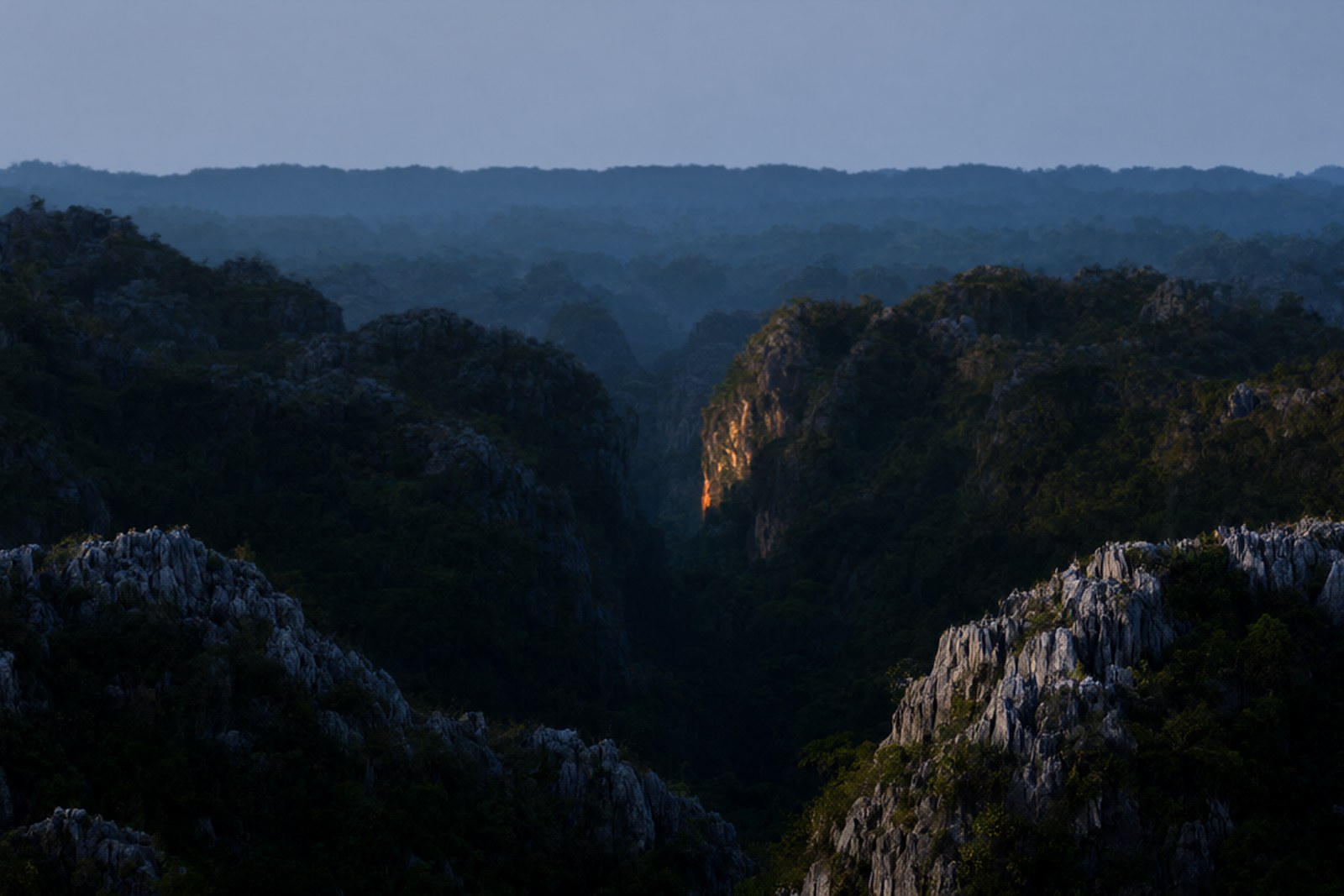
flowcloud would say that Xian’an is the county’s wild card – a stone forest under a rainforest, a river that disappears in one county and surfaces in another – and that the best thing about it is that nobody has yet put up a gate.
Getting there: Xian’an Stone Forest lies in Maogan Township, western Baoting Li and Miao Autonomous County, Hainan, about 37 kilometres from the county seat by the county road in the X620 direction, with the entrance on the Rainforest National Park loop road and Qianlong Cave (also known as Xianlong Cave) on the X620 northwest of the township government; entry is free with no ticket office, there are no fixed hours and no closing day, and self-drive or a charter car is the only way in (checked October 2026, subject to change).