
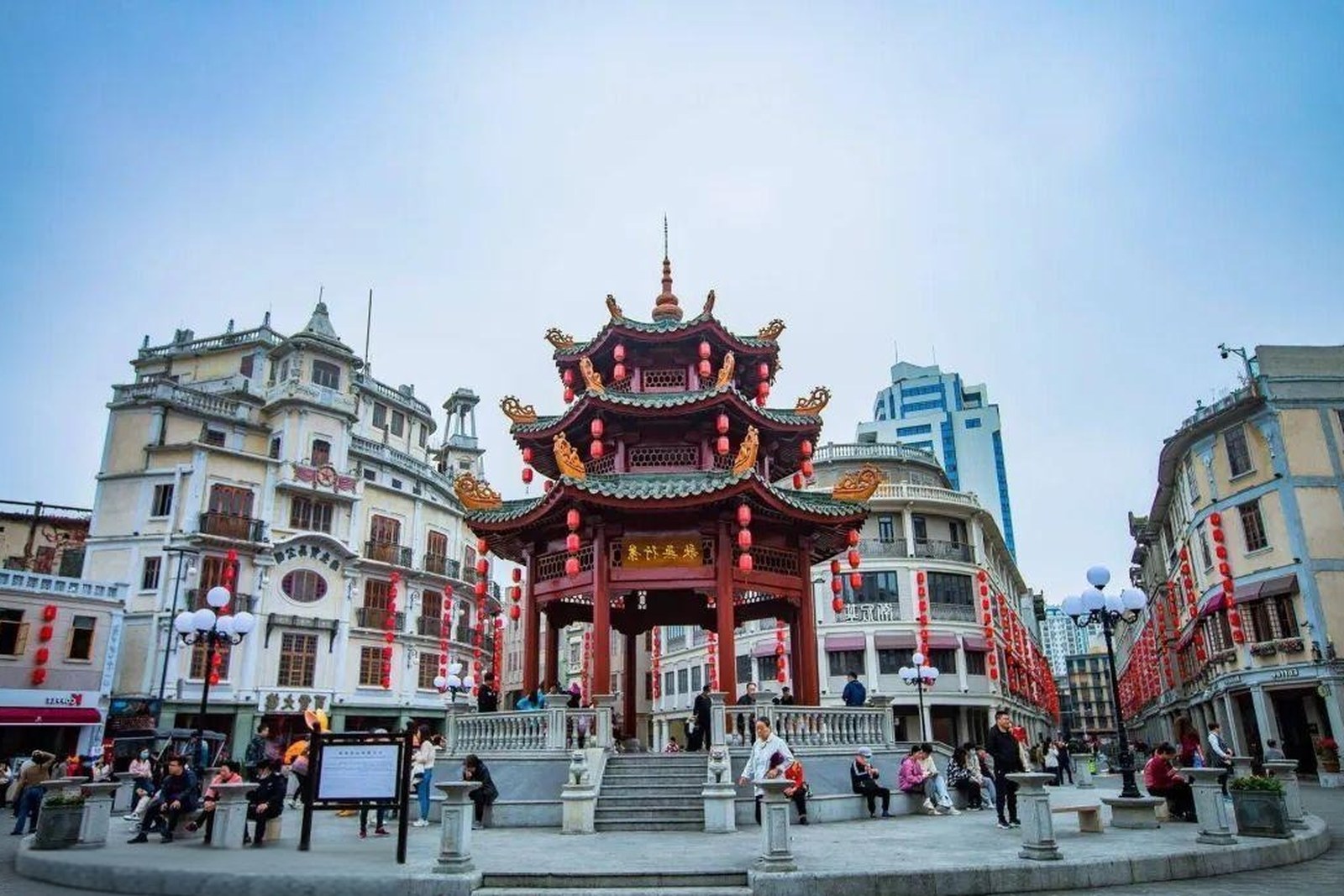
The pavilion at the centre of it is a reconstruction and the streets around it are not. 小公园 Xiǎogōngyuán, literally the small park, is the pivot of old 汕头市 Shàntóu Shì: a ring of streets laid out from the 1920s onward with a memorial pavilion at the hub and a radial grid of arcade shophouses running away from it in every direction. What you see standing there today is a restored quarter rather than an abandoned one, and it is worth being precise about that, because the restoration has been extensive. The facades have been repaired, the colonnades cleared, the shopfronts rebuilt to a common standard, and the whole district turned back into a place where people shop rather than a set that tourists photograph. The effect is honest and slightly strange at once: a continuous run of 骑楼 qílóu arcades, several blocks long, in better repair than most working buildings ever are.
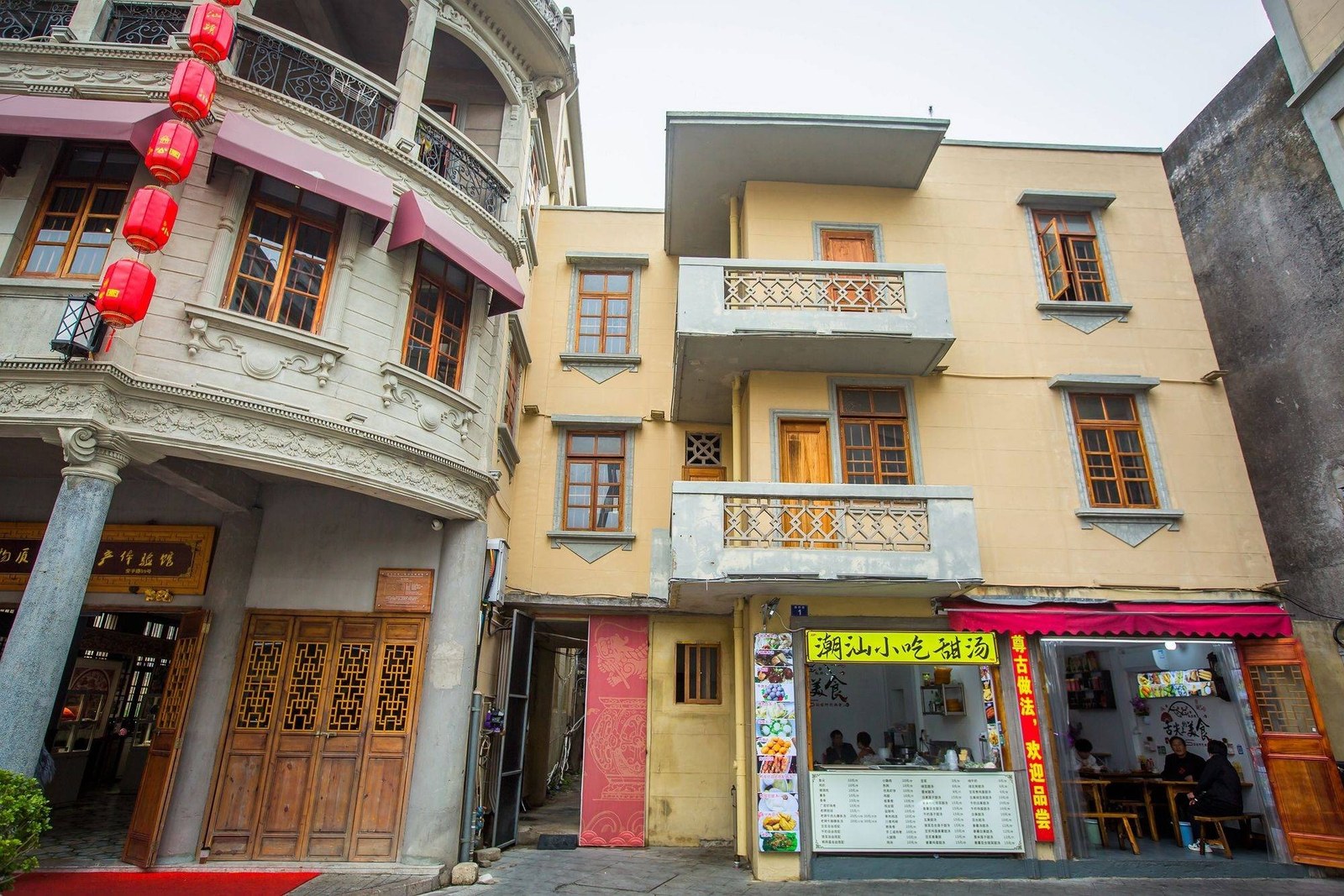
The district exists because of the port. Shantou was opened as a treaty port in 1860, and by the early twentieth century it was one of the busiest in southern China, with shipping lines to Southeast Asia and a steady flow of emigrants leaving through it and money coming back. The merchants who profited built the arcades, and the arcade form itself is the giveaway: it came from the Straits Settlements and the colonial cities of Southeast Asia, brought home by people who had seen it there. A colonnade along the ground floor keeps the rain off the pavement and the sun off the goods; the shophouse above it is one room wide and several deep; the whole street is a dense, shaded commercial machine. Walking it in the middle of a downpour is the quickest way to understand why it was built.
What You Actually See
The arcades are the main event, and the best way to see them is simply to walk the radial streets one after another rather than to look for a single address. The pavilion at the centre is the obvious meeting point and the surrounding streets fan out from it, each lined with continuous colonnades on both sides. Look up: the upper floors show the range of the period, from plain shuttered walls to stucco ornament, small balconies and corner turrets, and the variation between adjacent houses is the interesting part, because each plot had a different owner and a different budget. Look down at the pavement: it runs under the buildings, and the rhythm of the columns is what gives the district its scale.
A number of individual buildings have been restored as small museums or shops, including the 汕头开埠文化陈列馆 Shàntóu Kāibù Wénhuà Chénlièguǎn, the port-opening museum, which sets out the city’s history as a trading port with photographs and documents. The 中山纪念亭 Zhōngshān Jìniàntíng at the centre of the park is a memorial pavilion rather than an ancient structure, rebuilt in the restoration, and it functions as the landmark everyone navigates by. The surrounding blocks are a working commercial district, so you will find the restoration and a hardware shop and a noodle stall on the same street, which is the point.
Practicalities
Tickets. The district is a public neighbourhood and is free to walk through, at any hour. The small museums charge separately and modestly, generally ¥10 to ¥20, with the usual reductions for students, children and the elderly. There is no ticket for the arcades themselves and no gate to pass.
Opening hours. The streets are always open. The shops keep ordinary retail hours, roughly 09:00 to 21:00, and the restaurants run later. The museums keep museum hours, typically 09:00 to 17:00 with last entry in the afternoon, and most close on Mondays, which is worth checking before you plan a day around one of them.
Closing day. The public streets have no closing day. Individual museums and shops close on their own schedules, usually one weekday, and during 春节 Chūnjié and 国庆 Guóqìng week the district is extremely busy and some shops shut altogether, which is a mixed blessing: fewer services, but also a good deal of local life on the streets.
Getting there. The district is in the centre of 汕头市 Shàntóu Shì, in 金平区 Jīnpíng Qū, fifteen to twenty minutes by taxi from 汕头站 Shàntóu Zhàn, the railway station, and around forty minutes from 揭阳潮汕国际机场 Jiēyáng Cháoshàn Guójì Jīchǎng, the airport. City buses stop on the surrounding main streets. The old streets are narrow and largely one-way and there is very little parking inside the district, so arriving on foot or by taxi is much easier than driving.
flowcloud would say that the arcades are the rare piece of colonial architecture that a Chinese city has decided to keep for its own reasons, since the colonnade was borrowed from Singapore and then made indispensable by the Shantou rain.
Getting there: on a weekday morning, starting at the pavilion and walking one radial street at a time outward rather than criss-crossing, which is how the grid is meant to be read. Stop for a bowl of 粿条 guǒtiáo at one of the shops on the ground floor, look at the upper floors rather than the shopfronts, and leave the museums for the afternoon when the light on the facades has gone flat.