
Xinglong Tropical Botanical Garden
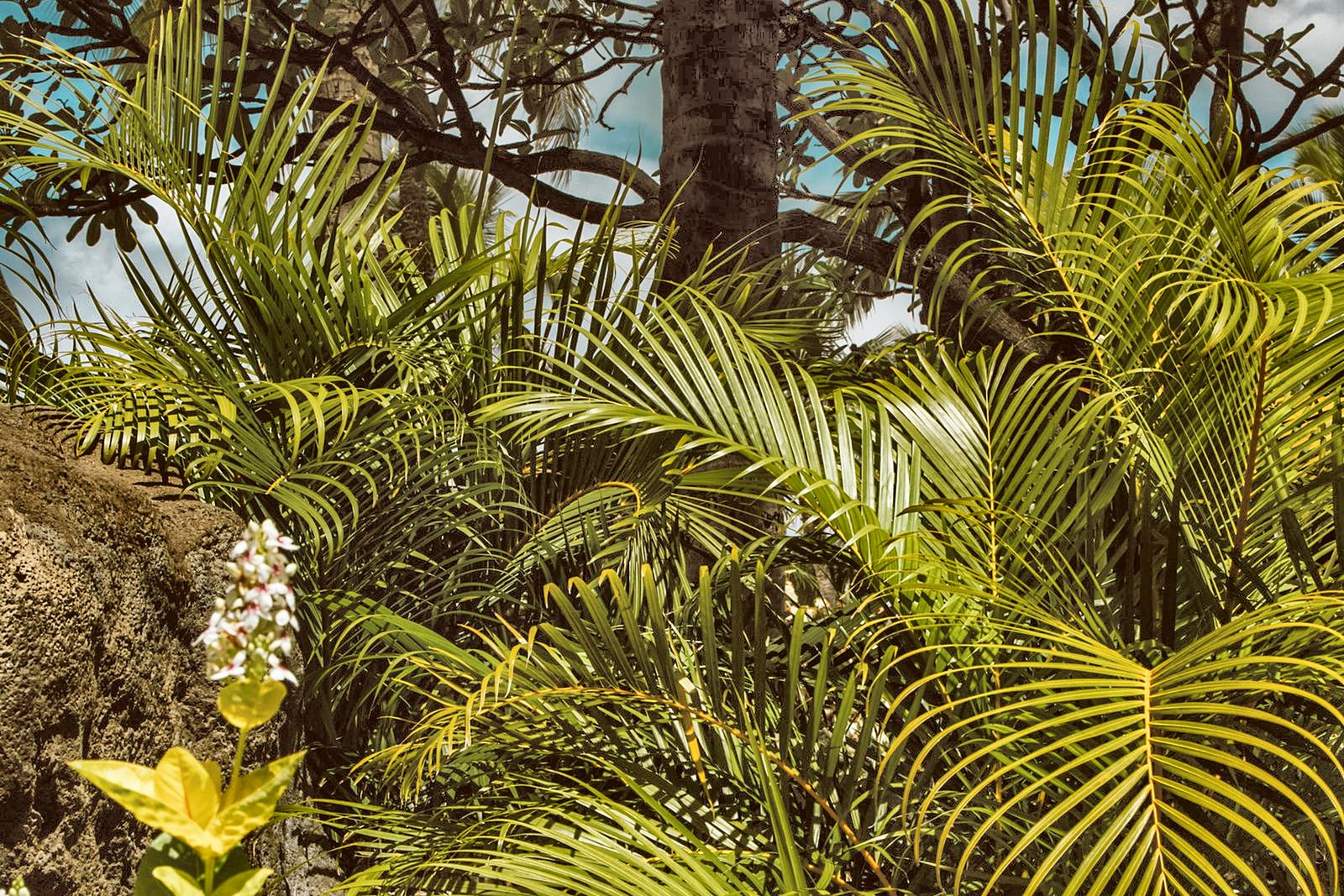
The first thing you notice is that nothing here is tidy in the way a European botanical garden is tidy. There is no lawn, no bedding scheme, no gravel path leading the eye to a folly. There is a path, and on both sides of it everything is growing over everything else — palms the size of umbrellas, vines making a grab at your shoulder, a plant with leaves that look like a fan that has been folded and refolded, and somewhere overhead a tree you cannot see that is dropping something onto the concrete. It smells green and wet. Within about ten minutes of walking your shirt is sticking to your back, and you stop minding.
兴隆热带植物园 (Xīnglóng Rèdài Zhíwùyuán) is a genuine scientific botanical garden, run by the Chinese Academy of Tropical Agricultural Sciences, sitting in the hills inland from Hainan’s east coast at 兴隆 Xīnglóng, in 万宁 Wànníng. It holds something over 3,000 species of tropical plant across about 40 hectares. It is not a theme park. It is a working collection, and it happens to be one of the most pleasant places to spend a morning on the whole island.
Why It Exists
Xinglong is not a natural choice of location for a botanical garden — it is a hot, humid valley where the land was, for decades, given over to rubber and coffee.
The 兴隆 area is a 华侨 huáqiáo settlement: from the 1950s onwards it took in overseas Chinese returning from Southeast Asia — mainly from Indonesia, Malaysia and Vietnam, families displaced by the political upheavals of the region’s post-colonial years. They brought with them not just habits and recipes but seeds and cuttings: coffee, cocoa, vanilla, pepper, durian, mangosteen, and the whole toolkit of the tropical smallholder’s garden. Xinglong today is the only place in China where you will find a majority community of Southeast Asian returnees, and its food, its coffee (兴隆咖啡 Xīnglóng kāfēi is a genuine local appellation) and this garden all come from the same root.
So the garden is, in a real sense, a seed bank of that migration. That is why the collection is unusually strong on the useful plants of Southeast Asia rather than on showy ornamentals.
What You Actually See
The path loops through themed sections and you should let a guide walk you through at least part of it, because almost everything here is a plant you have eaten without ever having seen growing.
Cocoa is the revelation for most visitors. 可可 (kěkě) — the pods do not hang from the branches like apples. They grow directly out of the trunk and the thick main branches, on short stalks, a phenomenon called cauliflory, which looks flatly wrong the first time you see it: a heavy, rugby-ball-shaped pod, ridged and either deep red or yellow-green, attached to bare bark a metre off the ground. Inside the pod are the seeds in a white, sour-sweet pulp, and this is the raw material of all chocolate. Hainan grows cocoa commercially; most of China’s chocolate starts somewhere not far from here.
Coffee is the second. 咖啡 (kāfēi) bushes stand in rows under shade trees, and in season the branches carry clusters of small round fruit — green, turning yellow, then deep red — which are the coffee cherries, each with two beans inside. The Hainan bean is mostly robusta, grown low and hot, and it makes a strong, bitter, unfashionable cup that the locals are extremely attached to. You will be offered a taste of it.
香草兰 (xiāngcǎolán, vanilla) is the one that surprises people, because it is an orchid — a vine, not a bush — and it has to be hand-pollinated flower by flower, which is why real vanilla is expensive. Hainan is one of the few places in China growing it at scale, and the garden’s vanilla research is one of its actual institutional purposes.
Then there is the rest of the spice shelf: pepper vines climbing their poles, cardamom, nutmeg, cinnamon, cloves, and the curry-leaf and pandan and lemongrass that ended up in the region’s cooking.
And then the plants that are simply strange. The see-blood-seal tree, 见血封喉 (jiànxuèfēnghóu) — the name translates roughly as “seal the blood, stop the throat” — whose sap is a genuine and historically notorious arrow poison, and which stands behind a fence with a sign on it. The bottle palm, swollen at the base like a flask. Dragon fruit on its cactus-like stems. Jackfruit hanging off the trunk on its own account. The traveler’s palm, whose fan of leaves holds rainwater at its base and is said to have given water to travellers.
Halfway round there is usually a tasting stop where you are given small cups of the garden’s own coffee, 香草兰茶 (vanilla-leaf tea) and 苦丁茶 (kuding tea). It is a sales pitch, but the tea is good and nobody pressures you.
Practicalities
Tickets. Adults ¥41 to ¥50 depending on season — the official price list sets peak season (1 October to 30 April) at ¥50 and off-peak (1 May to 30 September) at ¥42, with the online platforms often a few yuan cheaper. Students and seniors aged 60 to 69 pay ¥25; children under 1.2 m or under six, and seniors 70 and over, go free; disabled visitors and serving police officers also enter free with ID. Electric shuttle inside the garden ¥20 all year, worth it if it is hot or you are with anyone who cannot do a long walk in humidity. Guided tour ¥50 for about an hour — genuinely worth it here, because a plant collection without explanation is just a lot of leaves. Packages combining entry with a coffee ticket, a tasting session or the children’s activities run from about ¥105 up to ¥258.
Do you need to book? No. It is a walk-up ticket office and it very rarely sells out. Booking online a day ahead simply avoids the queue in holiday weeks. The exception is the upgraded packages — the chocolate-making, coffee-roasting and “seed hunter” experiences have limited slots, so reserve those online a few days ahead if you want one.
Opening hours. 08:30 to 17:00, with last admission and last ticket sale at 17:00. Some older listings say 07:30 to 17:30, but 08:30 to 17:00 is what the garden itself publishes and what the ticket platforms honour. Open every day, no closing day.
How long. Two to three hours at a normal pace. Half a day if you take the guided tour, do a tasting and sit in the shade for a while — which you should, because the middle of the day here is punishing.
When to go. Early. The light is better, the birds are active and the heat has not arrived. It also rains a lot in Hainan from roughly May to October — not usually all day, but hard and suddenly — so a morning visit is the safer bet. The garden is green year-round and there is no bad season for it, though the peak-season ticket price applies from October.
Getting there. Xinglong sits on the G223 road in 万宁市兴隆镇, about 29 km from Wanning town.
- By high-speed rail: Hainan’s east-coast line runs to 万宁站 (Wanning). From Haikou it is roughly 59 to 95 yuan depending on class, 20 to 60 minutes apart; from Sanya roughly 40 to 65 yuan. From 万宁站, take bus 102 (海汽专线) to 兴隆, every 30 minutes, or a taxi for the 29 km.
- By bus: the 万城–南林 line from the old Wanning bus station runs to the garden, every 15 to 20 minutes.
- By car: from Haikou, take the Hainan East Line Expressway to the 莲兴 / 神州半岛 exit, then 兴梅大道, turn left at the 兴隆太阳河大桥, and follow G223. From Sanya, exit at 石梅湾, then the same route. Navigation to 兴隆热带植物园 is reliable. There is a car park at the gate.
What to combine it with. 兴隆 has hot springs and the town is built around them, so an afternoon at a 温泉 after a hot morning in the garden is the obvious pairing. 石梅湾 (Shimei Bay) and the 石梅湾/兴隆 coast are about 20 minutes east, and 东山岭 (Dongshan Ridge) is back towards Wanning. Most people visit Xinglong on the drive between Haikou and Sanya rather than as a dedicated stop, and it works well that way.
What to bring. Water, a hat, mosquito repellent and shoes you do not mind getting damp. And leave room in your bag: the garden shop sells its own coffee, vanilla tea and vanilla pods, and the coffee in particular is a real souvenir rather than a novelty.
Getting there: 兴隆热带植物园 (Xīnglóng Rèdài Zhíwùyuán), 万宁市兴隆镇223国道, 兴隆温泉旅游区, 万宁 (Wànníng), Hainan — about 163 km from Haikou and 97 km from Sanya. Hainan East Line high-speed rail to 万宁站, then bus 102 to Xinglong every 30 minutes or a taxi for the 29 km; by car, take the East Line Expressway and exit at 莲兴 (from Haikou) or 石梅湾 (from Sanya), then G223. Tickets ¥42 off-peak (1 May–30 Sep) and ¥50 peak (1 Oct–30 Apr); students and seniors 60–69 ¥25; children under 1.2 m and adults over 70 free. Electric shuttle ¥20, guided tour ¥50. Open 08:30–17:00 daily, no closing day. Go early, take the guide, and pair it with the Xinglong hot springs.