
The hill is the crater of a volcano that has been dead for tens of millions of years, and it is now a park. 西樵山 Xīqiáo Shān rises out of the flat delta southwest of 佛山 Fóshān, roughly four hundred metres at its highest point, a circular mass of volcanic rock with a lake in the old caldera, forest on the slopes, temples in the gullies and a long history of visitors. It has been a place of pilgrimage and study since at least the Ming, and the marks of that are still on it: cliff carvings cut into the rock faces, a Confucian academy on the slope, temples and shrines at various heights, and paths cut as stone steps. From the top the view runs across the whole Pearl River delta, which is flat, waterlogged, densely built and almost without a horizon.
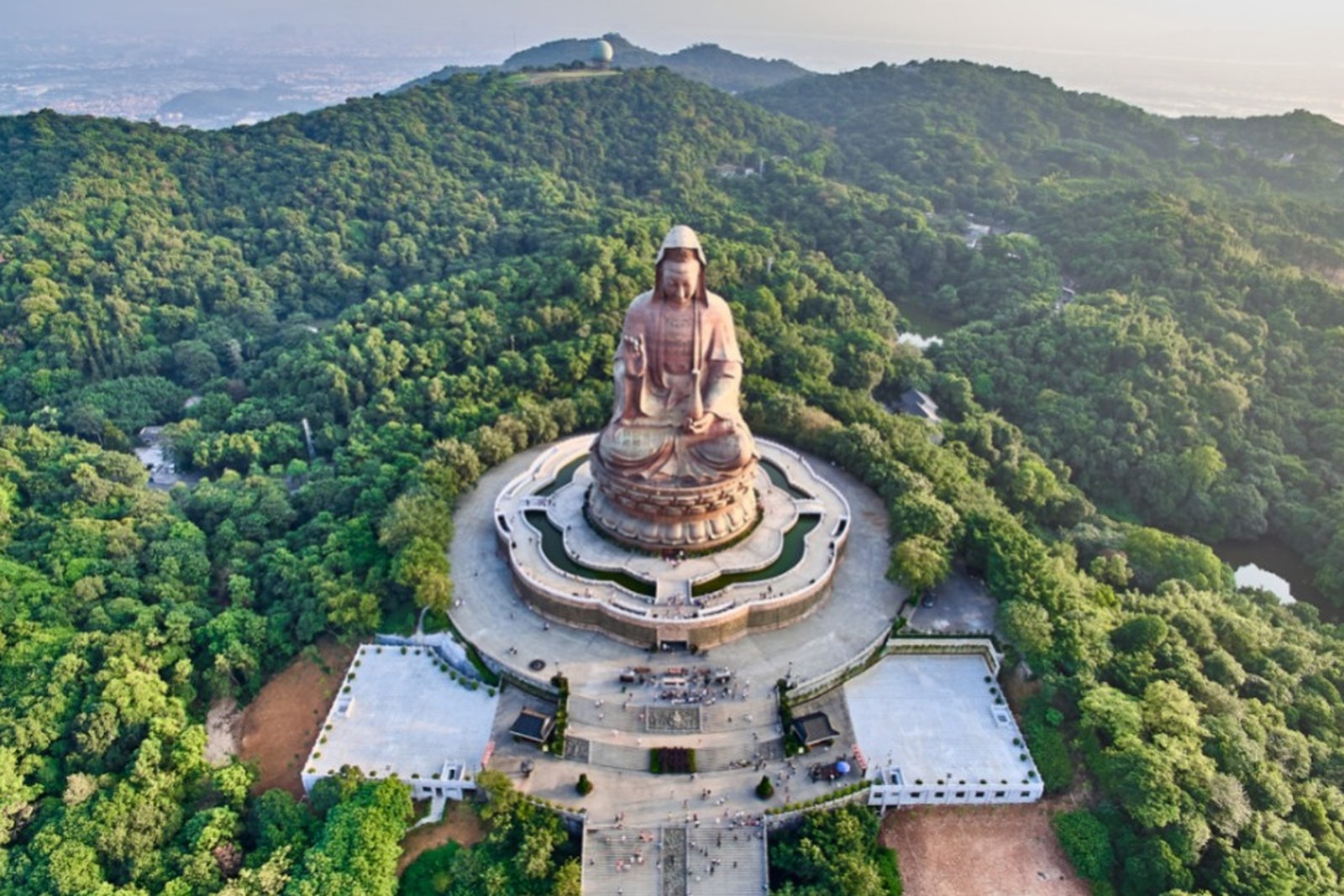
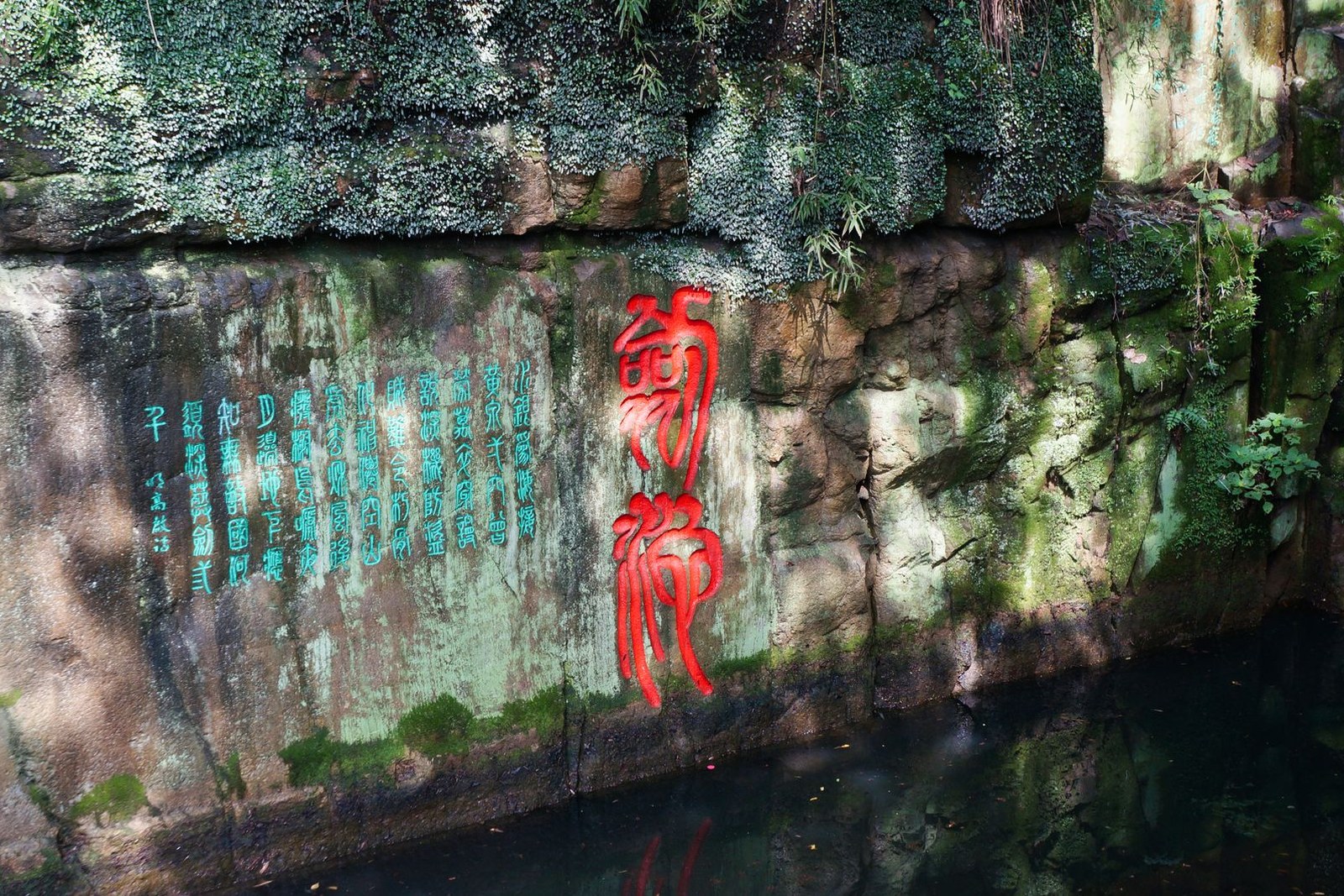
The mountain’s reputation rests partly on geology and partly on scholarship. The rock is volcanic tuff and breccia, quarried here since the Neolithic for stone tools, and the 石燕岩 Shíyàn Yán quarries and caves on the northern side are the surviving evidence of that industry, cut into the hillside as large chambers with pillars left standing to support the roof. The scholarly tradition is later: the Ming philosopher 湛若水 Zhàn Ruòshuǐ taught here, and his academy, together with the carvings left by generations of visitors, made Xiqiao a modest centre of learning in the delta at a time when the region had few. The carvings, several hundred of them on the cliff faces, are the most distinctive thing on the mountain.
What You Actually See
The mountain is large enough that most visitors use the internal shuttle or a car to move between the sections, which are spread around the slopes and around the lake in the crater. The 白云洞 Báiyún Dòng area, despite the name, is a valley of temples, pavilions and streams on the western side, and it is the most visited and the most built-up. The lakes in the crater, 天湖 Tiān Hú among them, are the quietest part and the best place to walk. The old quarries at 石燕岩 Shíyàn Yán are on the north side and involve a walk, and the summit, with its viewing platform, is the place to understand the delta.
The carvings are the thread that ties the mountain’s history together and are worth looking for on the rock faces along the main paths and especially in the 白云洞 valley, where they cluster. Allow a full day if you want to walk between sections rather than shuttle, and half a day if you use transport. The mountain is also the source of the local 西樵大饼 Xīqiáo dà bǐng, a large flat cake sold at the entrances, which is a bigger, plainer cousin of the Foshan biscuits.
Practicalities
Tickets. Admission to the scenic area is around ¥50 to ¥70 depending on the season and what is included, with reductions for students, children and the elderly. The internal shuttle and the cable car are charged separately, and the carvings, temples and lakes are all within the single ticket. Prices are set locally, so confirm at the gate rather than relying on older information.
Opening hours. The mountain is generally open from about 08:00 to 17:30, with last admission in the afternoon. The internal shuttle runs through the day and stops earlier than the gates. Because the mountain is wooded and the paths are unlit, an evening visit is not practical, and the best light on the delta from the summit is in the morning.
Closing day. There is no weekly closing day and the scenic area is open daily. Sections occasionally close after heavy rain, when the stone paths become slippery, and during typhoon warnings the whole mountain may be shut. During 春节 Chūnjié and the 国庆 Guóqìng week the car parks, the shuttles and the 白云洞 valley are very busy.
Getting there. 西樵山 Xīqiáo Shān is in 南海 Nánhǎi, in the southwest of 佛山 Fóshān, roughly an hour by road from the city centre and about forty minutes from 广州南站 Guǎngzhōu Nán Zhàn. Buses run from the Foshan and Guangzhou bus stations to the town at the foot of the mountain, and there are several entrances with car parks. A car or a taxi is much more practical than public transport for reaching the quieter north side and the quarries.
flowcloud would say that a dead volcano in the middle of the flattest landscape in China is the region’s best lesson in scale, since from the top the delta looks like what it is, a river system with a city poured over it.
Getting there: early, by car or taxi, entering on the west side and working the 白云洞 valley before the coaches arrive. Take the shuttle up to the crater and walk the lakes rather than the main road, look for the cliff carvings along the paths rather than only at the marked ones, and finish at the summit for the view over the delta, which is the reason the mountain was worth climbing at all.