
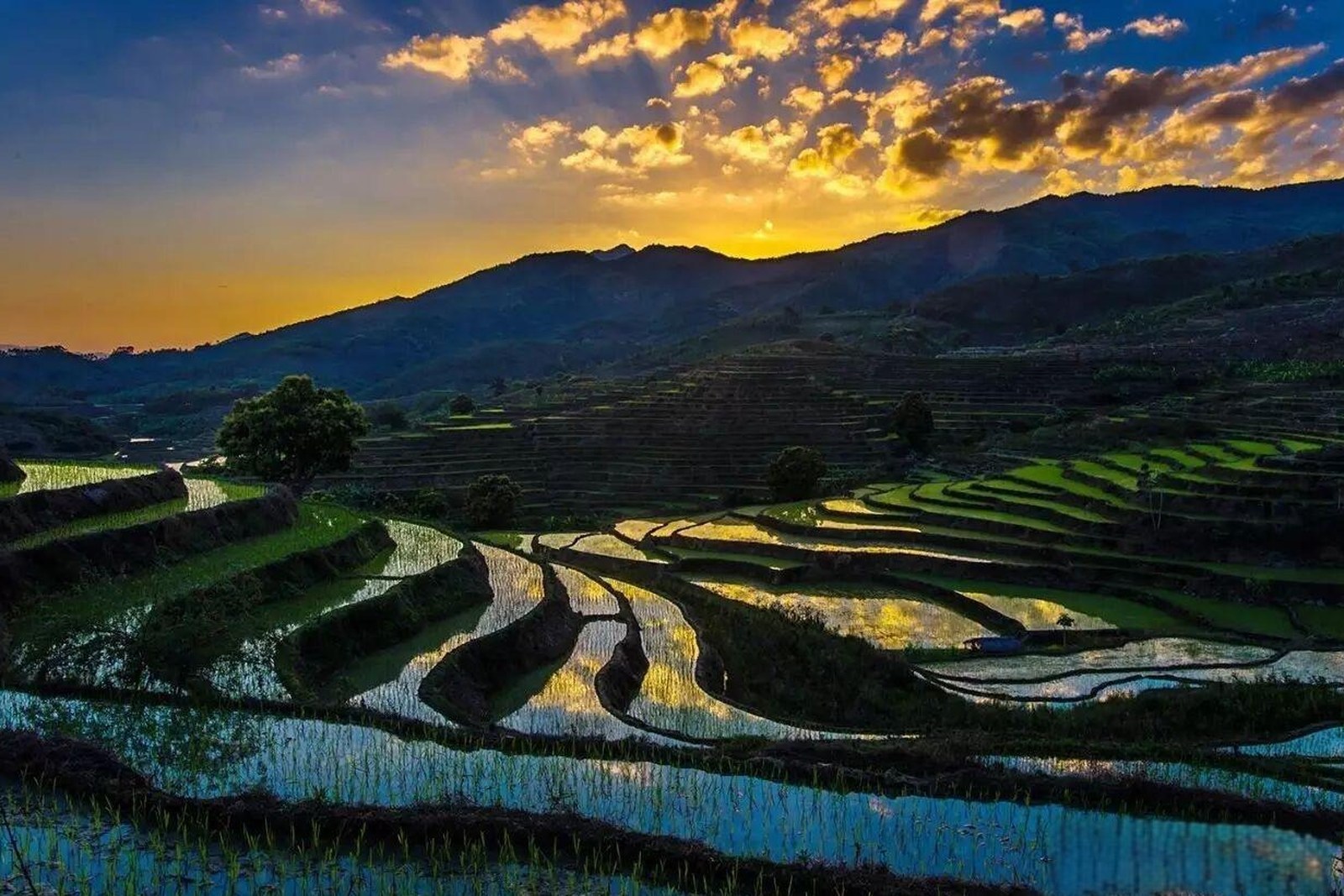
The road climbs through forest and then turns a corner and the whole hillside opens out into steps. Hundreds of them, stacked from the valley floor to the ridge, each one a shallow band of water held behind a wall of earth, curving with the shape of the slope so that the whole structure reads as a single set of contour lines drawn by hand. In February the terraces are flooded for transplanting and each step is a mirror, so the sky is repeated four hundred times down the hill, breaking into fragments wherever a farmer is walking along a bund with a hoe. In July the same slopes are solid green; in October they are gold and being cut. This is 牙胡梯田 Yáhú tītián, the Yahu rice terraces, in 毛阳镇 Máoyáng Zhèn on the western side of 五指山市 Wǔzhǐshān Shì, and the comparison people make — the ones in Yunnan, the ones in Guangxi — is a compliment that misses the point, because this one is on Hainan, an island nobody associates with hill farming at all.
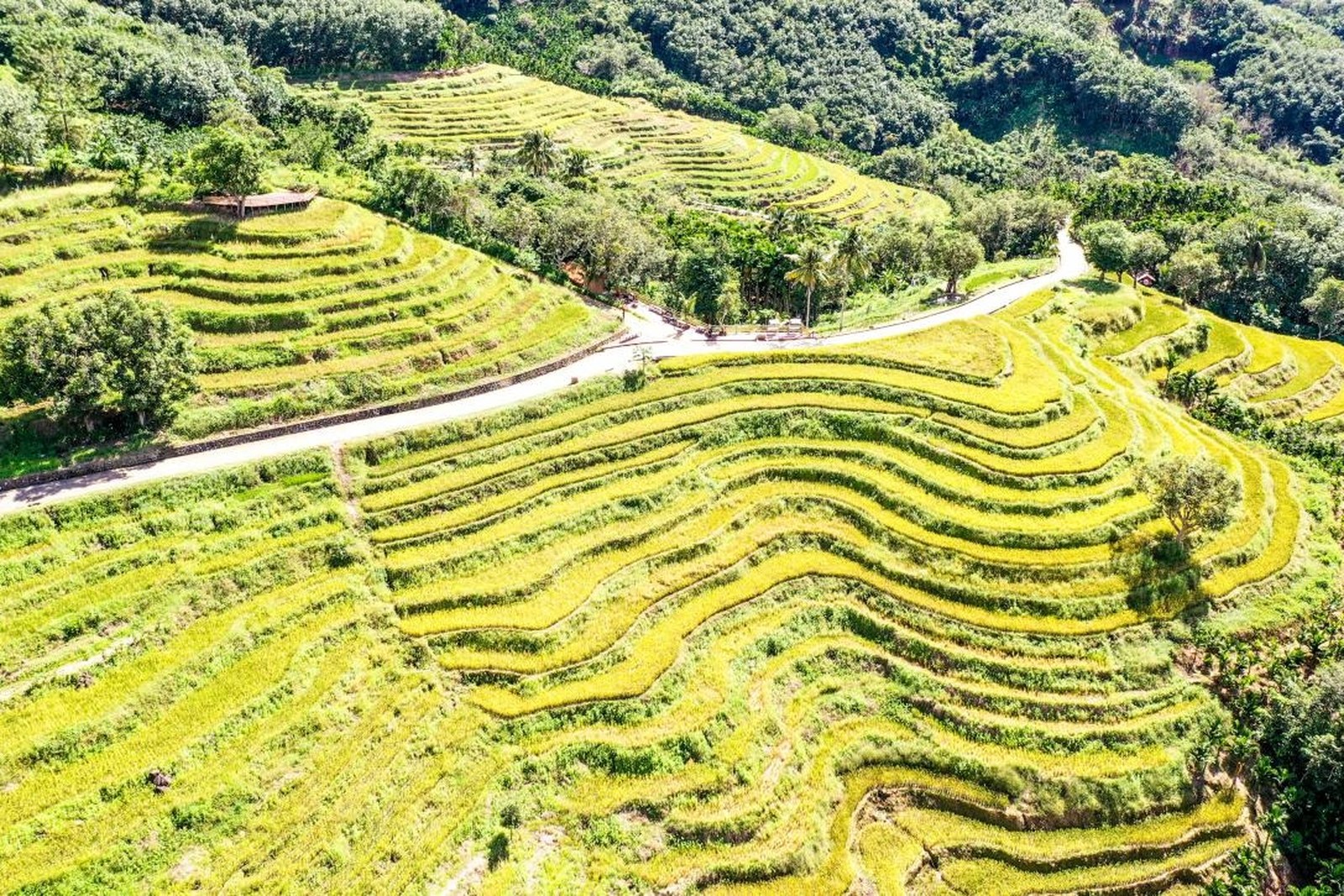
The terraces belong to the 黎族 Lízú villages of the 牙胡 Yáhú area, and the numbers attached to them vary depending on who is counting. Some accounts give the area as a little over 1,200 亩; the provincial write-ups give 2,700-odd 亩 with a vertical drop of more than four hundred metres between the lowest and highest fields, and something like 160 separate levels of terracing. What is not in dispute is that this is the largest and most completely farmed terrace system on Hainan, that it has been recognised as a Li agricultural heritage site, and that the farming calendar followed here — flooding, transplanting, weeding, harvesting, all of it done by hand on slopes too steep for machines — is the same calendar that has shaped Li village life in these hills for centuries. It is also worth being honest about scale: these are not the vast amphitheatres of the mainland’s famous terraces. They are tighter, smaller, closer, and framed by the 鹦哥岭 Yīnggēlǐng ridge on one side; the pleasure is the intimacy of the thing rather than its grandeur.
The practical structure of a visit is simple. There is a viewing area with a small shuttle service that runs visitors up through the terraces, and the road along the ridge gives you the classic panorama at the point where the valley bends. Down in the fields, farmers work in the way they always have; the terraces are productive land and not a maintained exhibit, and the villages behind them — including 牙胡村 Yáhú Cūn itself — are ordinary places with ordinary lives. Around fifteen kilometres away on the same road is 毛阳镇 Máoyáng Zhèn’s other claim to importance, the 五指山革命根据地纪念园 Wǔzhǐshān gémìng gēnjùdì jìniànyuán, the memorial to the guerrilla base that held out in these mountains for twenty-three years and raised the first flag of the People’s Republic on Hainan; the two together make a full day of the western side of the city.
Practicalities
Tickets. Entry to the terrace area is free. The shuttle that carries visitors up through the fields costs around ¥33, and there is a small parking charge if you drive yourself. Bring cash or a phone with a working payment app, because the ticket point is not always connected.
Opening hours. The terraces are farmland and have no gate; the shuttle runs daylight hours, roughly 08:30 to 17:30. The light is best in the two hours after sunrise, when mist sits in the folds of the valley, and in the hour before sunset, when the bunds cast long shadows across the flooded steps.
Closing day. There is no closing day. The season that matters is the farming one: the flooded mirror phase falls in the weeks around transplanting, usually February to April, the green phase covers May to August, and the harvest turns the slopes gold from September into October. Arrive in the wrong month and you will see brown earth, which is a fine thing to see but not what the photographs promised.
Getting there. 牙胡梯田 Yáhú tītián is about forty kilometres from the centre of 五指山市 Wǔzhǐshān Shì, on the road towards 毛阳镇 Máoyáng Zhèn, and the drive takes a little over an hour on mountain roads. There is no practical bus service to the viewing area, so drive or arrange a taxi for the round trip, including the wait. From 三亚 Sānyà the total distance is around a hundred and thirty kilometres.
flowcloud would say that the terraces are the one place in Hainan where the island admits it is a mountain, and that a hillside shaped entirely by hand over centuries is a better monument than most of what gets built deliberately.
Getting there: go for the transplanting weeks if you can, aim to be at the ridge before the mist lifts, and walk down one of the footpaths through the fields rather than looking at them from the road. Ask before photographing people at work, offer nothing for the picture, and remember that the water in the upper terraces is somebody’s drinking supply.