
The azaleas are the headline and they are worth the trip, but the thing that makes 阳明山 Yángmíng Shān unusual is that the flowers are on a mountain that has spent a thousand years being a place of religion, so the two most commonly photographed objects here are a red hillside and a temple bell. In late April the upper slopes of this massif in 双牌县 Shuāngpái Xiàn go from green to an unbroken red in about a week, ten mu of wild rhododendron opening more or less simultaneously, and the local signage — which claims the finest red azalea display in the world — is only mildly exaggerating. The rest of the year you come for the forest, the 万寿寺 Wànshòu Sì on the ridge, and the cloud sea that forms below the summit most mornings.
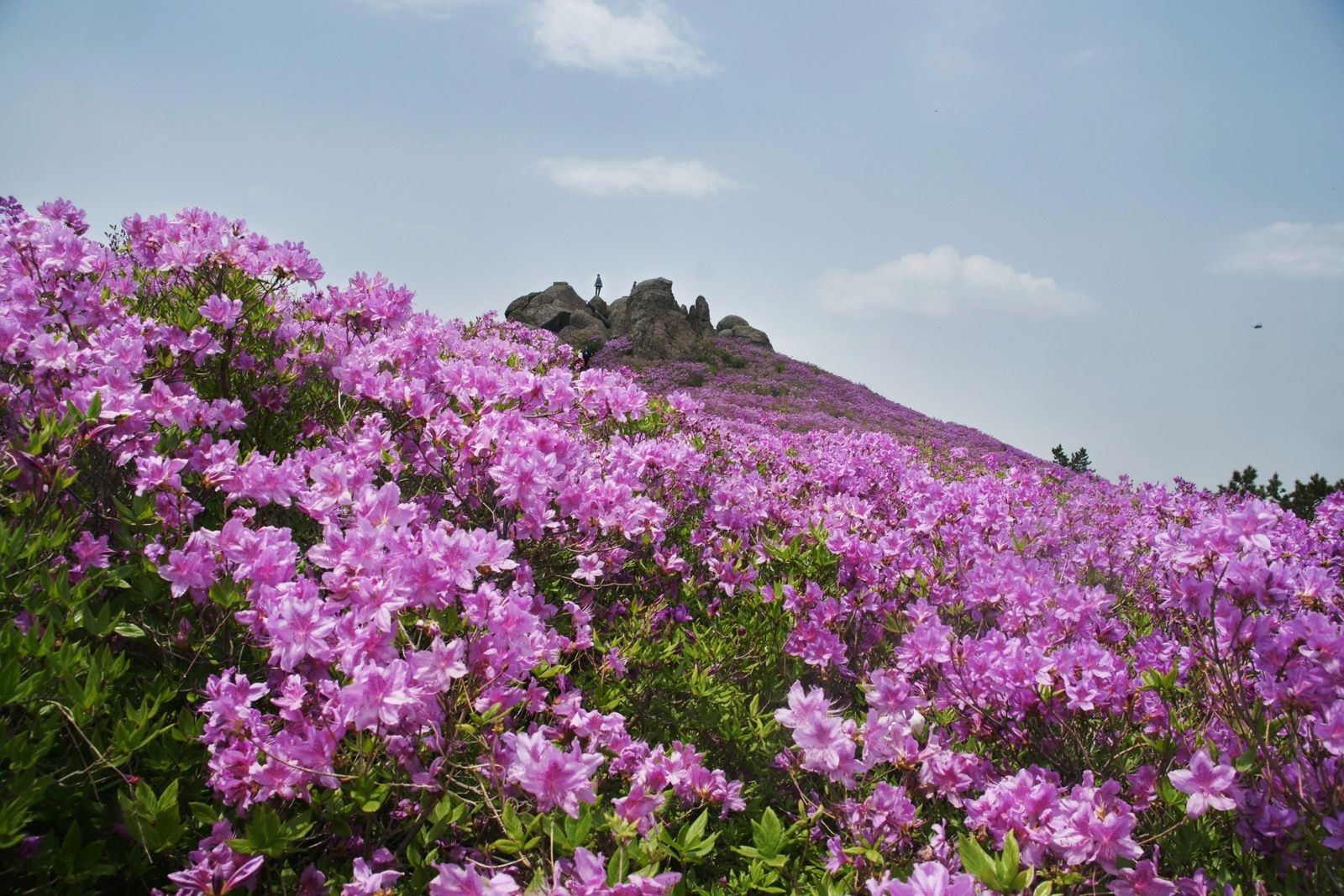
The mountain’s altitude is modest — the main ridge around 1,350 metres, the highest point a little over 1,600 — but it sits in a band of warm, wet air coming up from Guangxi and the result is a forest with more species per hectare than its latitude has any right to. This is also why the cloud sea is reliable: the air is loaded with water, and at dawn the valley fills while the ridge stays clear. The lodges on the ridge are positioned for it, which is the single most useful thing to know about visiting.
万寿寺 Wànshòu Sì, the Long Life Temple, goes back to the Song and has been rebuilt repeatedly; its importance in the region rests on 秀峰禅师 Xiùfēng Chánshī, a Ming monk who is said to have sat in meditation until his death and whose preserved body was venerated here for centuries. The modern temple is functional and busy, and the walk up to it through the old forest is the best short hike on the mountain. Behind the temple the ridge continues to viewpoints and, further on, to a waterfall with a path that passes behind the curtain of water — the wettest, loudest and most memorable five minutes on the mountain.
The mountain’s branding is 和 hé, harmony, which sounds like marketing until you read why: the local story is that this is where Buddhism and the earlier Chinese traditions met without a fight, and that the seventh patriarch’s lineage was specifically a reconciling one. It is a stretch. It is also a nicer organising idea than most scenic areas manage.
Practicalities
Tickets. Around ¥60–80 for the 阳明山国家森林公园 Yángmíng Shān Guójiā Sēnlín Gōngyuán entrance; the temple is inside and not separately charged. Parking at the ridge ¥10–20.
Opening hours. Roughly 07:00–18:00. The ridge road is narrow and single-track in places, and the park limits vehicles in the flowering period when numbers are high.
Closing day. No closing day; open year-round. The azalea fortnight in late April is the only time anything like a queue forms.
Getting there. About 60 kilometres and 90 minutes by car from 永州 Yǒngzhōu; roughly 40 minutes from 双牌 Shuāngpái county town. There is no useful public transport to the ridge; hire a car and driver for ¥250–350 a day, or stay on the mountain and let the lodge arrange collection.
What People Get Wrong
They come in the afternoon. The cloud sea is a dawn phenomenon and is usually gone by ten; the azaleas photograph better in early light; and the ridge road is far less pleasant to drive with a day’s worth of cars coming the other way.
Getting there
Drive from 永州 Yǒngzhōu in the early morning, ideally staying on the ridge the night before. Two days on the mountain is generous and one is enough for the flowers, the temple and the waterfall walk. It combines naturally with 九嶷山 Jiǔyí Shān to the south-east, an hour and a half away, if you are touring southern Hunan by car.
flowcloud would say that a mountain where the monks chose the site for the silence and the tourists come for the red flowers has ended up well served by both, and that the fact the two crowds arrive at different hours is the only scheduling that matters.
Getting there: 阳明山 (Yángmíng Shān), 双牌县 (Shuāngpái Xiàn), 永州市 (Yǒngzhōushì), 湖南 (Húnán). Open daily 07:00–18:00, no closing day, entry ¥60–80. 90 minutes by car from 永州 (Yǒngzhōu); hire a car and driver ¥250–350 per day. Come before 09:00, and come in the last week of April for the azaleas.