
长江索道 Chángjiāng Suǒdào, the Yangtze River Cableway, leaves the southern toe of 渝中区 Yúzhōng Qū, Yuzhong District, from 新华路 Xīnhuá Lù, Xinhua Road, and hangs out over the water toward 上新街 Shàngxīn Jiē, Shangxin Street, opposite. Chongqing is a municipality of southwest China, and Yuzhong is its central district on the peninsula where the Yangtze meets the Jialing River, with the north station at the peninsula’s southern toe. When it opened, its rivals were the ferry and the bus, not the camera: a bus route that happened to fly. Platform writing calls it the first corridor in the air over the Yangtze, and the fact underneath is solid – the first large passenger cableway across the river designed and built in China. A crossing of about four and a half minutes that once moved clerks to work now moves visitors into the sky.
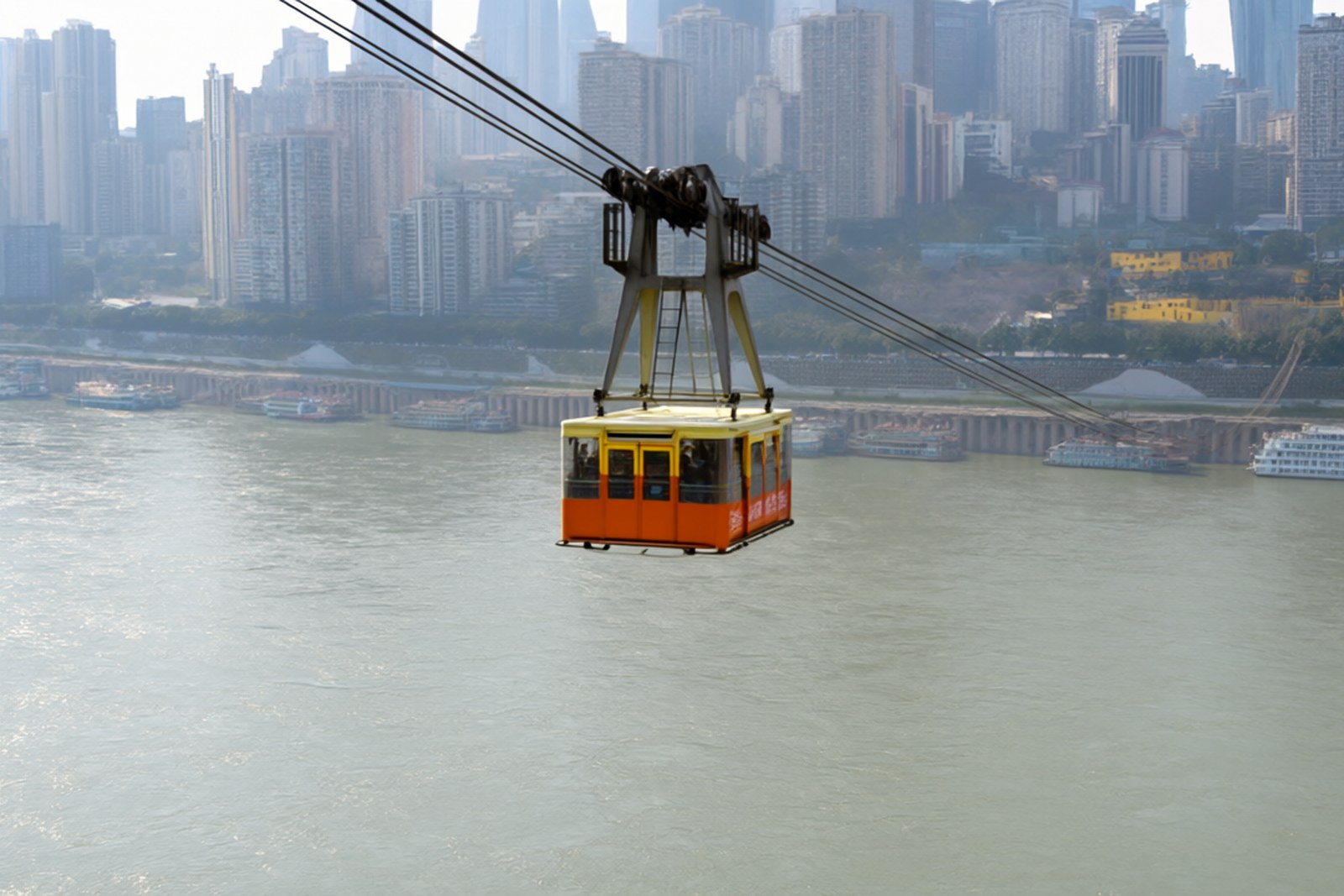
The engineering is all of a piece. Decided in January 1983, designed by December 1984 and begun on 20 March 1986, the line entered service as a city transit facility on 24 October 1987. It is a reciprocating system on the double-carrying, double-hauling principle, all equipment but the four carrying cables made domestically under chief designer Shi Fengqiang. The span runs 1,166 metres at up to six metres a second, each cabin rated for sixty-five passengers plus an attendant, and anti-sway devices keep it running through winds of force five to six. The crossing takes about four and a half minutes – the shorter “four minutes” of some listings rounds the same ride – and for a generation of Chongqingers it was simply the commute.
The transformation came slowly and then all at once. Through the late 2000s, as bridges multiplied and commuter crowds thinned, the line drifted toward tourism, and from 1 January 2014 it became a full sightseeing operation – described in the operator’s own account as the only urban sightseeing cableway in the country. The city listed it as a municipal protected site in 2010, though accounts differ over whether the announcement came at the end of 2009; the scenic grades followed, 3A in 2013 and 4A on 6 February 2018 – a 4A, not a 5A. The cabins changed with the decades, cream in 1987, blue in 1995, red in 2005, orange-grey in 2016, and in 2019 the third-generation cars went back to the 1987 look. The line is also a recurring backdrop in Chinese films.
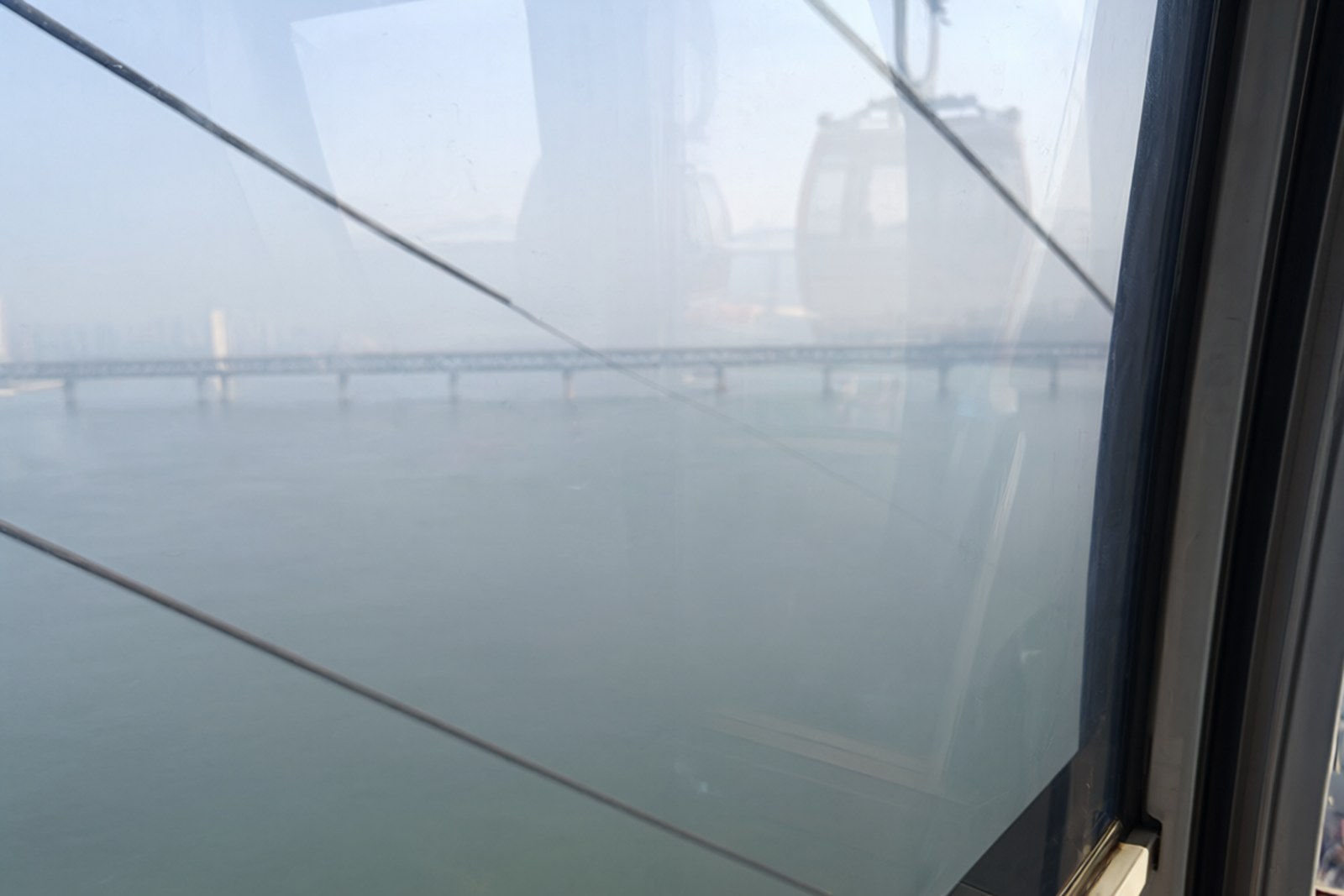
Riding it well is mostly timing. Queues of one to two hours are normal on holidays and weekends, so a weekday morning or an evening slot is the difference between a ride and a wait. The standard strategy is one way only: cross on the cableway, return by metro or bus, because the return is the same water and the fare is not the point. Cabin departures are scheduled by demand rather than a posted headway, so there is no minute to chase – only the queue to read. And manage the view honestly: in mist or rain the fog capital’s crossing is atmosphere rather than panorama. On a clear evening the cabin climbs out over the peninsula’s toe and hands you the whole composition at once – two rivers, bridge lines, towers stacked up the slope.
Two pieces of context finish the story. First, the boundary with the site’s other cableway: the line at Tianmen Mountain carries visitors up a mountain; this one once carried Chongqingers across a river to work – a piece of public transport that outlived its job and became the ride itself. Second, the sister line it outlived: the Jialing River cableway closed in February 2011 and was dismantled in 2013, its surviving parts kept in the Three Gorges Museum and a small exhibition on the north station’s second floor, worth ten minutes while the queue settles. From the north station a short walk along the bank reaches the stilt-house quarter at Hongya Cave, the subject of its own article here, so the crossing chains into an evening by the water.
Practicalities
Tickets. Since 31 March 2025 the operator’s schedule is 30 yuan single and 50 yuan return, with a single plus audio-guide headset at 40 yuan. Platform snapshots in 2026 also quote a south-station combination with the Crown Escalator and Kaixuan Road lift at about 35 yuan and fast-entry returns from about 118 to 168 yuan – the listings disagree, so read the base fare as a single ride around 30 yuan. As of October 2026, subject to change.
Opening hours. In the high season, 1 March to 31 October, the line runs from about 07:30 to 22:30; in the low season to about 21:30. One platform prints 08:00 to 22:00 for ordinary days, so the honest line is roughly seven-thirty to ten-thirty at night in season.
Closing day. There is no fixed closing day, but the cableway closes for one or two days each month for scheduled maintenance – recent notices show two-day weekday shutdowns – so check the operator’s announcement before planning a day around the crossing.
Getting there. The north station is at 151 Xinhua Road: metro lines 1 or 6 to 小什字 Xiǎoshízì, Xiaoshizi, exit 5B, leaves you about twenty metres away, and buses 181, 261 and 0833 stop at the Xinhua Road stop. The south station is on Shangxin Street, near the Longmenhao street office, and pairs with a walk into the old Longmenhao lanes.
flowcloud would say that the Yangtze River Cableway is a bus that learned to fly and then outlived its route, and that the best transport heritage is the kind that gets a second job instead of a museum.
Getting there: The Yangtze River Cableway crosses the Yangtze from 151 Xinhua Road in Yuzhong District, Chongqing, a municipality of southwest China, to Shangxin Street on the south bank; opened on 24 October 1987 as China’s first large domestically designed passenger cableway across the river, it runs 1,166 metres in about four and a half minutes, became a full sightseeing operation in 2014 and a national 4A scenic area in 2018; fares since 31 March 2025 are 30 yuan single and 50 yuan return, the high-season day runs roughly 07:30 to 22:30, there is no fixed closing day but the line shuts one or two days a month for maintenance, and the north station is reached by metro lines 1 or 6 to Xiaoshizi exit 5B (checked October 2026, subject to change).