
Two trees stand in front of the hall, one dead and one alive, and they have been doing it for something like a thousand years. 灵光寺 Língguāng Sì is the temple at the foot of 阴那山 Yīnà Shān, in 雁洋镇 Yànyáng Zhèn in 梅县区 Méixiàn Qū, and the 生死树 shēngsǐ shù, the life-and-death trees, are its emblem: a pair of cypresses said to have been planted by the founding monk, of which one died and stayed standing while the other kept growing. The living one is a full, dark tree; the dead one is bare, silvered and hard as iron, with no rot visible where the two trunks meet the ground. Whether or not one accepts the founding story, the pair is an unusually effective piece of religious stagecraft: a sermon on impermanence that a visitor understands without being told anything.
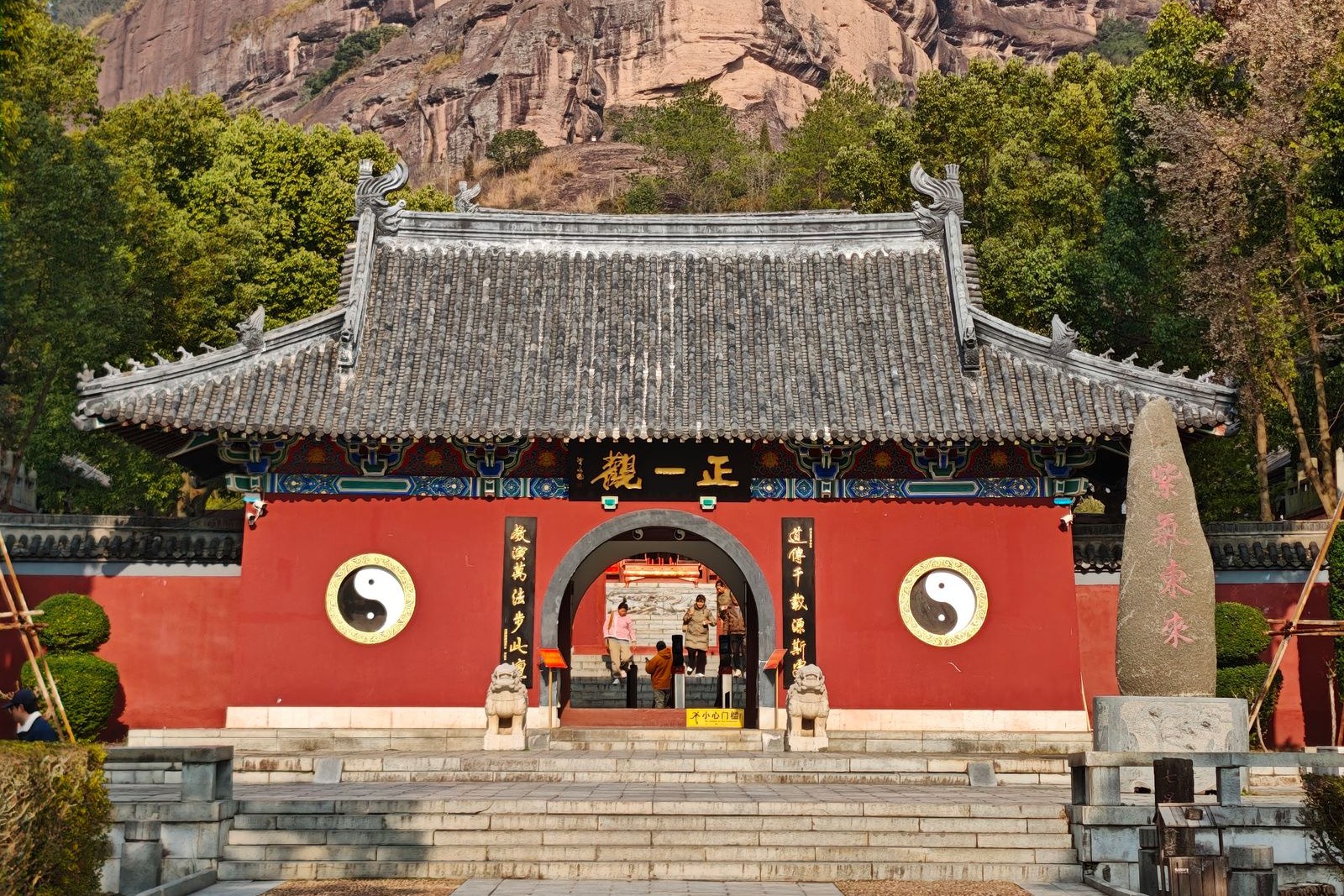
The temple was founded under the Tang, in the middle of the ninth century, by a monk known as 惭愧祖师 Cánkuì Zǔshī, the Master of Shame, whose family name was 潘了拳 Pān Liǎoquán; the name refers to his own reported sense of unworthiness rather than to anything he did. The buildings have burned and been rebuilt more than once, and the present halls are late imperial, with the usual sequence from the mountain gate through a series of courtyards to the main hall. 阴那山 itself is the second-highest massif in eastern Guangdong, over 1,200 metres at the summit ridge, and the temple sits low on its flank in forest, which is why the air is cool and wet and why the moss on the stonework is thick enough to be part of the architecture.
The hall to look at is the main one, whose ceiling is built as a spiralling coffered dome, 菠萝顶 bōluó dǐng, a form used in a handful of temples in this region. Its purpose is not decoration: the dome draws smoke up and out through the roof structure in a controlled vortex, so the hall stays clear when incense is burning heavily and the beams have stayed free of soot. It is the kind of solution that visitors tend to notice only after being told, and then cannot unsee. Outside, a path continues up the mountain through forest to viewpoints and, eventually, the summit ridge, which is a full day’s walk and is usually done from a separate trailhead.
Practicalities
Tickets. About ¥40 for the 阴那山 Yīnà Shān scenic area, which includes the temple. Separate small charges may apply at festival times, and the mountain trails above the temple are covered by the same ticket.
Opening hours. Roughly 07:30 to 17:30 daily. The temple is busiest at festival dates in the lunar calendar, especially the birthday of the founding master; an ordinary weekday morning is quiet enough to hear the water in the gutters.
Getting there. 雁洋镇 Yànyáng Zhèn is in 梅县区 Méixiàn Qū, about forty minutes by road from 梅州市 Méizhōu Shì and roughly thirty minutes from 梅州西站 Méizhōu Xī Zhàn on the 梅汕 Méi-Shàn line. Local buses run from the 梅州 terminal to 雁洋, and the temple is a short taxi ride from the town. The village of 桥溪 Qiáoxī is a few minutes further on the same road, which makes the two an easy pair for one day.
Closing day. No closing day: the temple is open every day of the year, being an active place of worship rather than a museum, and the resident monks keep the halls open through the winter.
The Master of Shame
The founding story is worth knowing because it explains the name and the mood of the place. 潘了拳 Pān Liǎoquán is said to have come from 福建 Fújiàn in the ninth century and to have settled here on the mountain, where he practised and taught until his death; he took the name 惭愧 Cánkuì, ashamed, out of a conviction that his attainments fell short of his teachers’. He is said to have planted the two cypresses himself and to have told his followers that after his death one would die and one would live, which is precisely what the courtyard shows. Whether the trees are a thousand years old is a question for dendrochronology rather than faith, but the pairing has been recorded for centuries, and the dead trunk has been left standing rather than removed for as long as anyone has kept records.
The temple’s standing in the region comes from that founding and from its position: 阴那山 is one of the few substantial mountains in this part of Guangdong, and the temple was the main religious house serving the Hakka villages of the 梅县 hills. It still functions that way. On festival days the courtyard fills with families from the surrounding townships, the vegetarian kitchen runs all day, and the 生死树 shēngsǐ shù is where people stand and, quite often, say nothing at all.
Words and Names
灵光寺 Língguāng Sì is the temple, 阴那山 Yīnà Shān the mountain, 雁洋 Yànyáng the township and 梅县区 Méixiàn Qū the district. 生死树 shēngsǐ shù are the life-and-death trees, 惭愧祖师 Cánkuì Zǔshī the Master of Shame who founded the temple, and 菠萝顶 bōluó dǐng the spiral coffered ceiling of the main hall. 祖师 zǔshī is a founding master, 柏树 bǎishù a cypress, and 藻井 zǎojǐng the general term for a temple ceiling of nested coffers.
flowcloud would say that the two cypresses are the most persuasive sermon in Guangdong, because a dead tree that refuses to fall makes the point about impermanence better than any inscription, and it has been making it for a thousand years without a single repair.
Getting there: by road to 雁洋镇 Yànyáng Zhèn in 梅县区 Méixiàn Qū, about forty minutes from 梅州市 Méizhōu Shì and half an hour from 梅州西站 Méizhōu Xī Zhàn, with local buses from the 梅州 terminal to 雁洋 and a short taxi from there. Go on a weekday morning, look at the ceiling of the main hall before you look at anything else, and walk the forest path a little way up the mountain rather than turning back at the courtyard.