
永庆寺 yǒng qìng sì is the largest Buddhist monastery in northern 海南 Hǎi nán and the only one on the island that stands with its face to the open sea. It is on the western shore of the 盈滨半岛 yíng bīn bàn dǎo in 老城镇 lǎo chéng zhèn, 澄迈县 Chéng mài xiàn, built on ground where the water of the 琼州海峡 Qióng zhōu hǎi xiá is on three sides of the headland, and it is counted among the 澄迈八景 Chéng mài bā jǐng, the eight views of Chengmai, in the county’s old gazetteers. The choice of the site was deliberate: the people who picked it argued that the peninsula, seen from the air, is shaped like the palm of a Buddha’s hand pointing west, and that a monastery built on it would be a pearl in the palm.
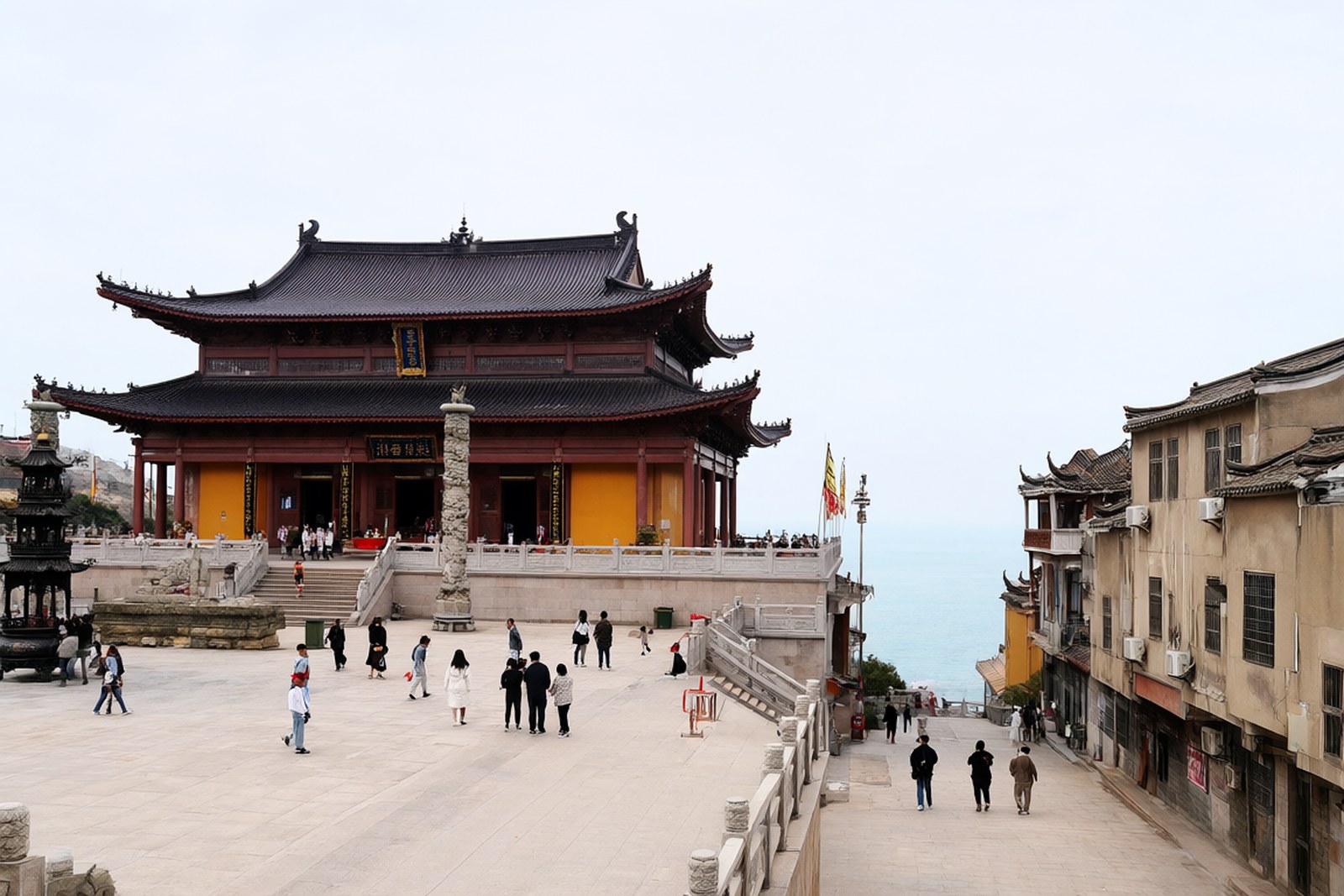
Its history is long, contested at the edges and unusually well documented. The county’s gazetteers – the 正德琼台志 Zhèng dé Qióng tái zhì of the Ming, and the 澄迈县志 Chéng mài xiàn zhì editions of 1700 and 1820 – record the foundation, and they do not agree on the date: one tradition puts it in the Tang, another in the 熙宁 Xī níng period of the Northern Song, around 1068 to 1077. What the records do agree on is where it stood, 老城以东二里 lǎo chéng yǐ dōng èr lǐ, two li east of the old town, and what happened to it. The monastery was destroyed and rebuilt under 洪武 Hóng wǔ by the county magistrate 汪贵 Wāng Guì, rebuilt again under 成化 Chéng huà by the assistant magistrate 陆佑 Lù Yòu, converted into a 书院 shū yuàn, a Confucian academy, by the magistrate 秦志道 Qín Zhì dào in 1818, damaged again in the Guangxu period, and finally wrecked in the Cultural Revolution. What is standing now was decided on in 2001 and completed on 22 April 2009 on a new site on the peninsula, and it is that rebuilding – 80 mu of grounds, 9,200 square metres of building, a five-courtyard plan laid out on Song lines – that made it the biggest Buddhist compound in the north of the island.
The reason the temple matters to anyone who is not a Buddhist is who came through it. 苏东坡 Sū Dōng pō was exiled to the island in 1097 and landed at 老城, where he spent a night at the 通潮阁 Tōng cháo gé; the next day he went to 永庆寺, and the poem he wrote about it is quoted in every account of the place. Three years later, pardoned and on his way home, he came back and left the line that the county prints on its own literature, 九死南荒吾不恨,兹游奇绝冠平生 jiǔ sǐ nán huāng wú bù hèn, zī yóu qí jué guàn píng shēng – nine deaths in the southern wilderness and I do not resent them, this journey was the strangest and best of my life. 李纲 Lǐ Gāng, 李光 Lǐ Guāng and 胡铨 Hú Quán, three of the Song officials exiled south in the same century, are all recorded as having visited. The line over the mountain gate sums the whole claim up in two couplets and is worth reading slowly, because it names the founding, the poet and the sea in a single breath.
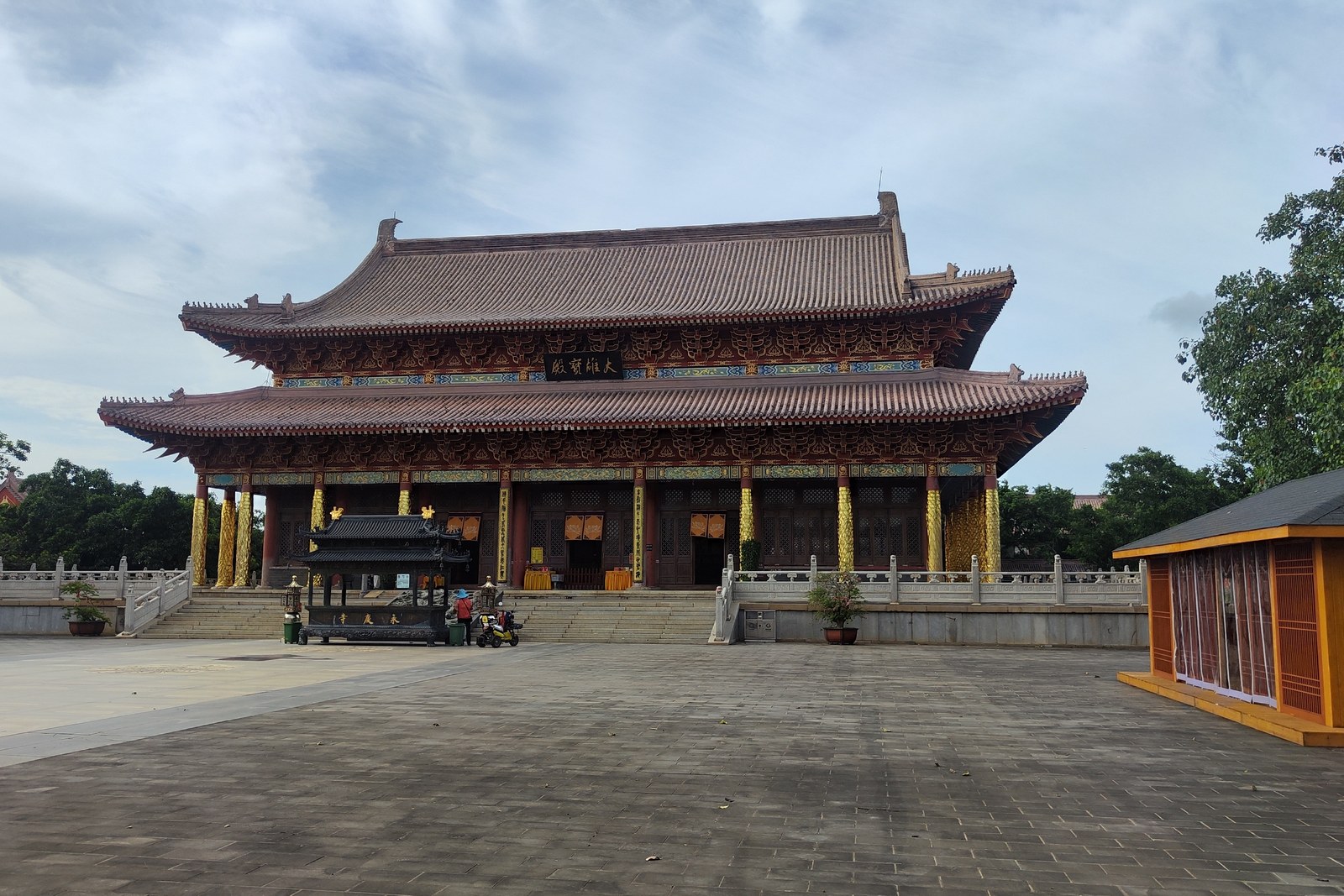
What the rebuilding added is a set of objects rather than a set of stories. The halls hold forty-two statues carved from single blocks of Burmese white jade, together with a set of very large figures in the same stone, and the monastery has collected a long list of records for them – the most jade Buddhas in one monastery, the most in one hall, the tallest jade island 观音 Guān yīn. The courtyards are planted to the old Buddhist scheme of 五树六花 wǔ shù liù huā, five trees and six flowers, which here means 菩提 pú tí, the bodhi tree, 贝叶棕 bèi yè zōng, the talipot palm whose leaves were the island’s writing material, 糖棕, 大青 and 槟榔, with 鸡蛋花 jī dàn huā, frangipani, 文殊兰, lotus, 黄缅桂, 黄姜花 and 地涌金莲 dì yǒng jīn lián among the flowers. In 2016 the monastery began work on a 观音阁 Guān yīn gé, a Guanyin pavilion, designed in Song style with a main structure fifty-three metres high and paid for by a resort group, which is a very 海南 arrangement: a monastery with a thousand years of literary history being extended by a property developer and a Song-revival architect in the same decade.
Practicalities
Tickets. Entry is free and there is no charge for the halls; the monastery takes donations in the usual way, and the large-scale reconstruction was funded by donors and by the group that is building the Guanyin pavilion. The temple is a working religious site with resident monks rather than a scenic park, so dress and behave accordingly and ask before photographing anyone in robes.
Opening hours. The monastery is open through the day and closes in the late afternoon; the courtyards are at their best early, before the coaches arrive, and again in the last hour of light, when the sea to the west catches it. The Guanyin pavilion is a separate building and its interior is opened when it is opened, so ask at the gate rather than assuming.
Getting there. The temple is on the western shore of the 盈滨半岛 at 老城镇, 澄迈县, on the coast road a few minutes from the hotels of the peninsula and twenty to thirty minutes east of 海口市 Hǎi kǒu shì; the address is 永庆大道 Yǒng qìng dà dào and the island’s west-ring high-speed railway stops at 老城镇 lǎo chéng zhèn inland of the harbour. There is parking at the gate and the approach is walkable from the peninsula hotels.
Closing day. There is no weekly closing day; the monastery keeps religious hours rather than an attraction’s roster and closes early on the days of major observances, which is the only time the gates shut before dark. It is busiest at the Spring Festival and on the first and fifteenth of the lunar month, when the county’s own households come.
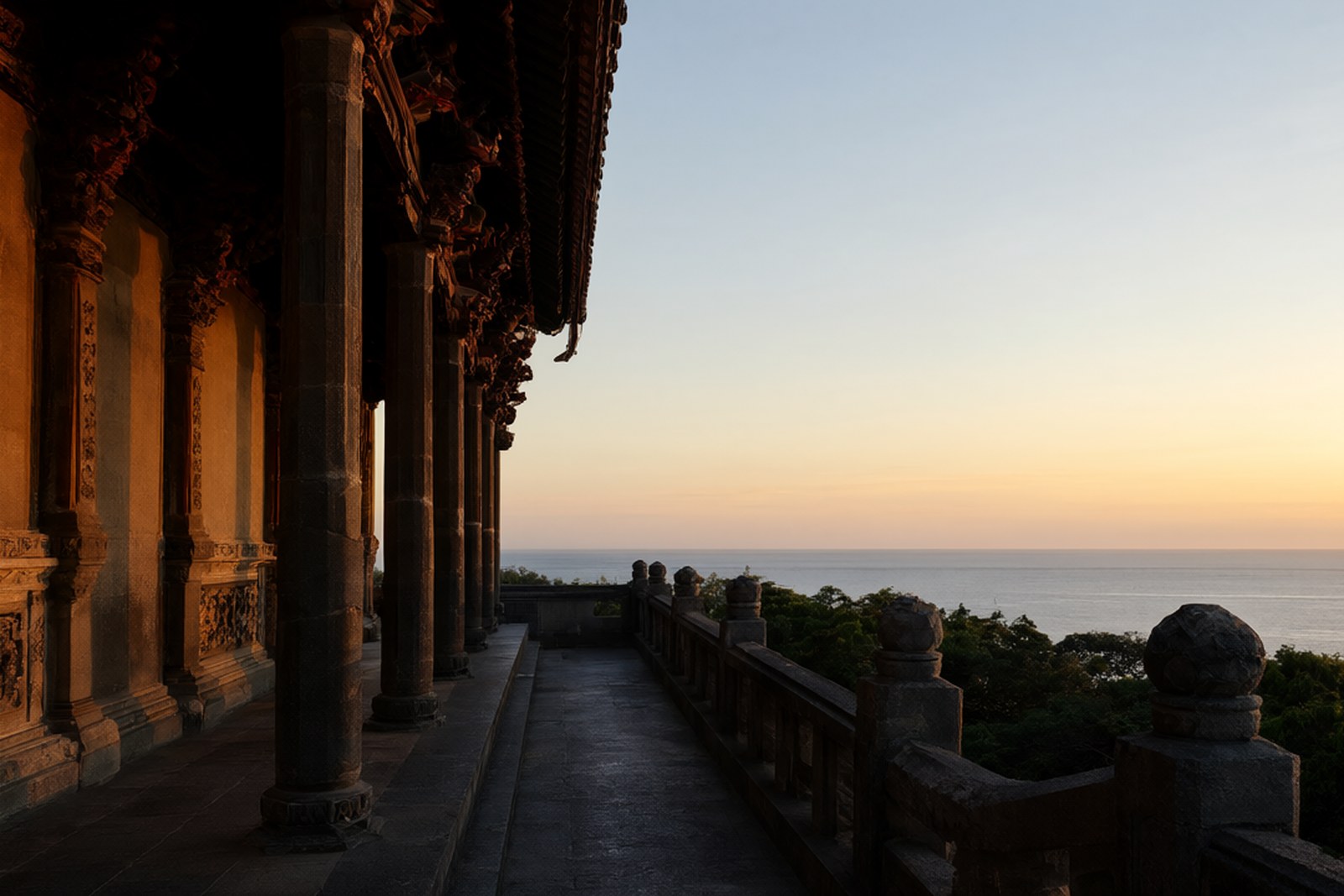
flowcloud would say that a monastery which a Song poet reached by shipwreck, which was rebuilt, converted into a school, wrecked and then rebuilt again on a different headland by a development company, has been rewritten by every century that touched it – and that the one thing it has never lost is the sea on three sides of the gate.
Getting there: 永庆寺 is on the western side of the 盈滨半岛 in 老城镇, 澄迈县, on 永庆大道 Yǒng qìng dà dào, a few minutes’ drive from the peninsula’s hotels and twenty to thirty minutes from 海口市 by the coast road. The west-ring high-speed railway’s 老城镇 station is inland of the peninsula, and there is parking at the temple gate; most visitors come by car or taxi and walk out to the shore afterwards.