
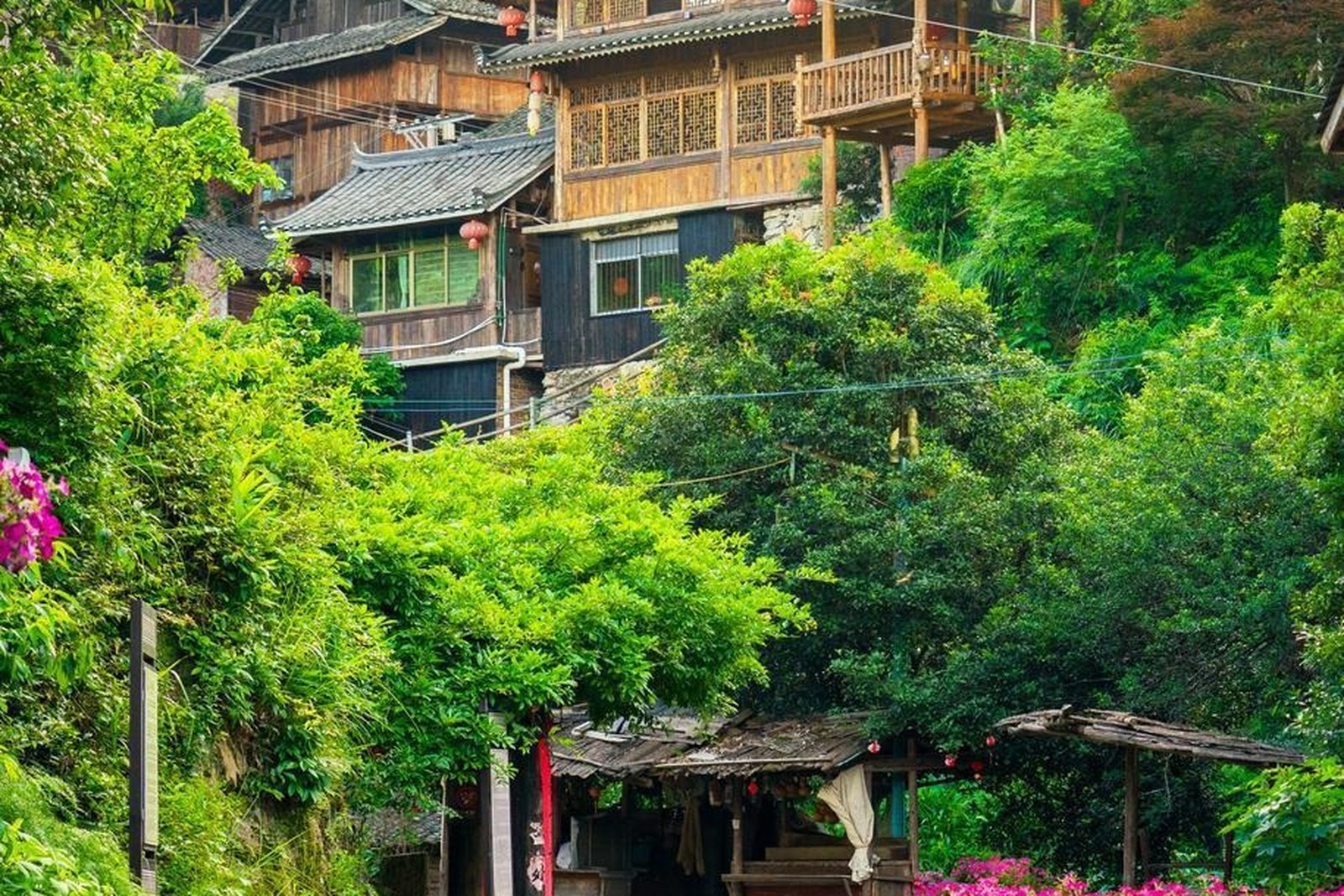
The village is built up a hillside in seven clusters, with a stream running down the middle of it, and it contains four drum towers, four covered bridges, three stone bridges, three 芦笙 lúshēng grounds and a shrine to the 萨 Sà, the Dong ancestor goddess, that has been in use since the Ming. 芋头侗寨 Yùtóu Dòngzhài has been called the 侗族建筑的实物博物馆 Dòngzú jiànzhù de shíwù bówùguǎn — the Dong architectural museum in object form — and the phrase is fair: nowhere else has so many kinds of Dong building survived in one valley, from a 清代 悬空鼓楼 hung off a cliff to the old 青石板驿道 qīngshíbǎn yìdào, the stone-slab post road that runs through the middle of the settlement.
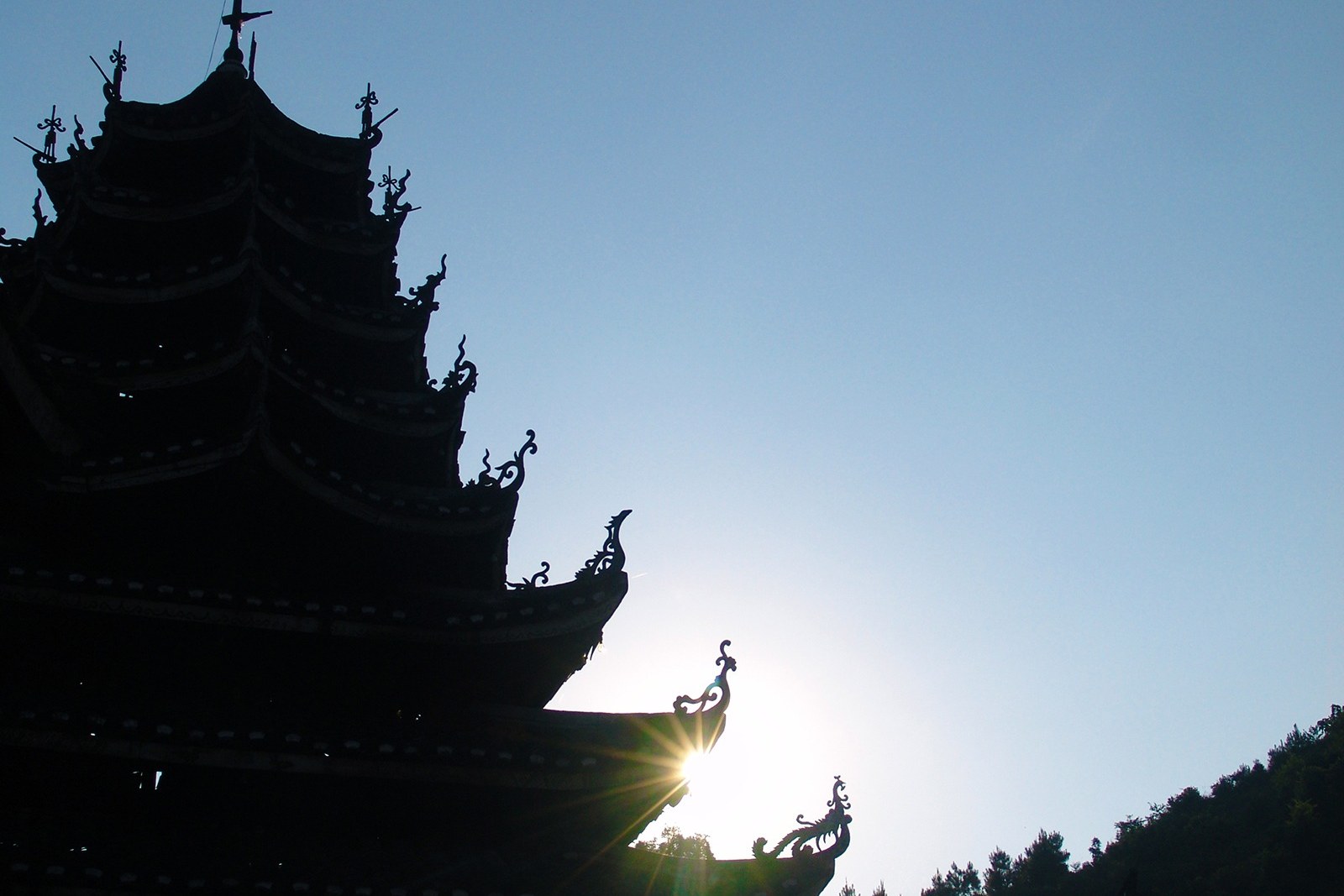
The 鼓楼 gǔlóu are the reason to come, and they are not all the same. 龙氏鼓楼 Lóngshì Gǔlóu, on the ridge above the upper village, is the oldest, built in 清乾隆五十二年 (1787). 芦笙鼓楼 Lúshēng Gǔlóu, in the centre of the 下寨 xiàzhài, lower village, was built in 道光九年 (1829) and rebuilt in 1993, and it is the decorative one: nine tiers, the lower five square and the upper four octagonal, with dragons and phoenixes modelled on the upturned eaves — and, unusually, the phoenix above the dragon, because this is a society with strong matrilineal survivals. And 牙上鼓楼 Yáshàng Gǔlóu, on the flank of the hill, is the extraordinary one: half of it stands on flat ground and half hangs out over the slope, carried on seventeen columns of pear wood, the longest of them 9.1 metres, so that the village could have a drum-tower square without cutting into the hillside it stands on.
The village was founded in the 洪武 period of the Ming, and the founding story is the standard frontier one: three Yang brothers came from 江西 Jiāngxī in flight, divided their directions by killing an ox, and the second brother’s line, after a couple of moves, went hunting with a dog that refused to leave a patch of grass at the head of this valley. The hunter promised to stay if the dog caught food thrown into the air three times; the dog caught all three. Reconstruction after a fire in the 顺治 period produced the current seven clusters, and by the 嘉靖 period the place was substantial. The villagers still keep 萨坛 sàtán, the shrine; still hold 祭萨 jì Sà; still play 芦笙 lúshēng; still conduct 讲款 jiǎng kuǎn, the recitation of the customary law, in the drum tower; and still press oil tea on visitors.
Practicalities
Tickets. The village charges a scenic-area ticket, generally around ¥60–80, with student and senior discounts. Prices are set seasonally; check at the entrance or online before you go.
Opening hours. Roughly 08:00–18:00. The village is inhabited, and walking its public lanes outside the ticketed houses in the evening is not restricted.
Closing day. Open every day.
Getting there. 通道站 Tōngdào Zhàn on the 贵广 high-speed line is about thirty minutes from 双江镇 Shuāngjiāng Zhèn, the county town, and the village is a further twenty minutes by road up the valley. There are local buses; a taxi from the county town is the simpler option, ¥40–60. From 怀化 Huáihuà it is about three hours by road; from 桂林 Guìlín it is closer, which is worth knowing when you plan the route.
What to Look For
The 牙上鼓楼 Yáshàng Gǔlóu from below. Walk down the slope to see the suspended structure — the overhanging half of the building — and count the columns. It is the most interesting piece of vernacular engineering in the county.
A drum tower’s interior. Look up. There is no ceiling: the tower is a stack of diminishing rings held by interlocking timber with no nails and no metal, and the roof is a single beam of light.
The 回龙桥 Huílóng Qiáo. The covered bridge at the village entrance, built in 乾隆四十二年 (1777) and rebuilt in 2009 with contributions from both sides of the strait; a stone with the words 津梁有托 jīnliáng yǒu tuō, “the ford and the bridge have their trust”, survives from the original. Look for it in the grass near the new bridge.
The eaves. The decoration on the drum towers is Dong work, and the pattern of the phoenix over the dragon repeats across all four towers.
Getting Around
The village is small and vertical: you walk it in two hours, up and down. Do not skip the upper cluster, which is where the oldest architecture is, and do not skip 上寨 shàngzhài at dusk, when the light comes down the valley and the timber goes very dark. Combine with 皇都侗文化村 Huángdū Dòng Wénhuà Cūn and the other Dong villages along the same road, and with the 通道 Tōngdào red-leaf season in November if you can time it. Stay overnight in a village homestay — the towers are one thing in the daytime and a different thing when the only light is from the houses.
flowcloud would say that a people who build their most important building out over a cliff rather than levelling the hill, and who carve the phoenix above the dragon without being asked, have a clearer idea of what a building is for than a great many architects with better materials.
Getting there: 芋头侗寨 (Yùtóu Dòngzhài), 双江镇 (Shuāngjiāng Zhèn), 通道侗族自治县 (Tōngdào Dòngzú Zìzhìxiàn), 怀化市 (Huáihuàshì), 湖南 (Húnán). Tickets around ¥60–80; open roughly 08:00–18:00 daily. About thirty minutes from 通道站 (Tōngdào Zhàn), then twenty minutes up the valley. Look at 牙上鼓楼 (Yáshàng Gǔlóu) from below, look up inside a drum tower, and stay the night so you see the village after dark.