
中山詹园 Zhōngshān Zhān yuán sits in 北台村 Běi tái cūn of 南区街道, by the 105 National Road south of the city, its back to 湖洲山 Hú zhōu shān and its feet in the 北溪河 Běi xī hé, water on both banks. It was built as a present. In 1998 the local businessman 黄远新 Huáng Yuǎnxīn began an estate for his parents’ old age, designing it himself and hiring hundreds of craftsmen from Suzhou and Hangzhou; the work took five years, and in August 2003 the family opened the result to the public. The name honours the mother, whose surname was Zhan; the main bridge honours the father, whose given name supplies its two characters – a garden named for one parent and a bridge for the other, which is as compact a statement of the place’s theme as landscape architecture allows.
The estate runs to about 120 mu – eight hectares – on the official city archive figure, and the archives and the wire services both describe it as the largest classical private garden in Lingnan, a claim repeated often enough to be the standard line even if the marketing posters inflate it to “first”. The build leans on Suzhou and Hangzhou for its grammar but speaks with a Lingnan accent: the layout follows the water-town pattern of one water and two banks, the brick and tile were gathered from old buildings so that, as the guides put it, every brick carries history, and the water gardens absorb a western taste for geometry.
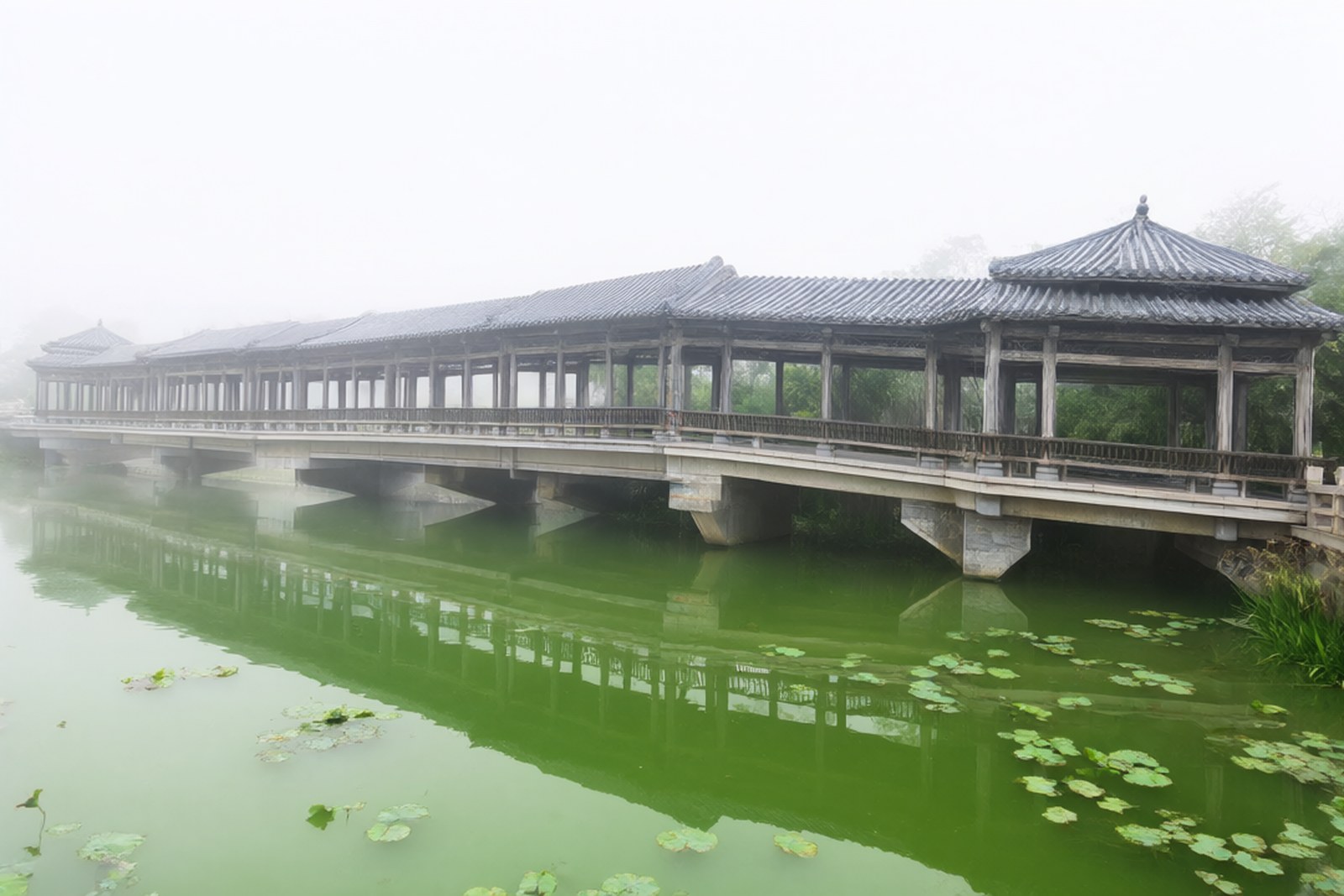
Three districts divide the grounds – the birthday-celebration quarter, the covered-bridge quarter and the mansion’s blessing quarter – and five buildings carry the signature: the Hall of Shun, first of the filial sons in the Chinese canon; the 68-metre 善源桥 Shàn yuán qiáo, the largest wind-and-rain covered bridge in Lingnan; the ceremony stage where the performances run; the 双依亭 Shuāng yī tíng, a pair of hexagonal pavilions joined like a leaning couple; and a courtyard house deliberately built with a single court, so that the mother who was to live nearby would be easy to look after.
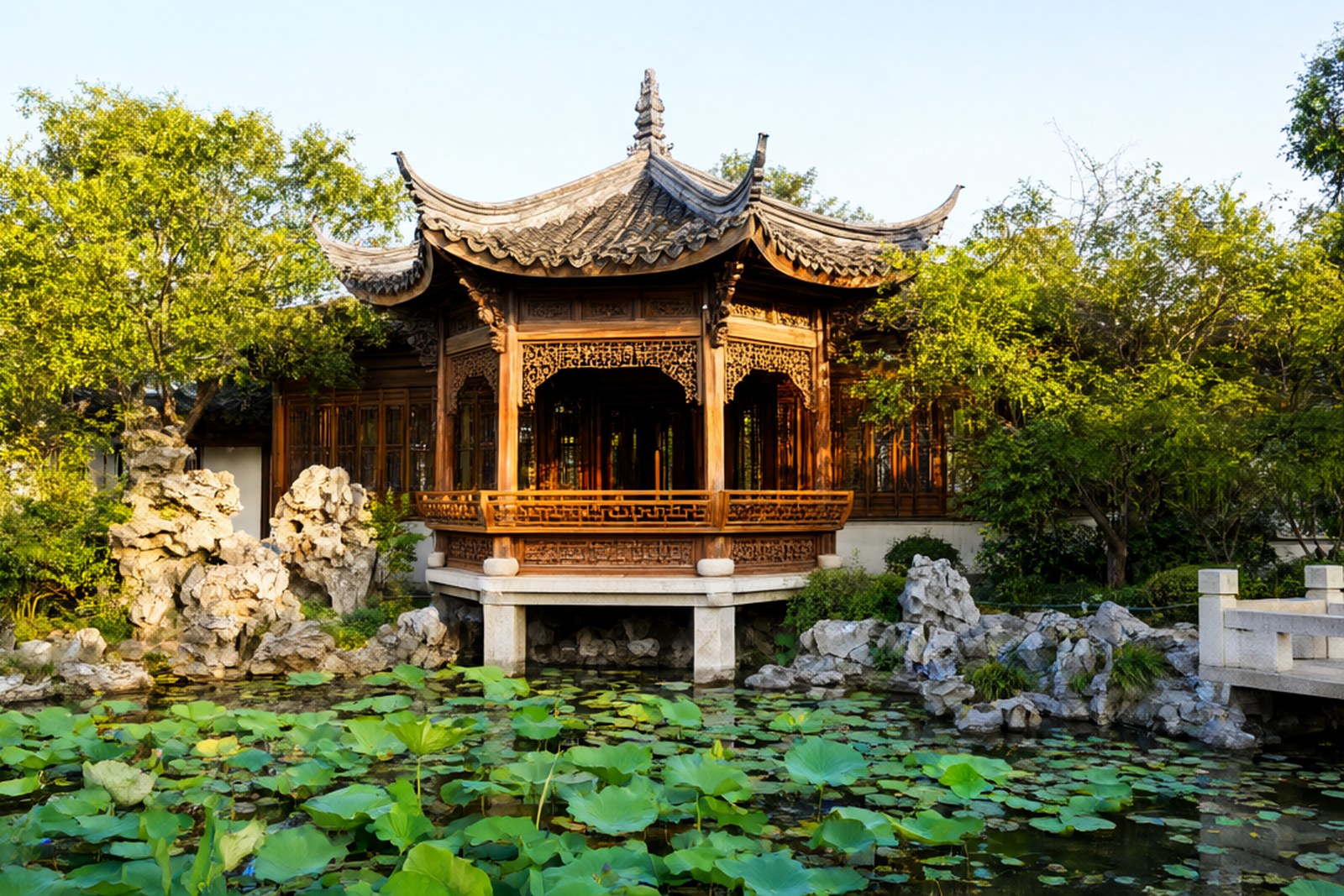
Filial piety is the programme, not just the backstory. The garden keeps a filial-duty hall hung with painted scenes of the Twenty-Four Exemplars, and the daily bill of fare mixes Sichuan-opera face-changing, kung-fu tea and close-up magic with the stonework. The state noticed: on 27 November 2007 the national tourism administration rated it AAAA, and the city has since strung the garden into a longer line – the Cao Bian to Bei Tai “ten-li gallery”, a rural culture corridor built along the North Stream with the 4A garden as one of its beads. Give the visit two to three hours; the covered bridge is the photograph everyone takes, the pavilions earn their name best in the late light, and weekend evenings occasionally add a lit session.
The alternative name locals use, 中山大宅门 Zhōngshān dà zhái mén, “the great gate of Zhongshan”, fits the way the place reads from the water: you arrive across the North Stream, the covered bridge takes you first, and the courtyards unfold behind it in the Lingnan manner – low eaves, deep verandas, ponds set to cool the summer air. Water is the organising fact everywhere: pavilions sit on it, the bridge crosses it, the lotus fills it in season, and the straight geometry of the pools and canals is the one place the design lets a western line show through the Suzhou-and-Hangzhou grammar. Walk the bridge twice – once outward with the morning crowd, once back at the end of the visit, when the tiles show their age in a kinder light.
Practicalities
Tickets. Adults pay about 60 yuan at the gate and around 50 yuan online – platform listings at 49.9 to 50 checked September 2026 and floating – with concessions at 28 to 30 yuan. Free entry goes to children under 1.2 m, visitors over 70, disabled visitors, serving and retired military, guides, journalists and firefighters; discounted tickets cover children of 1.2 to 1.5 m, visitors of 60 to 69 and students. The ticket line is 0760-23336288.
Opening hours. The official listing page gives 8:30 to 17:30 all year, with entry stopping at 17:30; other platforms print 8:00 to 18:30 or 8:30 to 19:00, a known discrepancy – go by 8:30 to 17:30 and arrive before mid-afternoon. Weekend evening sessions appear seasonally.
Closing day. No closing day is reported; the garden opens through the year on the official listing. The practical exception is the holiday morning, when the free car park fills and the bridge gets a queue – come at opening, then walk out to the village lanes for lunch.
Getting there. Buses 206 and 211 run from the Chengnan bus terminal to the garden, and K10 stops at Bei Tai A1, a few minutes’ walk out. By car the garden sits beside the 105 National Road, an hour to ninety minutes from Guangzhou or Zhuhai; the on-site car park is free with roughly 300 spaces.
flowcloud would say that a garden built by a son for his parents and then priced, staffed and rated like any scenic area has already answered its own question – the filial hall and the face-changing show share a courtyard without friction, because in this part of the world the two have always been the same industry: keeping the old people interested, honoured and dry.
Getting there: 中山詹园 stands in 北台村 of 南区街道, 中山市, beside the 105 National Road with its back to 湖洲山 on the 北溪河; tickets are about 60 yuan at the gate and near 50 online with concessions at 28 to 30 (checked September 2026, floating), hours run 8:30 to 17:30 with entry stopping at 17:30, and no closing day is reported; buses 206, 211 and K10 serve the site, the free car park holds about 300 cars, and Guangzhou or Zhuhai are an hour to ninety minutes by road.