
昭山 Zhāo shān is a hill of one hundred and eighty-five metres on the east bank of the 湘江 Xiāng jiāng, at 易家湾 Yì jiā wān in 岳塘区 Yuè táng qū, 湘潭市 Xiāng tán shì, standing exactly where the built-up areas of 湘潭, 长沙 and 株洲 come closest to each other. It is not a mountain and it does not pretend to be: the whole scenic area is about two hundred and fifty-four hectares, it was designated a provincial scenic area in 1991, and the walk up takes twenty minutes. What it has instead of altitude is a position and a painting.
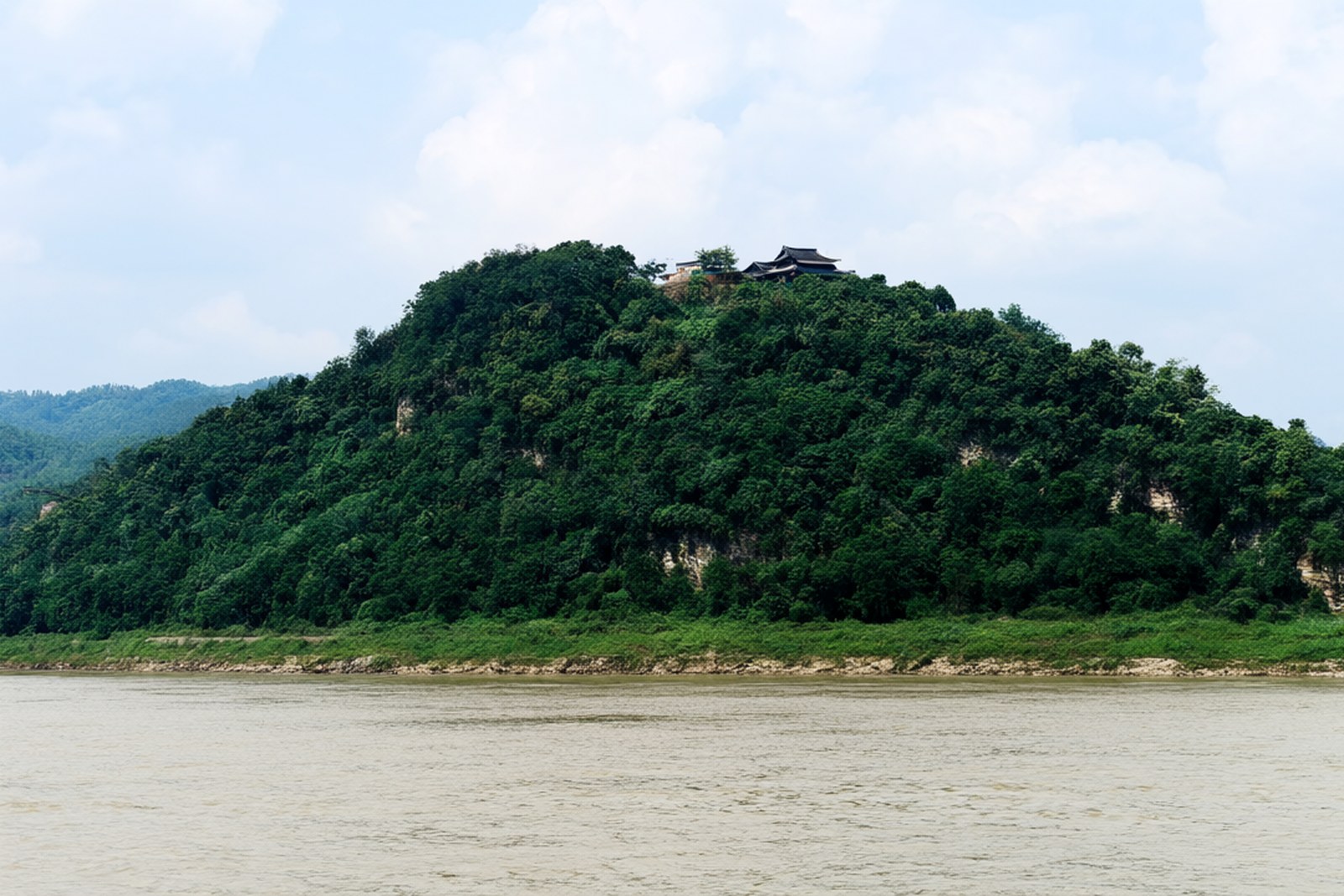
The position is a bend in the river with a hill sitting right on it, which is the arrangement that made the place a landmark for anybody travelling the 湘江 by boat: the hill is the point at which the river coming down from the south turns into the plain, and for centuries it was the last thing seen going north and the first thing seen coming home. The name comes from a king. Local tradition holds that 周昭王 Zhōu Zhāo wáng, the fourth Zhou ruler, came south on campaign in about 980 BC, lingered here, and died in the deep water below the hill, which took the name 昭潭 Zhāo tán from him; an alternative story gives the hill its other name, 马山 Mǎ shān, from the Han general 马援 Mǎ Yuán, who is said to have camped here. The hill is also called 招山 in some texts.
The painting is the reason it is on anybody’s list. In the Northern Song, the painter and calligrapher 米芾 Mǐ Fú came here and made a picture of the hill when the weather was clearing – mist over the slopes, sun breaking through, colour shifting minute to minute – and called it 山市晴岚图 shān shì qíng lán tú, the market town in clearing mist. That picture took the place straight into the 潇湘八景 Xiāo xiāng bā jǐng, the Eight Views of the Xiao and Xiang, which is the classic list of Hunan landscapes and the one every literate traveller of the last thousand years has tried to tick off. A Ming poet, 周九烟 Zhōu Jiǔ yān, wrote his own lines on the same subject. The condition the picture records is a real one and it still happens: after rain, or at dawn, the hill sits in its own layer of vapour with the river shining below it.
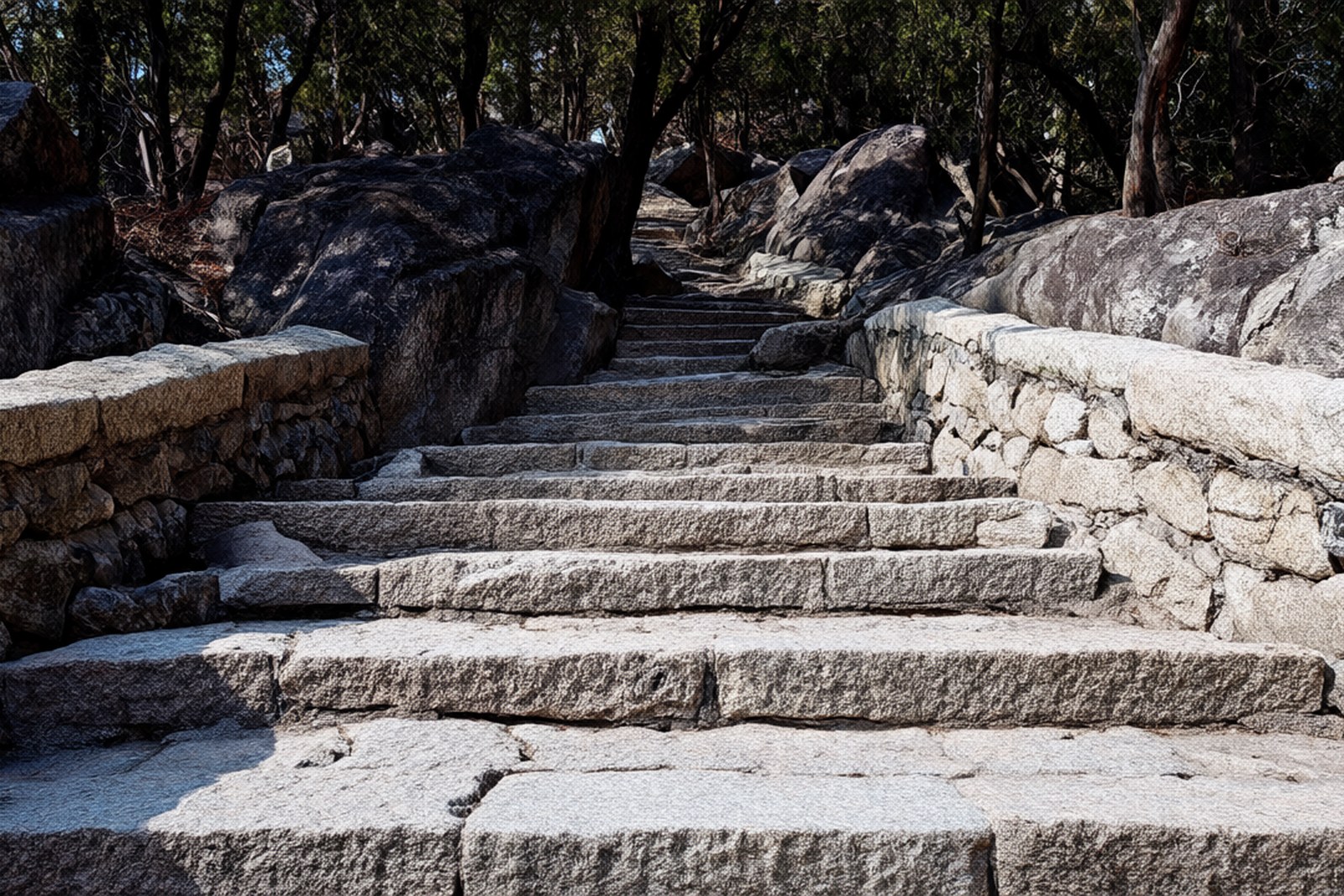
For a small hill it carries an unusual amount of building and history. The summit has 昭山寺 Zhāo shān sì, a temple first built in the Tang, and there is a 观音寺 Guān yīn sì at the foot. The slope holds the remains of the house of 刘锜 Liú Qǐ, the Song general who beat the Jin at 顺昌; a 伟人亭; a 昭阳寺; a 奎星楼; and a scatter of old inscriptions. On the southern shoulder there is a ridge called 岳公岭 Yuè gōng lǐng in memory of 岳飞 Yuè Fēi, and on the western side the grave of the mother of 黄兴 Huáng Xīng, the revolutionary. The hill’s own list of eight views – 屏风夕照 sunset on the screen rock, 拓岭丹霞 the red beds of the opened ridge, 桃林花雨 blossom falling in the peach wood, 双井清泉 the two sweet springs, 老虎听经 the tiger listening to the sutras, 狮子啸月 the lion roaring at the moon, 古寺飞钟 the temple bell in flight, 石港远帆 sails far off at the stone harbour – is the sort of list Chinese hills have been making since the Song, and most of the names still describe something you can find. The old stone path up the hill is the most tangible thing on it: begun in 1777, in the forty-second year of the Qianlong reign, and finished in 1796, twenty-five years later, it runs for more than thirteen kilometres of which about half survives, and it was laid with over five thousand blocks of granite carried up by hand.
Practicalities
Tickets. The hill is an open scenic area rather than a walled attraction, and there is no significant gate charge; the temple takes a small sum for incense rather than for admission. Anything beyond that, including any charge for a lift or a shuttle, changes with the season, so treat the sign at the entrance as the answer.
Opening hours. The area is open all day and all night, and the walking paths are not lit, which means the sensible hours are daylight ones. Two hours is enough for the hill and the temple; three if you walk down to the river and along the bank. Early morning and the hour before dusk are the two times the hill looks like the painting it is famous for.
Getting there. 昭山 is at 易家湾 Yì jiā wān in 岳塘区 Yuè táng qū, 湘潭市, about twenty kilometres north-east of the city centre and right at the junction of the three 长株潭 cities; the 京广 railway and the 107 national road both run past the foot of it, and 湘潭站 Xiāng tán zhàn and 湘潭北站 Xiāng tán běi zhàn are both within a half-hour taxi ride. There is a footpath up from the river side and a road up from the inland side.
Closing day. There is no closing day as such; the hill is open year round and the paths are maintained, and the only days that are impractical are the ones with heavy rain or a summer typhoon remnant coming through, when the stone path gets slippery enough to be genuinely dangerous. The temple keeps its own hours and shuts for part of the afternoon, so go up before lunch if the temple is the point of the visit.
flowcloud would say that a hill which is too small to be a mountain, which got into the canon of Chinese landscape painting because one man happened to climb it on the right morning, and which has been living off that morning for nine hundred years, has proved that in scenery, as in most things, the timing matters more than the height.
Getting there: 昭山 is on the east bank of the 湘江 at 易家湾 Yì jiā wān, 岳塘区 Yuè táng qū, 湘潭市, about twenty kilometres north-east of the centre and roughly equidistant from the city centres of 湘潭, 长沙 and 株洲; taxis from 湘潭站 Xiāng tán zhàn take about half an hour, and the 长株潭 intercity railway and the 京广 line both run through the corridor on the far side of the river.