
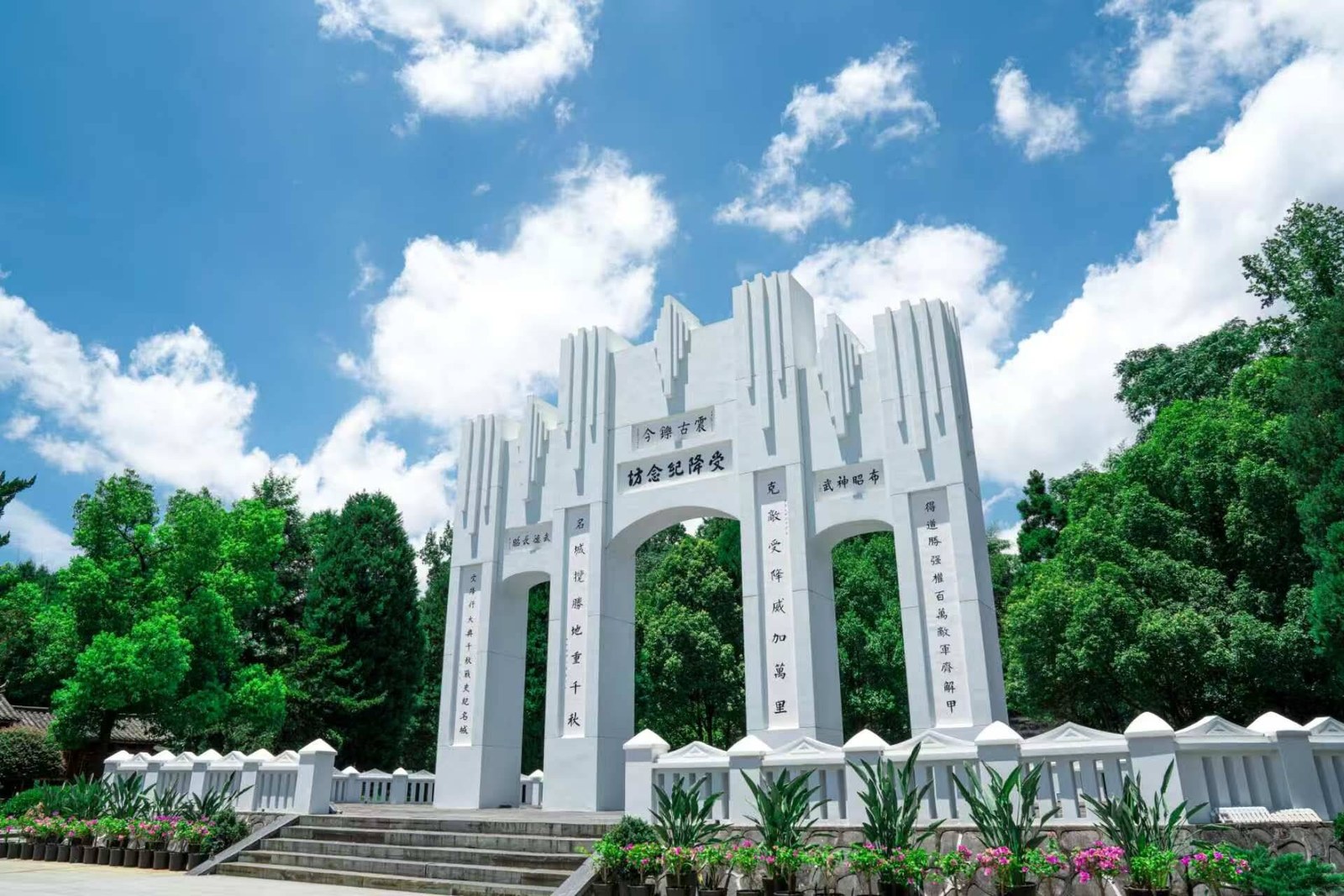
The arch is about eight metres high and stands in a field outside a small town in western Hunan, and it is the single place in China where the country’s eight-year war with Japan formally ended. On 21 August 1945, a Japanese delegation led by 今井武夫 Imai Takeo landed at the airfield at 芷江 Zhǐjiāng, was driven to a building on this spot, and handed over the disposition of Japanese forces in China — the first formal act of surrender anywhere in the China theatre, three weeks before the papers were signed aboard the USS Missouri in Tokyo Bay. The 受降纪念坊 Shòuxiáng Jìniànfāng, built in 1946, is the monument over that desk.
The choice of 芷江 Zhǐjiāng was deliberate and the reasoning is worth knowing. The town sits in mountains at the throat of the route between Hunan and Guizhou — 西南门户,黔楚咽喉 xīnán ménhù, Qiánchǔ yānhóu, the southwestern gate and the throat of Qian and Chu. It had, by 1945, the second-largest secret airfield in China, with the Chinese-American Composite Wing and the US Fourteenth Air Force based on it, and Japanese land forces had been trying to reach it all year: the 湘西会战 Xiāngxī Huìzhàn, the battle of western Hunan, fought from April to June 1945, was the Japanese army’s last offensive of the war, an attempt to destroy the airfield that cost them some 28,000 casualties and failed.
The 纪念坊 jìniànfāng is built as four pillars and three arches, with an inscribed panel of 沅州紫袍玉带石 Yuánzhōu zǐpáo yùdài shí and a shape at the top intended to read as 山 shān, a mountain. The names carved into it are those of the national and military leadership of the day. Around it are the 受降旧址 shòuxiáng jiùzhǐ, the original surrender site — a black-painted double-storey timber building that was the air force club, restored with the desks, chairs and sofas of the period — and the 抗日战争胜利受降纪念馆 Kàngrì Zhànzhēng Shènglì Shòuxiáng Jìniànguǎn, the memorial museum, which holds several hundred documents and objects from the surrender and the campaign. 何应钦 Hé Yìngqīn, who received the surrender, had an office here; his motto, painted on the wall, was 吃得苦中苦,方为人上人 chī dé kǔ zhōng kǔ, fāng wéi rén shàng rén — endure the bitterest bitterness to become the best of men.
Practicalities
Tickets. Free, but not unconditionally free: 免费不免票 miǎnfèi bù miǎn piào — you need to show an ID card or passport at the gate to get in. Foreign visitors should bring a passport.
Opening hours. Summer 09:00–17:30, last entry 17:00; winter 09:00–17:00, last entry 16:30. Allow about two hours for the arch, the surrender site and the museum.
Closing day. Closed Mondays, except during public holidays.
Getting there. The site is at 七里桥村 Qīlǐqiáo Cūn, about 3.5 kilometres outside 芷江 Zhǐjiāng town on the road towards 怀化 Huáihuà. 芷江站 Zhǐjiāng Zhàn on the 沪昆 high-speed line is ten minutes away by taxi; 怀化南站 Huáihuà Nán Zhàn is about fifty minutes by road. Local buses from the town centre run past the entrance.
What to Look For
The inscription on the arch. The panel stone is local and the calligraphy is worth a slow look; the verses include contributions from 蒋中正 Jiǎng Zhōngzhèng, 李宗仁 Lǐ Zōngrén, 白崇禧 Bái Chóngxǐ and 于右任 Yú Yòurèn, and the 芷江受降坊记 Zhǐjiāng Shòuxiáng Fāngjì, a 206-character record of the event, is carved on it.
The surrender hall. The furniture is original. The desk at which 今井武夫 Imai Takeo laid out the disposition maps is the object the whole site exists to preserve, and the room is deliberately left plain.
The airfield. 芷江机场 Zhǐjiāng Jīchǎng is still operating, north of the town. In 1945 it was the target of the entire Japanese campaign; looking at it now, a regional airport with a handful of flights, is the shortest available summary of what changed.
Getting Around
The site is a single compact campus and can be walked in ninety minutes, but the museum deserves longer if you read Chinese. The town of 芷江 Zhǐjiāng is worth the rest of the day: the 龙津风雨桥 Lóngjīn Fēngyǔqiáo, one of the longest covered bridges in China, rebuilt in 1999 with 294 timber piers and no nails of steel, and the 天后宫 Tiānhòu Gōng, a Ming guild-hall temple with a carved stone gate. Combine the visit with the food: 芷江鸭 Zhǐjiāng yā, the local duck braised in sweet bean paste, is the dish the town is known for, and it is not on the memorial site’s menu. One full day, one night in the town.
flowcloud would say that a plain grey arch in a field outside a town nobody outside China can locate is a strange place to put the end of a war, and that the plainness is exactly right — that the important thing was that it happened, in a small place, in August, and that the field was always going to be the monument.
Getting there: 芷江受降纪念坊 (Zhǐjiāng Shòuxiáng Jìniànfāng), 七里桥村 (Qīlǐqiáo Cūn), 芷江侗族自治县 (Zhǐjiāng Dòngzú Zìzhìxiàn), 怀化市 (Huáihuàshì), 湖南 (Húnán). Free but ID required; open 09:00–17:30 summer, 09:00–17:00 winter, closed Mondays. Ten minutes by taxi from 芷江站 (Zhǐjiāng Zhàn). Bring a passport, allow two hours at the site, and eat 芷江鸭 (Zhǐjiāng yā) in town afterwards.